You probably did not consciously decide to create many of your habits.
Yet somehow they became part of daily life.
You automatically:
- check your phone
- procrastinate certain tasks
- overthink repeatedly
- snack mindlessly
- delay difficult work
- stay stuck in familiar routines
Even when part of you genuinely wants change.
That contradiction frustrates many people.
Because consciously, they want better habits.
But subconsciously, old behavior cycles keep repeating automatically.
If you have ever wondered:
“How do habits actually form?”
In simple terms, habits form when repeated behaviors become increasingly automatic. Each time a behavior is repeated in response to the same trigger and followed by a meaningful reward, the brain strengthens that pattern until it requires little conscious effort.
According to research from National Institutes of Health, repeated behaviors gradually become more automatic over time through neurological reinforcement and contextual repetition.
If you already read Why You Can’t Stick to Habits Long Term, you already understand how emotional patterns and subconscious resistance can quietly disrupt consistency.
How Habits Form
Habits form through repeated behavioral cycles where the brain connects a trigger, action, and reward over time. As repetition increases, behaviors gradually become more automatic and require less conscious effort or decision making.
The brain constantly searches for:
- efficiency
- energy conservation
- predictability
So when behaviors repeat consistently, the brain begins automating them.
This helps reduce mental effort.
Eventually behaviors shift from:
conscious action
to:
automatic response.
As habits become automatic, greater control shifts to the basal ganglia, a brain region that helps store repeated behaviors so they can be performed with less conscious effort.
The Habit Loop Psychology Explained
One of the simplest ways to understand habit formation is through:
The habit loop.
The cycle usually looks like this:
Trigger → Behavior → Reward → Reinforcement
Example:
Trigger
Stress after work
↓
Behavior
Scrolling social media
↓
Reward
Temporary distraction or emotional relief
↓
Reinforcement
Brain remembers the behavior helped reduce discomfort
The loop repeats again later.
Over time:
the habit strengthens automatically.
Why the Brain Loves Automatic Habits
The brain prefers familiar patterns because they require:
- less energy
- less decision making
- less uncertainty
This is why habits eventually feel:
effortless.
But this also explains why unhealthy habits can become deeply rooted.
The brain is not judging whether a habit is:
- productive
- healthy
- harmful
It mainly notices:
repetition and emotional reward.
Pause and Reflect
Many habits are not maintained through motivation.
They are maintained through:
automation.
That changes how behavior should be understood completely.
How Emotional Rewards Strengthen Habits
This part matters enormously.
Most habits survive because they create:
- emotional relief
- comfort
- stimulation
- familiarity
- distraction
- temporary safety
Even unhealthy habits often provide:
Short term emotional rewards.
Examples:
- procrastination reduces pressure temporarily
- scrolling reduces boredom
- comfort eating reduces stress
- avoidance reduces emotional discomfort
The brain learns:
“This behavior helps me feel better.”
So the pattern repeats.
Why Habits Become Hard to Change Permanently
People often assume:
“I just need stronger discipline.”
But habit change is more psychological than people realize.
Because habits are connected to:
- emotional conditioning
- environmental cues
- subconscious familiarity
- nervous system responses
- identity patterns
This is why old habits often return during:
- stress
- overwhelm
- exhaustion
- emotional discomfort
The brain naturally falls back toward familiar automatic behaviors.
According to National Institutes of Health, sustainable habits depend more on repetition and realistic behavioral systems than motivation alone.
The Phone Checking Loop
Someone checks their phone constantly throughout the day.
Initially the behavior started from:
- boredom
- curiosity
- notifications
But over time the brain connected phone use with:
- stimulation
- distraction
- emotional relief
Now the action happens automatically.
Sometimes before conscious awareness fully notices it.
The Procrastination Loop
A person repeatedly delays important tasks.
Not because they are lazy.
But because difficult tasks trigger:
- pressure
- fear
- overwhelm
- perfectionism
Avoidance temporarily reduces discomfort.
The brain learns:
avoidance creates relief.
So procrastination gradually becomes conditioned behavior.
The Subconscious Side of Habit Formation
Many habits eventually move into:
subconscious automation.
This means behaviors begin happening:
- quickly
- automatically
- with minimal conscious thought
The subconscious mind helps preserve repeated patterns because automation saves energy.
This is why behavior change often feels harder than expected.
You are not only changing actions.
You are changing:
conditioned neurological patterns.
One Misconception About Habits
Many self-help systems make habits sound purely mechanical.
As if habits only depend on:
- discipline
- motivation
- willpower
But emotional state matters enormously.
Someone experiencing:
- burnout
- anxiety
- emotional exhaustion
- chronic stress
will struggle with consistency differently than someone emotionally regulated.
Habits are not purely productivity systems.
They are deeply connected to psychology.
Why Identity Shapes Habits
This is one of the most powerful behavioral insights.
The brain resists behaviors that conflict with identity.
For example:
Instead of:
“I need to exercise.”
The deeper shift becomes:
“I am becoming someone who takes care of their health consistently.”
Identity-based habits create less internal resistance over time.
The Psychology Behind Habit Formation
While habits are often discussed as mechanical routines, their roots are entirely psychological.
True behavioral change is not just about physical repetition. It requires understanding the emotional state of the individual.
When a person experiences burnout, anxiety, or chronic stress, their nervous system will naturally resist intense, forced changes.
Sustainable habit formation relies on emotional regulation, reducing subconscious resistance, and aligning new routines with your personal identity.
By focusing on the psychological drivers behind your actions, you allow the brain to transition a high energy conscious choice into an effortless, automatic routine.
The 5 Stages of Habit Formation
The Habit Formation Process Step by Step
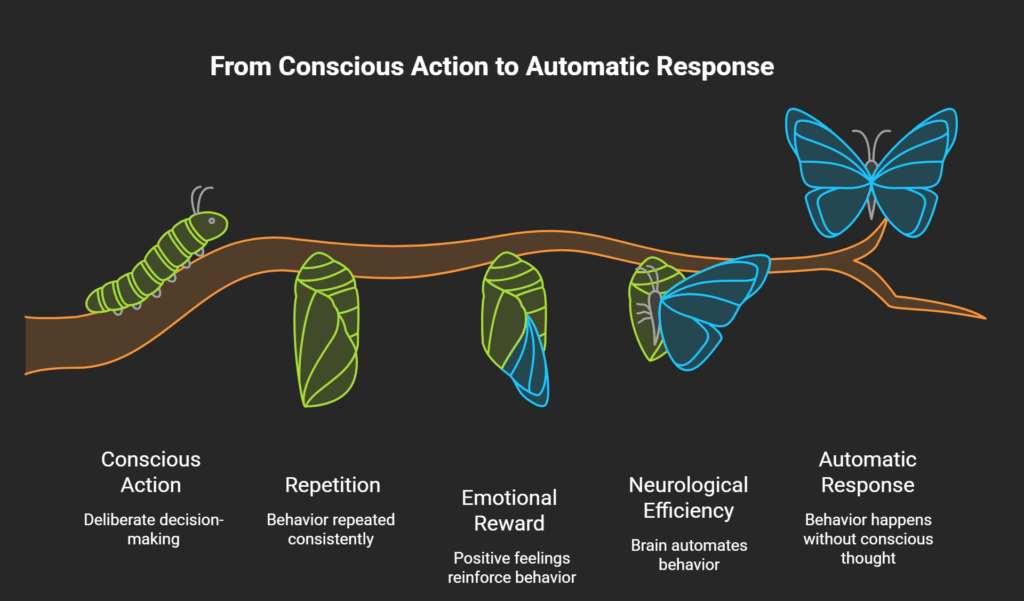 The behavioral transformation: How the brain systematically converts high energy conscious decisions into effortless, subconscious routines over time.
1. Repetition Begins
A behavior happens repeatedly in a specific situation.
2. Emotional Reward Appears
The brain receives:
- relief
- comfort
- pleasure
- stimulation
- certainty
3. Neurological Efficiency Increases
The brain begins automating the behavior to conserve energy.
4. The Behavior Becomes Automatic
The action starts happening with less conscious effort.
5. Environmental Triggers Reinforce It
Specific situations begin activating the habit automatically.
Examples:
- stress
- boredom
- time of day
- certain environments
- emotional states
Why Extreme Behavior Shifts Fail
Many people try:
- aggressive routines
- unrealistic systems
- extreme self discipline
for short periods.
But sudden drastic change often overwhelms:
the nervous system.
The brain perceives excessive change as:
- emotionally difficult
- exhausting
- unsustainable
This creates:
- inconsistency
- resistance
- collapse cycles
Smaller sustainable changes work better psychologically.
Reflection Pause
Ask yourself honestly:
- Which habits feel completely automatic in your life?
- What emotional reward keeps reinforcing them?
- Which triggers activate your habits most strongly?
- Are your routines emotionally sustainable?
- What habits support your wellbeing and which quietly drain it?
Awareness is where habit change begins.
How to Change Habits More Effectively
1. Identify the Trigger First
Most habits begin with:
- emotional states
- situations
- environmental cues
Finding the trigger matters more than forcing behavior.
2. Reduce Behavioral Friction
Make healthy habits easier to begin.
Examples:
- prepare environments earlier
- simplify routines
- reduce unnecessary steps
The brain repeats low resistance behaviors more easily.
3. Replace Instead of Purely Removing
The brain struggles with behavioral voids.
Replacing habits works better than simply suppressing them.
Example:
- walking instead of stress scrolling
- journaling instead of mental rumination
4. Focus on Consistency Over Intensity
Sustainable repetition matters more than dramatic effort.
Smaller habits survive stressful periods more effectively.
5. Create Identity Based Reinforcement
Behavior change strengthens when it aligns with self image.
This creates less subconscious resistance long term.
If you want deeper practical systems for sustainable change, continue with How to Build Habits That Actually Stick.
Why Distractions Quietly Destroy Consistency
Habit consistency becomes much harder when the brain experiences:
- constant stimulation
- digital distraction
- overstimulation
- fragmented attention
Modern environments train impulsive behavior constantly.
That weakens sustained focus and routine consistency over time.
If this feels familiar, How to Eliminate Distractions and Stay Disciplined explores this pattern more deeply.
How Long Does It Take to Form a Habit?
There isn’t a single timeline for habit formation. The time it takes depends on the person, the behavior, and how consistently it is repeated. Rather than focusing on a specific number of days, it is more helpful to think of habit formation as a gradual process in which repeated actions become increasingly automatic over time.
Final Thoughts
Habits are not created instantly.
They form gradually through:
- repetition
- emotional reinforcement
- environmental triggers
- subconscious automation
- neurological efficiency
That is why habits can feel difficult to change permanently.
You are not simply changing actions.
You are reshaping deeply conditioned behavioral patterns the brain learned to repeat automatically.
And that process becomes easier when:
- awareness increases
- systems become sustainable
- emotional patterns become visible
- change feels psychologically manageable
Because lasting habits grow through repetition and consistency, not pressure alone.