
Most new routines don’t collapse because someone stopped caring about them. They collapse because, by 4pm on a normal Tuesday, the new habit simply never came to mind. The intention was real in the morning. By evening, it had quietly disappeared under everything else the day required.
This is the part that rarely gets addressed directly. Building a new routine isn’t primarily a motivation problem. It’s a memory problem — the challenge of reliably remembering to act on an intention at the exact moment that intention was supposed to matter. Habit stacking solves that specific problem, and understanding why it works changes how effectively it can be used.
Why Willpower-Based Routines Struggle
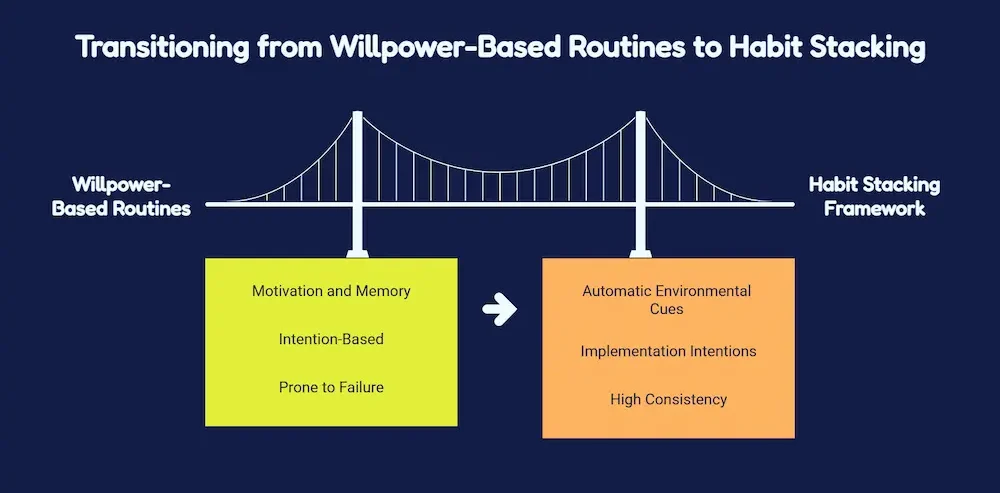 A typical approach to building a routine looks something like this: decide on a new behavior, feel motivated about it, and try to remember to do it at some point during the day. This works for a day or two, sometimes longer. Then a busy morning arrives, the moment to act passes unnoticed, and the habit quietly slips for the first time — usually not from unwillingness, but because nothing in that moment triggered the memory to act.
This gap between intending to do something and actually remembering to do it in the moment has a name in psychology: the intention-behavior gap. Most people don’t fail to build habits because they lack commitment. They fail because good intentions, on their own, are a weak cue.
What Habit Stacking Actually Is
Habit stacking works by removing memory from the equation almost entirely. Instead of relying on remembering to perform a new behavior at some point in the day, the new behavior gets attached directly to an existing habit that already happens automatically — using that existing habit as the cue.
This isn’t a new invention dressed up in modern language. It’s a direct, practical application of a well-studied psychological strategy called implementation intentions, developed by psychologist Peter Gollwitzer. According to a summary from the National Cancer Institute’s research division, implementation intentions work by forming a specific “if-then” plan that links a clear situational cue to a specific response — and this planning has been shown, across a substantial body of research, to significantly increase the likelihood that an intended action actually gets carried out.
Habit stacking applies this exact mechanism, using an existing habit as the “if” and the new behavior as the “then.” The structure is simple: identify something you already do automatically, every day, without needing to think about it — and attach the new habit immediately after it.
Repeating the same cue-and-response pairing over time reduces the need for conscious decision-making. Instead of asking yourself whether you should do the habit, the familiar cue begins prompting the behaviour automatically.
Why the Existing Habit Matters So Much
Not just any cue works equally well. The strength of a habit stack depends almost entirely on how automatic the anchor habit already is.
Research on real-world habit formation offers a useful clue here. In a well-known study from University College London, researchers led by Phillippa Lally tracked participants forming a new habit over several months and found that behaviors reached automaticity — the point where they required little conscious thought — after a median of 66 days, though the range varied enormously between individuals and behaviors. Critically, every participant in that study linked their new behavior to a consistent daily cue, such as “after breakfast.” The cue wasn’t incidental to the study design. It was central to how automaticity developed at all.
This also helps explain why habits often feel easier in familiar environments. Consistent surroundings provide the same cues repeatedly, making it easier for the brain to recognise when a behaviour should happen.
This is the same principle a habit stack relies on. An anchor habit that already happens reliably — brushing your teeth, making coffee, sitting down at your desk — already carries its own automaticity. Attaching a new behavior to it means borrowing some of that existing consistency, rather than trying to build automaticity completely from scratch.
The Habit Stacking Framework
Put together, the framework has three working parts.
| Component | What It Requires | Why It Matters |
| The anchor | A habit that already happens daily, without effort or decision-making | Weak or inconsistent anchors produce weak, inconsistent stacks |
| The attachment point | Immediately before or after the anchor, not “sometime around” it | Vague timing reintroduces the exact memory problem stacking is meant to solve |
| The new habit | One small, specific action — not several at once | Overloading a single anchor increases the chance the entire stack gets skipped |
Each part depends on the others. A strong anchor with a vague attachment point still leaves room to forget. A precise attachment point on an unstable anchor collapses the moment the anchor itself gets disrupted — which is often exactly what happens on unusual days, holidays, or during travel.
What This Looks Like in Practice
Someone who wants to start a two-minute stretching habit doesn’t rely on remembering to do it “sometime in the morning.” They attach it directly to something that already happens without fail — for example, immediately after turning off the shower, or right after pouring the first cup of coffee. The cue isn’t a reminder on a phone. It’s a moment that was already going to happen regardless.
The same logic applies to an evening wind-down routine. Instead of trying to remember to put the phone away before bed, the habit gets attached to something already automatic — right after brushing teeth, for instance — so the new behavior inherits a cue that doesn’t depend on willpower or memory at all.
If you’re working on the specific behaviors that make up a routine like this, How to Build Habits That Actually Stick covers the deeper mechanics of what makes any single habit durable, separate from the stacking structure itself.