

Most people try to change a habit by changing the habit.
They build a schedule. They download a tracker. They set a rule — no phone before 9am, gym three times a week, no sugar after dinner. For a while, willpower carries it. Then life gets busy, the rule breaks once, and within a few weeks the old behavior quietly returns, almost as if it had never left.
If this has happened to you more than once, it’s worth asking a slightly different question than the one you’ve probably been asking. Not “why can’t I stick to this?” but: “what was I actually trying to change?”
Because most people are trying to change a behavior. And behavior, it turns out, is rarely the thing that needs to change first.
What Are Identity-Based Habits?
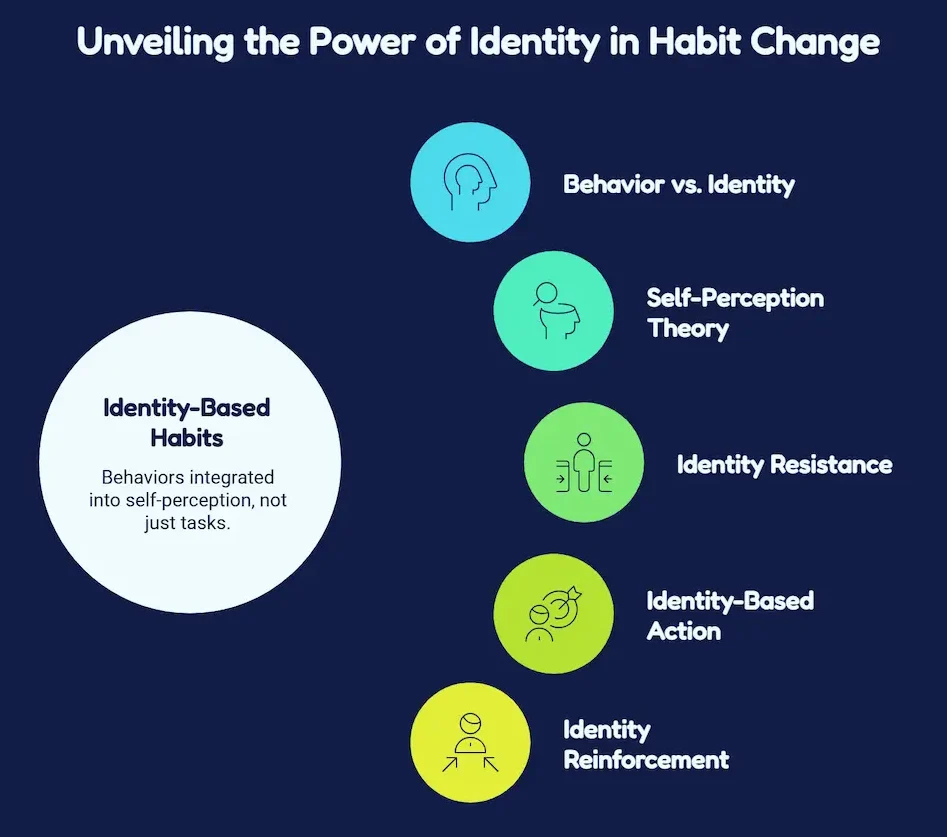 Identity-based habits are behaviors that become part of how you see yourself rather than simply tasks you try to complete. Instead of focusing only on what you want to do, they focus on who you want to become. Over time, these repeated actions also begin shaping your self-image the way you see yourself and what you believe you’re capable of becoming.
As your actions repeatedly reinforce that identity, the habits become easier to maintain over time.
Quick Start
● Most habit change fails because it targets behavior directly, without ever touching the underlying self-concept driving that behavior.
● Psychologists have long observed that people don’t just act based on who they believe they are — they also infer who they are by watching their own actions. This works in both directions.
● Every repeated action functions as evidence for a private, ongoing story about identity — “I’m someone who follows through,” or “I’m someone who gives up.”
● Lasting habit change usually isn’t caused by more discipline. It’s caused by a shift in that internal identity story, with behavior following naturally afterward.
Why Most Habit Advice Starts in the Wrong Place
Most habit advice is built on a simple, intuitive-sounding idea: repeat a behavior enough times, and it becomes automatic. Track it. Reward it. Remove friction. Eventually, the theory goes, the action becomes “who you are.”
This isn’t wrong, exactly. But it gets the order backwards for most people, most of the time.
The common belief treats identity as the finish line — something you arrive at after enough repetition. In reality, identity usually has to move first, even a little, before the behavior has anywhere stable to land.
The Misconception Hiding Inside That Belief
Here’s the part that rarely gets said out loud: when a habit doesn’t stick, most people conclude they simply didn’t repeat it enough, or didn’t want it badly enough.
That conclusion feels logical. It’s also usually incomplete.
A person can repeat a behavior for weeks and still abandon it — not because the repetition failed, but because the behavior never stopped feeling like something they were doing, rather than something they were. The action stayed external. It never became part of how they understood themselves. And behavior that isn’t backed by identity has almost nothing holding it in place once motivation dips, which it eventually always does.
If you’ve ever wondered why good intentions so often fade before they become lasting routines, Why You Can’t Stick to Habits Long Term explores the psychological reasons consistency often breaks down before identity has a chance to catch up.
This is the misconception worth correcting: habits don’t fail from insufficient repetition nearly as often as they fail from insufficient identity alignment. You can do something forty times and still feel, underneath it, like a fraud borrowing someone else’s routine.
The Psychology Behind Why This Happens
There’s a well-established idea in psychology called Self-Perception Theory, first proposed by psychologist Daryl Bem in the early 1970s. Since then, psychologists have continued exploring how repeated behaviors shape identity and how identity, in turn, influences future behavior.
It suggests something that sounds almost backwards at first: people don’t only act according to their existing beliefs about themselves. They also form beliefs about themselves by observing their own behavior — much the way an outside observer would, watching from the outside in.
In plain terms: you don’t only run because you believe you’re a runner. Over time, watching yourself run repeatedly is part of how the belief “I’m a runner” gets built in the first place.
This matters more than it might sound like it does, because it means the relationship between identity and behavior isn’t one-directional. It’s a loop. Identity shapes what you do. What you do noticed, repeated, witnessed by yourself, quietly reshapes identity in return.
This same feedback loop explains why How Habits Are Formed: Why You Feel Stuck focuses less on motivation and more on the repeated behaviours that gradually become automatic.
This is why two people can follow an identical habit plan and get completely different results. One is tracking a behavior. The other is quietly building evidence for a version of themselves they’re starting to believe in.
Why Your Identity Resists Change
One reason identity can be surprisingly difficult to change is that it acts like a filter for new evidence. People tend to notice the actions that confirm their existing self-image more readily than the ones that challenge it. A single missed workout may feel like proof of “I’m inconsistent,” while ten completed workouts are dismissed as exceptions. Until the internal story begins to change, new evidence is often interpreted through the lens of the old one. Recognizing this can make setbacks feel less like confirmation that you’ve failed and more like part of the gradual process of rewriting the story.
What This Looks Like in Everyday Life
Someone decides to start writing. They set a goal, a page a day, and for the first week or two, it feels effortful, almost performative, like they’re auditioning for a role.
Somewhere around week three or four, something shifts. It’s rarely dramatic. They just start noticing themselves thinking, unprompted, I need to write today, not as an obligation on a list, but as something closer to a fact about who they are. Missing a day doesn’t just feel like a missed task anymore. It feels slightly off, the way skipping something core to your routine does.
That shift from “I’m doing this” to “I’m someone who does this” is the entire mechanism this article is describing. It usually isn’t caused by hitting some magic number of repetitions. It’s caused by enough repeated evidence accumulating that the old identity story (“I’m not really a writer”) becomes harder to believe than the new one.
If your older self-image feels so deeply rooted that changing your habits alone never seems enough, Identity Crisis: Why You Feel Lost in Life And How to Find Yourself Again explores why identity itself can sometimes feel uncertain before it begins to change.
How Identity-Based Habits Actually Work
Once this becomes visible, the whole project of habit change looks a little different.
The question stops being: How do I force myself to repeat this behavior long enough for it to stick?
And becomes: What would someone who already has this identity naturally do — and can I borrow that action, even before I fully believe it applies to me?
This isn’t about faking confidence or repeating affirmations. It’s smaller and more concrete than that. It means choosing the next action based on the identity you’re trying to grow into, rather than the mood you happen to be in that day. A person building the identity of someone consistent doesn’t skip the gym because they don’t feel motivated not because they’re more disciplined, but because skipping would contradict the identity they’re gradually reinforcing through their actions.
If you’d like to explore the process of deliberately reshaping your self-concept beyond habits alone, How to Change Your Identity When You Feel Stuck looks at how identity can gradually change through repeated evidence, reflection, and everyday choices.












One Response