

You probably believe most of your behavior is fully conscious.
That you actively choose:
- your reactions
- your habits
- your decisions
- your emotional responses
But much of human behavior operates automatically.
Without awareness. Without deliberate intention.
And sometimes without realizing how deeply those subconscious behaviors shape everyday life.
You may notice yourself:
checking your phone automatically
- overreacting emotionally
- apologizing constantly
- procrastinating repeatedly
- expecting worst case scenarios
- sabotaging consistency
even when you consciously want something different. That contradiction often feels confusing.
But according to research from Harvard University, a large portion of daily decision making and behavioral processing happens beneath conscious awareness.
If you already read What Is the Subconscious Mind? Meaning, Examples, and How It Works, you already understand that subconscious patterns influence behavior long before conscious thought catches up.
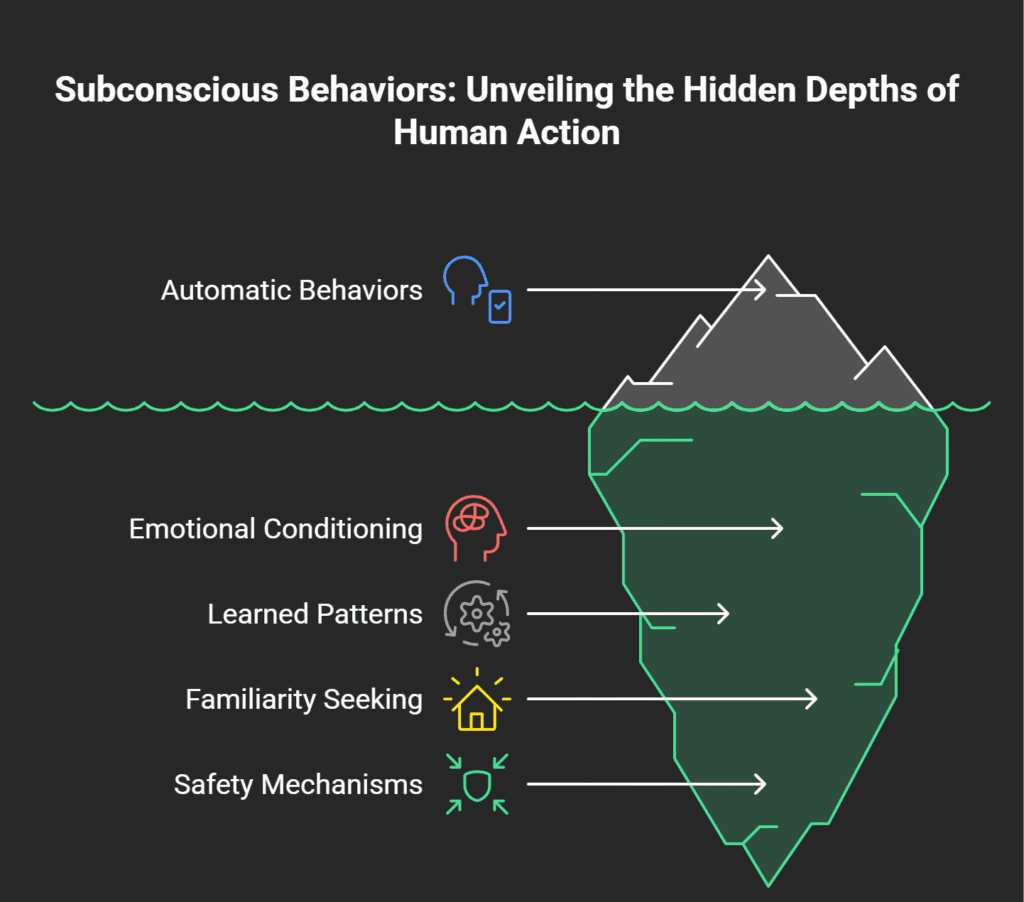 A minimalist breakdown of the automatic habits and subconscious behaviors that silently drive daily choices.
What Are Subconscious Behaviors?
Subconscious behaviors are automatic actions, habits, emotional reactions, thought patterns, and everyday activities that happen with little or no conscious awareness. They develop gradually through repetition, emotional conditioning, past experiences, and learned patterns until the brain begins performing them automatically. Some subconscious behaviors help you move through daily life efficiently, while others quietly reinforce habits, beliefs, and reactions that no longer serve you.
The subconscious mind constantly searches for:
- efficiency
- familiarity
- emotional safety
- repeated patterns
So behaviors practiced repeatedly eventually become automatic.
This is why many actions begin happening:
without active thinking.
Sometimes that helps. Sometimes it quietly controls your life.
1. Automatically Reaching for Your Phone
You may pick up your phone:
- during boredom
- stress
- discomfort
- awkward silence
- emotional overwhelm
before consciously deciding to. That is subconscious behavioral conditioning.
The brain begins associating:
discomfort → phone → temporary relief.
Eventually the action becomes automatic.
Pause and Notice
How many daily actions happen:
before conscious awareness fully enters?
That question alone changes self-awareness dramatically.
2. Expecting Negative Outcomes Automatically
Some people instinctively assume:
- rejection
- criticism
- failure
- disappointment
even in neutral situations.
This subconscious behavior often develops from:
- repeated stress
- emotional conditioning
- past experiences
- protective mental patterns
The brain begins predicting negativity automatically because it believes:
anticipating danger creates safety.
This is closely connected to the patterns discussed in Why Your Subconscious Mind Keeps You Anxious.
3. Apologizing Excessively
Many people apologize automatically for:
- taking space
- asking questions
- expressing needs
- setting boundaries
even when they did nothing wrong.
This subconscious behavior can form through:
- people pleasing conditioning
- fear of conflict
- emotional insecurity
- childhood emotional environments
The behavior becomes emotionally automatic over time.
4. Repeating the Same Emotional Reactions
Have you noticed:
- getting defensive quickly
- shutting down emotionally
- becoming anxious repeatedly
- reacting with irritation automatically
in similar situations?
The subconscious mind learns emotional response patterns through repetition.
Eventually reactions happen faster than conscious reasoning.
If you notice yourself reacting strongly to certain situations over and over again, understanding the psychology behind emotional triggers can help explain why those reactions feel so automatic.
According to Cleveland Clinic, emotional stress responses can become deeply conditioned through repeated nervous system activation.
The Brain Prefers Familiar Patterns
Even unhealthy behaviors can begin feeling emotionally familiar. And familiarity often feels safer to the brain than uncertainty.
This explains why people sometimes:
- repeat toxic habits
- return to unhealthy routines
- recreate emotional patterns
- resist positive change
even while consciously wanting growth.
5. Procrastinating During Emotional Discomfort
Procrastination is not always laziness. Sometimes it is subconscious emotional avoidance.
The brain learns:
difficult emotion → avoidance → temporary relief.
So tasks connected to:
- pressure
- fear
- overwhelm
- perfectionism
begin triggering subconscious resistance automatically.
A Real Life Example
Someone wants to start exercising consistently.
But every time they plan to begin:
- anxiety appears
- excuses increase
- distractions suddenly feel urgent
Consciously they want change.
Subconsciously the brain associates:
change with discomfort.
So avoidance becomes automatic.
6. Seeking Validation Without Realizing It
Many subconscious actions are socially driven.
Examples:
- checking messages repeatedly
- needing reassurance
- overexplaining yourself
- seeking approval constantly
The subconscious mind often connects external validation with:
- safety
- belonging
- emotional security
These behaviors may feel completely normal until they become visible consciously.
7. Interrupting Silence Constantly
Some people struggle with silence.
They:
- scroll
- talk excessively
- play background noise
- seek constant stimulation
without noticing why.
Often the subconscious mind uses stimulation to avoid:
- emotional discomfort
- loneliness
- unresolved thoughts
- nervous system unease
The behavior becomes automatic self distraction.
8. Self Sabotaging Positive Change
This surprises many people.
Someone begins:
- improving habits
- building confidence
- making progress
Then suddenly:
- consistency collapses
- motivation disappears
- old behaviors return
Why?
Because the subconscious mind often prioritizes:
familiarity over transformation.
If success feels emotionally unfamiliar, resistance can appear automatically.
One Misconception About the Subconscious Mind
Many self help communities describe the subconscious mind almost like:
mystical magic.
That becomes misleading.
The subconscious mind is not a supernatural force controlling reality.
It is better understood as:
- deeply conditioned behavioral programming
- emotional learning patterns
- automatic mental associations
- repeated nervous system responses
That grounded understanding matters.
9. Repeating Thought Loops Automatically
Many people replay:
- conversations
- fears
- embarrassing moments
- imagined future scenarios
without intending to.
The subconscious mind reinforces thoughts connected to:
- emotional importance
- fear
- uncertainty
- unresolved tension
Over time, repetitive thinking becomes habitual.
If this pattern feels familiar, Why You Keep Thinking the Same Thoughts: How to Break the Loop explores this cycle more deeply.
10. Reacting Before Thinking
Sometimes emotions appear:
before conscious logic.
Examples:
- snapping during stress
- panic reactions
- sudden defensiveness
- emotional shutdown
This happens because subconscious emotional processing is often faster than conscious reasoning.
The brain reacts first. Awareness comes later.
Although these behaviors may seem unrelated, they often follow the same psychological pattern. Each one begins with a trigger, leads to an automatic response, provides some form of emotional relief or familiarity, and becomes easier for the brain to repeat the next time. Understanding that cycle is the first step toward changing it.
A Simple Framework for Understanding Subconscious Behaviors
Most subconscious behaviors follow the same repeating cycle.
Trigger
↓
Automatic Behavior
↓
Emotional Relief
↓
Repetition
↓
Conditioning
Example
Stress
↓
Scroll social media
↓
Temporary relief
↓
Repeat the same response
↓
The brain begins treating scrolling as the default response to stress.
The more often this cycle repeats, the more automatic the behavior becomes. Over time, the brain no longer pauses to make a conscious decision. It simply follows the familiar pathway it has practiced before.
Reflection Pause
Ask yourself honestly:
- Which behaviors feel automatic in your life?
- What emotional state usually triggers them?
- Which reactions happen before conscious thinking?
- What patterns repeat most often?
- Are your behaviors helping you or protecting old conditioning?
Awareness begins changing patterns long before force does.
Can Subconscious Behaviors Change?
Yes. But usually not through:
- shame
- force
- harsh discipline
- motivational bursts
Subconscious behaviors change gradually through:
- awareness
- repetition
- emotional safety
- nervous system regulation
- new behavioral conditioning
The brain learns through repeated experience.
Not instant transformation.
How to Become More Aware of Subconscious Behaviors
1. Observe Repetition
Pay attention to:
- repeated emotional reactions
- recurring habits
- predictable thought patterns
Repetition reveals subconscious conditioning.
2. Notice Emotional Triggers
Ask, “What emotion appears before this behavior?”
That question exposes hidden patterns quickly.
3. Slow Down Automatic Reactions
Creating even small pauses between:
- trigger
and - reaction
increases conscious awareness dramatically.
4. Reduce Self Judgment
The more harshly you judge yourself, the more your mind may cling to familiar patterns. Awareness works better than shame.
5. Build Small Behavioral Interruptions
Examples:
- breathing before reacting
- delaying impulsive habits
- journaling repetitive thoughts
- reducing overstimulation
Small interruptions weaken automatic loops over time.