

Sometimes the reaction surprises even you. A small comment changes your mood instantly.
Someone’s tone feels personal. A delayed reply creates anxiety.
Criticism feels heavier than it should.
And afterward, you sit there wondering, “Why did that affect me so much?”
If you’ve ever wondered why small things affect you so deeply, you’re not alone. An emotional trigger is more than a bad mood or an overreaction. It’s your mind reacting to a situation that feels emotionally familiar because of past experiences, often before you’ve had time to think logically.
That question often carries a lot of hidden shame because many people mistake emotional triggers for personal weakness.
Because many people secretly fear: they are too emotional
too sensitive
too reactive
emotionally unstable
But emotional triggers are usually far more complex than that. Most aren’t random overreactions at all.
They are emotional patterns linked to experiences your mind learned to associate with pain, rejection, fear, or emotional danger.
If you’d like to explore the most common emotional triggers people experience in everyday life, continue with 10 Emotional Triggers That Control Your Behavior
What Are Emotional Triggers?
An emotional trigger is a situation, word, memory, behaviour, or experience that causes an intense emotional reaction because it reminds your brain of past emotional pain, fear, stress, or learned emotional patterns. These reactions often happen automatically before logical thinking fully catches up.
According to research discussed by Cleveland Clinic emotional triggers can activate stress responses connected to previous emotional experiences and learned psychological patterns.
Why Do Small Things Affect You So Deeply?
Most emotional triggers are not really about the current situation alone. They are connected to what the situation represents emotionally.
For example:
- criticism may feel like rejection
- silence may feel like abandonment
- conflict may feel unsafe
- being ignored may feel emotionally painful
Your nervous system reacts to the emotional meaning attached to the moment.
Not only the moment itself.
Why Emotional Triggers Feel So Powerful
This is important to understand. Your mind usually develops triggers to protect you.
If certain experiences repeatedly caused emotional pain in the past, your brain learns,
“We need to react quickly when this happens again.”
That reaction becomes automatic. Sometimes so automatic that logic barely has time to intervene.
Your emotional trigger is often your nervous system trying to protect an older version of you.
Common Causes of Emotional Triggers
Different people become triggered by different emotional experiences. But certain patterns appear frequently.
1. Fear of Rejection
People who experienced emotional rejection earlier in life often become highly sensitive to:
- criticism
- distance
- disapproval
- exclusion
Even small interactions can activate emotional alarm systems.
2. Fear of Abandonment
Delayed replies, emotional withdrawal and changes in tone.
These moments may trigger intense emotional reactions because the brain associates emotional distance with loss or instability.
3. Shame Based Conditioning
Some people grew up constantly feeling:
- “not enough”
- criticized
- emotionally judged
As adults, even small mistakes can trigger deep emotional discomfort.
4. Emotional Invalidations
If someone repeatedly felt unheard or dismissed growing up, they may become emotionally reactive when they feel ignored or misunderstood later in life.
Real-Life Examples of Emotional Triggers
Changes in Someone’s Tone
Someone speaks to you slightly differently than usual. Logically, you know,
“Maybe they’re just tired.”
But emotionally? Your body reacts immediately:
- anxiety
- tension
- overthinking
Why?
Because your subconscious mind may associate changes in tone with emotional conflict or rejection.
Criticism
A manager gives constructive feedback. Objectively, the feedback is normal.
But emotionally, you suddenly feel:
- defensive
- embarrassed
- emotionally small
The reaction may not be about the feedback itself.
It may be activating old emotional conditioning around criticism and self worth.
People often react strongly to emotional meanings, not only events themselves.
Feeling Ignored
Imagine sending a message to someone you care about and getting no reply for hours. Logically, you know they may simply be busy. Emotionally, however, you might feel rejected, unimportant, or forgotten.
For many people, being ignored is more than a delayed response. It reminds the mind of earlier experiences of emotional neglect or exclusion, making the reaction feel much stronger than the situation itself.
Rejection
Whether it’s being left out of a conversation, turned down for an opportunity, or feeling unwanted in a relationship, rejection is one of the most common emotional triggers.
The emotional pain often comes less from the event itself and more from what it seems to confirm about your worth, acceptance, or belonging.
Comparison
Seeing someone else’s success, appearance, or achievements can unexpectedly trigger feelings of inadequacy.
The comparison itself isn’t usually the real trigger. Instead, it activates deeper fears of not being good enough, falling behind, or lacking value.
Why Emotional Triggers Feel So Fast
Triggers often happen before conscious thinking fully activates.
That is because emotional processing is deeply connected to the nervous system and subconscious mind.
Research from National Institute of Mental Health explains that stress responses can activate rapidly before logical reasoning fully processes a situation.
This is why emotional triggers can feel:
- instant
- physical
- overwhelming
- difficult to control
The body reacts first. Logic arrives later.
The Emotional Trigger Loop
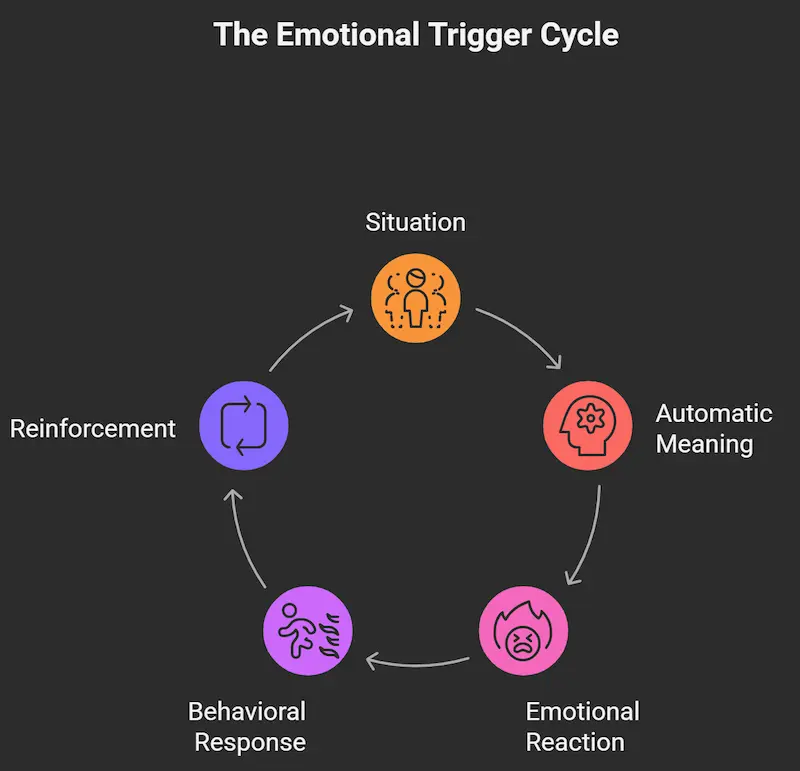
Every emotional trigger follows a pattern. Understanding this pattern makes it easier to recognise what’s happening before your emotions take over.
The BYW Emotional Trigger Loop
Trigger
A situation, word, memory, or behaviour activates an old emotional pattern.
↓
Meaning
Your mind quickly gives the situation emotional meaning, such as rejection, criticism, shame, or danger.
↓
Reaction
Your body responds with emotions like anxiety, anger, sadness, or defensiveness.
↓
Behaviour
You react automatically by withdrawing, arguing, people pleasing, shutting down, or overthinking.
↓
Reinforcement
The more often this pattern repeats, the more automatic it becomes.
The good news is that awareness is where this loop can be interrupted. Once you recognise what’s happening, you create space to choose a different response.













2 Responses