
You keep trying to stop overthinking. But your mind keeps returning to the same thoughts.
You promise yourself to wake up early. But somehow, you repeat the same routine.
You know certain reactions are unhealthy, yet you still fall into them automatically.
Many people experience this inner conflict and wonder:
“Part of me wants to change, but another part keeps pulling me back.”
This is often where the difference between the conscious vs subconscious mind becomes important.
Your conscious mind sets goals, makes decisions, and knows what you want to do. But your subconscious mind stores the habits, emotional patterns, and automatic behaviors that quietly influence many of your daily actions.
Understanding how these two systems work together can help explain why changing behavior often feels much harder than simply making a decision.
If you’re new to this topic, we recommend reading What Is the Subconscious Mind? Meaning, Examples, and How It Works first, then return to this guide to understand how the conscious and subconscious mind interact.
What is the Difference Between the Conscious and Subconscious Mind?
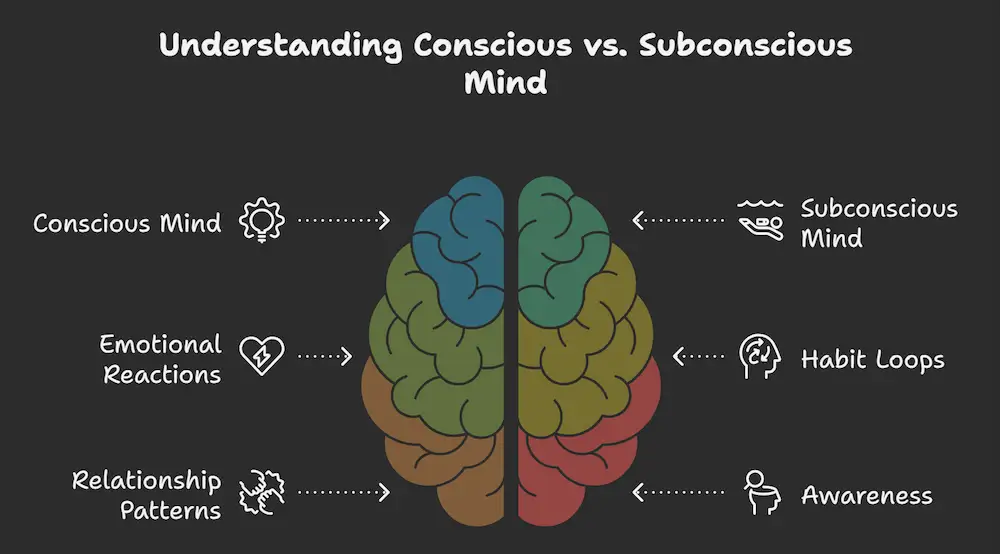
The conscious mind is the part of your mind responsible for logical thinking, decision-making, and present-moment awareness. The subconscious mind stores habits, emotional patterns, memories, beliefs, and automatic behaviors that quietly influence your actions outside your conscious awareness.
According to Cleveland Clinic, many emotional and behavioral responses become automatic through repeated learning and experience.
The Conscious Mind Explained Simply
Your conscious mind is the part you actively experience.
It helps you:
- think logically
- make decisions
- analyze situations
- focus attention
- plan intentionally
When you say:
“I should exercise regularly.”
“I should stop procrastinating.”
“I want to adopt healthier habits.”
that is conscious thinking.
Most people assume this conscious layer fully controls their behavior and choices. But the reality is more complicated.
The conscious mind is relatively slow and limited. It can focus on only a small amount of information at one time.
This is why simply knowing what you should do does not always lead to lasting behavior change.
The Subconscious Mind Explained Simply
The subconscious mind functions without conscious awareness. It stores:
- emotional connections
- habits
- fears
- repeated behaviors
- learned beliefs
- automatic reactions
It constantly scans, predicts, and repeats patterns based on past experiences. As a result, many behaviors and reactions feel automatic.
You do not consciously choose every reaction. Often, you are repeating deeply stored patterns that have developed over time.
According to Harvard Health Publishing, repeated thoughts and behaviors become increasingly automatic through reinforcement and repetition over time.
In Short
The conscious mind thinks. The subconscious mind runs patterns.
Who Controls Your Daily Behavior?
Most of us like to believe that we are fully in control of our behavior. But in reality, much of what we do happens automatically.
Psychologists suggest that many of our routines, reactions, and emotional responses are driven by deeply learned neural patterns rather than conscious, deliberate decision-making.
This includes:
- emotional triggers
- habits
- procrastination
- relationship reactions
- self-sabotaging behaviors
- thought loops
Your conscious mind often becomes aware of the behavior only after the pattern has already begun.
Real-Life Example: Emotional Reactions
Someone criticizes you gently. Consciously, you know, “They’re probably trying to help.”
But subconsciously, you suddenly feel defensive, anxious, or angry.
Why?
Your subconscious mind may associate criticism with:
- rejection
- shame
- childhood experiences
- emotional danger
The emotional reaction begins before your logical mind has time to evaluate the situation.
Another Everyday Example: Habit Loops
You decide, “I’ll sleep early tonight.” But at midnight, you are still scrolling on your phone.
Why?
Your subconscious mind is following a familiar reward pattern.
That habit loop may look like this:
- cue
- craving
- behavior
- reward
Your conscious intention is trying to compete with a pattern that has already become automatic.
In other words, most people are not lacking intelligence or motivation. They are struggling against deeply ingrained subconscious patterns.
Why the Subconscious Mind Feels More Powerful
Many people ask, “Why does my subconscious mind seem stronger than logic?”
The answer is simple. Repetition creates efficiency. Your brain automates repeated behaviors to save mental energy.
That is why:
- driving becomes automatic
- daily routines require little thought
- emotional reactions become predictable
According to the National Institutes of Health, neural pathways become stronger through repetition and emotional reinforcement.
Your subconscious mind is not trying to sabotage you. It is simply repeating what feels familiar and safe, even when those patterns no longer serve you.
The Subconscious Patterns Behind Relationship Behaviors
Many relationship struggles begin subconsciously before they become conscious.
You may notice yourself:
- shutting down emotionally
- overreacting
- constantly seeking reassurance
- pushing people away
- repeating unhealthy relationship patterns
Afterwards, you wonder,
“Why did I react like that again?”
Often, subconscious patterns are emotional before they become logical.
This is especially common when:
- there is a fear of abandonment
- communication has been shaped by childhood experiences
- emotional safety feels uncertain
Your subconscious mind is trying to protect you using emotional patterns it learned in the past. The problem is that those old patterns may no longer fit your present life.
Conscious vs Subconscious Mind in Daily Life
Here’s a simple comparison:
|
Conscious Mind |
Subconscious Mind |
|
Logical |
Emotional |
|
Intentional |
Automatic |
|
Present-focused |
Pattern-focused |
|
Slow thinking |
Fast reactions |
|
Short-term focus |
Long-term storage |
|
Sets goals |
Repeats conditioning |
Neither system is “good” or “bad.”
The real challenge begins when your conscious goals conflict with your subconscious programming. That is when you know what you want to do, but still find yourself repeating the same behaviors.
Why Pure Willpower Isn’t Enough
Most people try to change their behavior using only conscious effort. They rely on:
- motivation
- discipline
- willpower
While these can help in the short term, they rarely create lasting change if the underlying subconscious patterns remain the same.
That is why people often find themselves repeating:
- unhealthy relationships
- procrastination
- emotional eating
- overthinking
- negative self-talk
Real change begins with awareness.
As you become more aware, you start noticing:
- emotional triggers
- recurring thought loops
- your inner voice
- automatic habits
Once a subconscious pattern becomes visible, it becomes much easier to interrupt and gradually change it.
If you often find yourself stuck in repetitive thinking, you may also find this helpful:
Why You Keep Thinking the Same Thoughts: Break the Loop
You can begin changing a subconscious pattern only after you become aware of it.
A Common Misconception About the Subconscious Mind
Some self-help content presents the subconscious mind as something almost magical, creating unrealistic expectations about what it can do.
Your subconscious mind is not:
- a mystical mind-reading power
- an instant manifestation machine
- limitless magic
Instead, it is primarily:
- learned conditioning
- emotional memory
- automatic behavioral programming
That is actually good news. If your mind learned these patterns over time, it can also learn healthier ones.
Four Steps to Start Influencing Your Subconscious Mind
You cannot control your subconscious mind overnight. But you can gradually influence it through consistent awareness and repetition.
Step 1: Notice Repetition
Pay attention to:
- repeated emotional reactions
- recurring thoughts
- automatic behaviours
- relationship patterns
Patterns reveal your subconscious programming.
Step 2: Reduce Autopilot Moments
Create small pauses before automatic behaviors.
For example:
- pause before reacting emotionally
- notice the urge before scrolling
- take a breath before responding defensively
Even small moments of awareness begin to weaken automatic patterns.
Step 3: Reinforce New Patterns Repeatedly
The subconscious mind learns through repetition, not through a single moment of motivation.
Repeatedly practice:
- healthy boundaries
- consistent sleep habits
- calmer responses
- honest communication
- emotional regulation
Over time, your subconscious mind begins to recognize these healthier behaviors as familiar and automatic.
Step 4: Understand the Emotional Root
Many subconscious patterns develop as emotional protection mechanisms.
Ask yourself:
- What is this behavior protecting me from?
- What fear sits beneath this reaction?
- When did this pattern begin?
The more aware you become of your patterns, the easier they become to change.
If you would like to explore this process further, read How to Reprogram Your Subconscious Mind.
Reflection Questions for Daily Self-Check
Pause for a moment and ask yourself:
- Which behaviors in my life feel automatic?
- Which emotional reactions do I repeat most often?
- Where does logic lose to habit?
- Which patterns feel familiar but unhealthy?
- What subconscious belief might be driving this behavior?
These questions are often more powerful than a burst of motivation.
Small Awareness Actions
Today, try to:
- notice one repeated emotional trigger
- pause before one automatic reaction
- journal your recurring thought patterns
- observe your self-talk
- intentionally interrupt one automatic habit
Small moments of awareness create lasting change.
Final Thoughts
The conscious and subconscious mind are not opponents. They are two different systems that work together to shape your thoughts, decisions, and behavior.
Your conscious mind sets goals and makes intentional choices. Your subconscious mind repeats the habits, emotional patterns, and beliefs that have been reinforced over time.
That is why lasting change can feel frustrating. Knowing what you should do is important, but lasting behavior change rarely happens through logic or willpower alone.
The turning point is awareness.
When you begin noticing your automatic thoughts, emotional reactions, and behavioral patterns, you create the opportunity to respond differently instead of simply reacting on autopilot.
That is often where meaningful and lasting personal growth begins.
If you would like to learn how these patterns can gradually change over time, continue with How to Reprogram Your Subconscious Mind.