

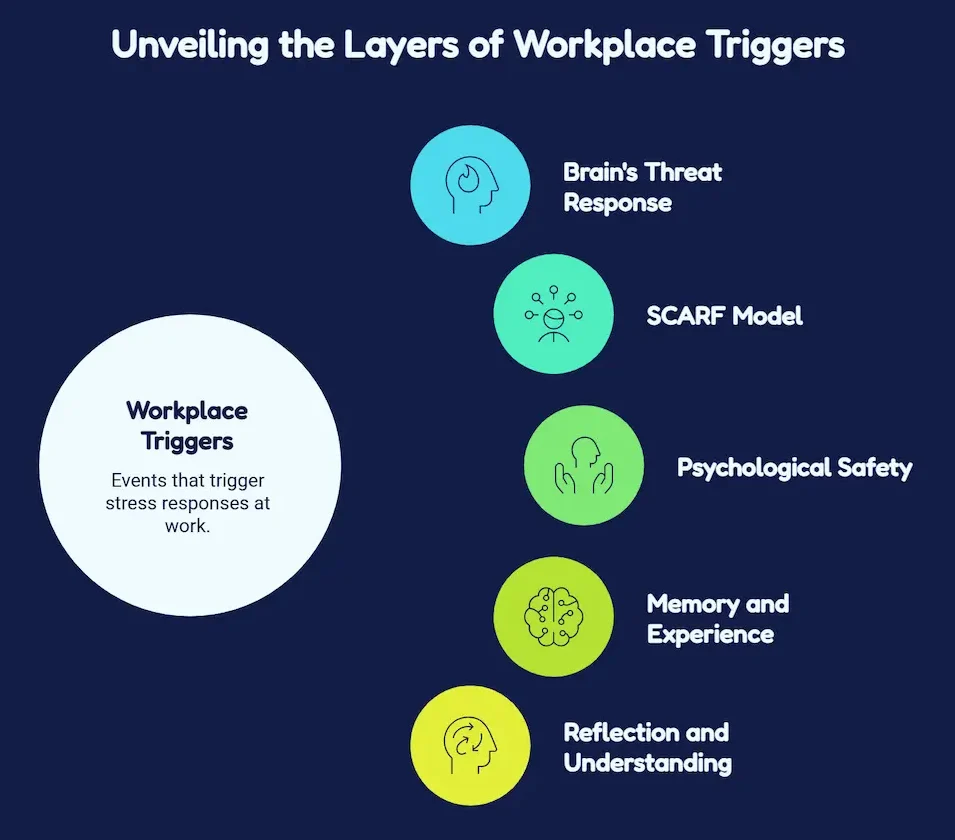
Together, these five domains contribute to what workplace psychologists often call psychological safety the feeling that you can speak up, contribute, ask questions, or make mistakes without constantly anticipating negative consequences. When one or more of these domains feels threatened, that sense of safety often weakens, even if nothing objectively dangerous has happened.
Why the Reaction Feels Bigger Than the Moment
Once a threat response begins, it doesn’t stay contained to the triggering event. Stress hormones prepare the body to act, not to sit quietly at a desk which is part of why an ambiguous message can leave someone distracted, irritable, or replaying the moment for hours afterward, long after the message itself has been read and understood.
There’s also a second layer worth understanding. The brain doesn’t evaluate each new situation in isolation. It uses memory and prior experience to judge how much of a threat something represents, which means a moment that resembles a past experience a certain tone, a certain kind of exclusion can generate a reaction shaped as much by that pattern as by what’s actually happening right now. This doesn’t mean every strong reaction points to something specific from someone’s past. It simply means the brain is comparing the present to whatever it has learned before, often faster than conscious thought can keep up with.
If you’ve noticed that certain workplace situations seem to trigger the same emotional response again and again, Why You Keep Thinking the Same Thoughts: Break the Loop explores how repeated mental patterns become easier for the brain to revisit over time.
What This Doesn’t Mean
This pattern doesn’t mean someone is fragile, unprofessional, or unsuited to their role. A strong reaction to an ambiguous message isn’t a character flaw, it’s a nervous system doing exactly what it evolved to do, applied to a modern environment it was never built for.
It also doesn’t mean every workplace frustration is “just biology” and therefore not worth examining. Real problems, unclear communication, exclusion, unfair treatment deserve real attention. Understanding the mechanism behind the reaction doesn’t erase the legitimacy of what triggered it. It simply explains why the reaction arrives with more force than the moment, on its own, seems to justify.
In many ways, workplace stress is simply one form of an emotional trigger. The setting changes, but the underlying psychological process is remarkably similar.
If you’d like to understand why emotional triggers affect us so powerfully in every area of life—not just at work—Emotional Triggers: Why You React So Deeply explores the psychology behind these reactions in more depth.
A Reflection Pause
Before moving into practical application, it can help to notice your own pattern rather than judge it:
- Which of the five domains, status, certainty, autonomy, relatedness, fairness tends to get triggered most often for you at work?
- Is there a specific type of message or moment that consistently produces a bigger reaction than the moment seems to warrant?
- What does your reaction usually look like in the first few minutes before you’ve had time to think it through?
There’s no right answer. The goal is simply to notice which domain your reactions tend to cluster around, because that noticing is what makes the pattern easier to work with later.
The Bigger Picture
Understanding this pattern changes what a strong reaction at work actually means. It’s rarely a sign that something is wrong with a person’s resilience. More often, it’s a sign that a specific, identifiable domain status, certainty, autonomy, relatedness, or fairness just got touched, and the brain responded the way it responds to any perceived threat: fast, and without asking permission first.
That distinction matters, because it turns a vague, uncomfortable experience , “I overreact at work and I don’t know why” into something far more specific and workable: “This message touched my sense of certainty, and that’s a domain I react strongly to.” One of those statements invites shame. The other invites understanding.
Understanding the trigger is the first step. How to Control Emotional Triggers Before They Control You explores practical ways to pause, regulate your response, and choose a more helpful reaction before emotions take over.
Questions You May Quietly Be Asking Yourself
Why do small things at work trigger such a big emotional reaction?
Why do I keep replaying conversations with my manager or colleagues?
How can I stop taking things so personally at work?
Continue Your Journey
If this pattern feels familiar, the next step is learning how to work with these reactions before they take over:
How to Control Emotional Triggers Before They Control You — the practical next step, once you can name which domain is being triggered.
For a broader foundation in how emotional triggers work in general, beyond the workplace:
Emotional Triggers: Why You React So Deeply
To see how this pattern connects to other common triggers across different areas of life:
10 Emotional Triggers That Control Your Behavior