
Sometimes the most frustrating feeling is not failure.
It is feeling trapped inside a version of yourself that no longer fits.
You tell yourself:
“I want to change.”
Yet somehow life keeps repeating itself.
The same habits. The same reactions. The same emotional patterns. The same limitations.
You try harder. You become motivated. You make plans.
And for a while, it feels like things are moving forward.
Then slowly, you find yourself returning to the same version of yourself again.
If you are searching for how to change your identity, what you may actually be searching for is something deeper:
How do I stop being the person I no longer want to be?
Because identity change is rarely about becoming someone completely new.
It is usually about letting go of patterns that no longer serve you.
If you have already read Identity Crisis: Why You Feel Lost in Life And How to Find Yourself Again, you already understand that feeling stuck often begins when your current identity no longer matches who you are becoming.
The old identity cannot create the future it was never designed to live.
How Identity Transformation Actually Happens
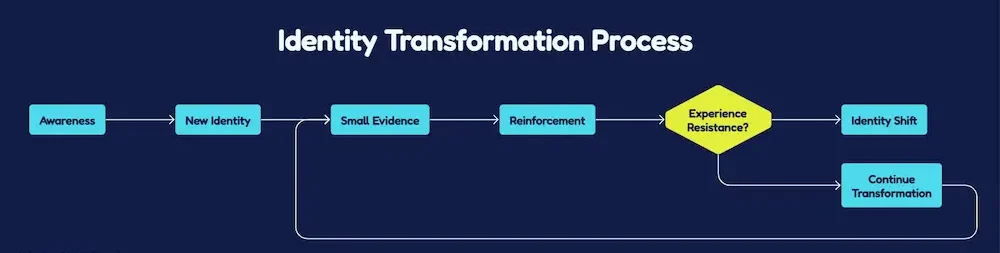
Changing your identity starts by changing the beliefs, behaviors, and self-perceptions that shape how you see yourself. Lasting identity transformation happens through repeated evidence, emotional awareness, and consistent actions that reinforce the person you want to become.
This process is not about becoming someone else.
It is about becoming more aligned with who you are capable of being.
What Is Identity Change?
Identity change is the gradual process of shifting how you see yourself, your self-concept, and the beliefs that shape your behavior over time. It involves replacing outdated beliefs, habits, emotional patterns, and self-perceptions with new ones that better align with who you want to become.
Many people assume identity is fixed. It is not.
Your identity is largely built from:
- repeated experiences
- learned beliefs
- emotional conditioning
- behavioral patterns
- personal stories you tell yourself
The problem is that many of those stories were created years ago. And they may no longer be true.
How Your Identity Is Formed
Your identity did not appear overnight.
It developed gradually through repeated experiences, emotional conditioning, and the meanings you attached to those experiences.
Over time, your brain begins collecting evidence about who you are.
Small moments slowly become larger conclusions.
For example:
A child who hears criticism repeatedly may begin believing:
“I am not good enough.”
Someone who repeatedly experiences rejection may slowly develop the belief:
“People don’t accept me.”
Eventually, those beliefs stop feeling like opinions.
They begin feeling like identity.
Psychologists often describe identity as something that is constructed rather than discovered.
Over time, these repeated beliefs and experiences become part of what psychologists call a self schema, the mental framework your brain uses to understand who you are and how you fit into the world.
That self-schema gradually shapes your self image, influencing what feels possible, what feels familiar, and how you interpret your experiences.
The brain continues reinforcing that self image through repeated experiences, emotional memories, relationships, and behavioral reinforcement, gradually strengthening your overall self concept. That is why identity feels so real.
And why changing it often feels uncomfortable.
One Misconception About Identity Change
Many people believe identity transformation means becoming a completely different person.
Not necessarily.
Identity change is usually less about creating a new self and more about releasing outdated versions of yourself.
You are not erasing your personality.
You are updating the beliefs, habits, and patterns that no longer fit who you are becoming.
That distinction matters because many people resist growth without realizing it.
They fear losing themselves.
When in reality, they are simply outgrowing an old identity.
Why You Feel Stuck In The Same Identity
Most people do not consciously choose their identity.
It develops automatically.
Over time, the brain begins creating statements like:
- “I am not confident.”
- “I always procrastinate.”
- “I am bad with people.”
- “I never stay consistent.”
- “I am not disciplined.”
At first these may simply describe behavior.
Eventually they become identity.
And once a behavior becomes part of identity, the brain works hard to keep it consistent.
This is one reason lasting change feels difficult.
The brain prefers consistency between:
- beliefs
- behaviors
- self-image
Even when that self image creates suffering.
According to research from the Harvard University, much of human behavior operates through automatic mental processes that occur outside conscious awareness. This helps explain why identity driven behaviors can continue repeating even when we consciously want to change.
This means many people are trying to change their life while unconsciously protecting an outdated identity.
Pause And Notice
Ask yourself:
What labels have I been repeating about myself for years?
And more importantly:
Are those labels describing who I am?
Or simply describing what I have repeatedly done?
That distinction matters more than most people realize.
The Hidden Pattern Most People Miss
Most self improvement advice focuses on behavior. But behavior is often the surface layer. Identity sits underneath it.
For example:
Someone wants to become healthier.
They focus on:
- workouts
- meal plans
- motivation
But internally they still believe:
“I am someone who always quits.”
The conflict begins immediately. One part of the mind is pursuing change. Another part is protecting the old identity.
Eventually the old identity usually wins.
This is why many people spend years trying to change habits while never changing how they see themselves.
As per discussion in You Don’t Change Habits: You Change Identity First, sustainable transformation often begins with identity shifts rather than behavioral force.
Why The Brain Protects Old Versions Of You
This surprises many people.
The brain does not automatically prioritize growth.
It prioritizes:
- familiarity
- predictability
- emotional safety
Even if those familiar patterns create frustration.
A familiar struggle often feels safer than an unfamiliar success.
For example:
Someone may genuinely want:
- confidence
- visibility
- success
- healthier relationships
Yet subconsciously fear:
- judgment
- rejection
- responsibility
- vulnerability
The brain notices the emotional risk.
Then quietly pulls the person back toward familiar behavior.
Not because they lack potential.
Because familiarity feels safer.
At this point, it might seem as though your identity is permanently fixed.
It is not.
The brain has a remarkable ability to adapt throughout life through a process known as neuroplasticity.
Rather than remaining permanently wired, it continually strengthens the neural pathways you use most often while gradually weakening those you use less.
That means the same brain that learned your current identity can also learn a new one.
Why Change Is Still Possible
According to Harvard Health, repeated thoughts, behaviors, and emotional responses reinforce neural pathways over time, making them feel increasingly automatic. The encouraging part is that this process works in both directions.
As you consistently practice new behaviors and reinforce a different way of seeing yourself, the brain gradually begins supporting that new identity instead of the old one.
Identity is not fixed.
It is reinforced.
That distinction matters.
Every repeated behavior, emotional experience, and personal interpretation provides new evidence about who you are.
Over time, the brain updates its internal model of your identity based on the evidence it receives most consistently.
This is why lasting identity change rarely happens through one dramatic breakthrough.
It happens through repeated evidence that quietly tells the brain:
“This is who I am becoming now.”
The old identity becomes weaker.
Not because you force it away.
Because you stop reinforcing it.
And the new identity becomes stronger because your daily actions keep proving it.
Change rarely feels dramatic while it is happening.
It usually feels like choosing a slightly different response often enough that, one day, it starts feeling like the most natural version of you.
Can You Completely Change Your Identity?
Yes, but probably not in the way most people imagine.
You do not wake up one day as a completely different person.
Instead:
- beliefs shift
- behaviors shift
- decisions shift
- emotional responses shift
- self perception shifts
And eventually, the person you have become feels different from the person you used to be.
The transformation appears gradual while it is happening.
But significant when viewed over time.
How The Subconscious Mind Reinforces Identity
Most identity patterns operate beneath conscious awareness.
The subconscious mind constantly looks for evidence that supports what it already believes about you.
If you repeatedly identify as:
- unmotivated
- shy
- inconsistent
- unlucky
- incapable
the subconscious mind begins filtering experiences through those expectations.
This does not mean the beliefs are true.
It means the brain becomes skilled at finding proof for them.
Over time, the identity feels increasingly real because the mind keeps collecting matching evidence.
This is one reason changing behavior alone often feels difficult.
The subconscious mind must gradually learn a new story through repeated experiences.
Psychologists often refer to this tendency as confirmation bias. Once we believe something about ourselves, the brain naturally notices evidence that supports that belief while overlooking evidence that challenges it. This is one reason outdated identities can feel surprisingly convincing.
If you want a deeper understanding of how these patterns form, read What Is the Subconscious Mind: How It Controls Your Life Secretly.
Why Your Brain Keeps Looking for Evidence
The brain naturally prefers consistency between what it believes and what it experiences.
Once an identity becomes established, the mind begins noticing evidence that supports it while overlooking evidence that contradicts it.
Someone who believes:
“I always fail.”
may remember every mistake while dismissing genuine successes.
Someone who believes:
“I am not confident.”
may ignore moments where they spoke up or handled a difficult situation well.
This pattern is closely related to confirmation bias.
The brain is not trying to deceive you.
It is trying to preserve a familiar picture of who you believe you are.
That is why collecting new evidence intentionally becomes such an important part of identity change.
Why Emotions Become Part of Identity
Identity is not built from thoughts alone.
It is also built from emotional experiences.
Someone who repeatedly experiences shame may begin identifying as someone who is fundamentally flawed.
Someone who repeatedly experiences criticism may begin identifying as someone who is never enough.
Over time, the emotion becomes attached to the identity.
This is why changing behavior alone often feels incomplete.
The emotional meaning underneath also needs to change.
Until then, the old identity continues feeling emotionally familiar.
A Real Life Example: The Identity Trap
Imagine someone who has spent years believing:
“I am shy.”
Over time they begin:
- avoiding conversations
- staying quiet
- avoiding opportunities
- withdrawing socially
Years later they decide they want more confidence.
They start reading.
Learning.
Practicing.
But every time they enter a social situation, the old identity speaks first:
“This isn’t who you are.”
Notice what happened.
The challenge is no longer social skills.
The challenge is identity.
The brain keeps defending a version of self that feels familiar.
Another Way This Appears: Personal Reinvention
Many people dream about reinventing themselves.
They imagine:
- moving somewhere new
- changing careers
- building better habits
- becoming more confident
But the location changes faster than the identity.
The habits change faster than the identity.
The appearance changes faster than the identity.
And eventually old patterns return.
This is why genuine transformation requires more than external change.
If this feels familiar, How to Reinvent Yourself Without Faking It explores why authentic reinvention starts internally before it becomes visible externally.
Yet Another Hidden Pattern: The Career Identity Shift
Imagine someone who has spent years seeing themselves as:
“the quiet employee.”
They avoid leadership opportunities. They stay in the background. They rarely speak up during meetings.
Eventually they decide they want career growth.
But every opportunity to become more visible triggers discomfort.
Why?
Because the challenge is not capability. The challenge is identity.
The old identity says:
“People like me don’t lead.”
Until that belief changes, opportunities often feel emotionally uncomfortable.
Once they begin collecting evidence that they can contribute, influence, and lead, the identity slowly starts shifting.
The career changes after the identity changes.
Not before.
Why The Same Patterns Keep Repeating
Most identity patterns follow a predictable cycle:
Identity → Behavior → Evidence → Reinforcement
Example:
Identity
“I am not disciplined.”
↓
Behavior
Avoid difficult tasks.
↓
Evidence
Tasks remain unfinished.
↓
Reinforcement
“See? I am not disciplined.” The cycle strengthens itself.
Over time, the identity begins feeling like objective truth. But often it is simply repeated evidence supporting an old belief.
The more often the cycle repeats, the more automatic it becomes. And eventually people stop questioning it.
They assume:
“This is just who I am.”
In reality, many identities are simply reinforced patterns.
Not permanent truths.
How Identity Shapes Everyday Decisions
Identity influences far more than the major choices you make. It quietly shapes hundreds of small decisions throughout the day.
For example, it affects:
- whether you speak up or stay silent
- whether you begin a difficult task or avoid it
- whether you keep a promise to yourself or postpone it
- how you respond to setbacks
- which opportunities feel possible or out of reach
These decisions may seem insignificant on their own.
But together, they reinforce the identity you already believe to be true.
Someone who sees themselves as “not disciplined” is more likely to postpone difficult work.
Someone who believes they are becoming consistent is more likely to return after a setback.
Over time, these small choices become evidence.
And that evidence gradually strengthens the identity behind them.
That is why lasting identity change rarely comes from one dramatic breakthrough.
It grows through repeated decisions that quietly tell the brain:
“This is who I am becoming.”
A Quiet Realization
You do not become stuck because change is impossible.
You become stuck because the old identity keeps collecting evidence for its own survival.
Real identity transformation begins the moment you stop treating old patterns as permanent descriptions of yourself.
How to Change Your Identity Step By Step
Identity transformation rarely happens through one dramatic moment.
Most lasting change happens through repeated small shifts that gradually alter how you see yourself.
The goal is not becoming a completely different person overnight.
The goal is becoming someone whose behaviors, beliefs, and actions align more closely with the life they want to create.
Identity change also requires psychological flexibility the willingness to question old beliefs and respond differently instead of automatically repeating familiar patterns.
1. Identify The Identity You Are Currently Living
Most people focus only on the identity they want.
Few examine the identity they already have.
Ask yourself:
- How do I describe myself regularly?
- What labels do I repeat?
- What limitations do I believe about myself?
- What behaviors reinforce those beliefs?
For example:
You may repeatedly say:
- “I’m not confident.”
- “I’m always inconsistent.”
- “I’m bad at relationships.”
- “I’m an overthinker.”
Those statements matter because the brain listens.
Over time, repeated descriptions become subconscious instructions.
Awareness begins by identifying the current identity before trying to create a new one.
2. Separate Yourself From Old Labels
This is where many people get stuck.
They confuse patterns with identity.
For example:
Instead of:
“I am inconsistent.”
Try:
“I have struggled with consistency.”
Instead of:
“I am anxious.”
Try:
“I experience anxiety sometimes.”
The difference may seem small.
Psychologically, it is enormous.
One defines who you are.
The other describes an experience.
Identity transformation becomes possible when you stop turning temporary patterns into permanent definitions.
This shift strengthens cognitive flexibility, allowing the brain to consider new possibilities instead of treating old labels as permanent truths.
3. Decide Who You Are Becoming
Many people know what they want to stop.
Few know who they want to become.
Instead of focusing on:
- stopping procrastination
- stopping overthinking
- stopping self-doubt
Ask:
Who would I need to become for those behaviors to lose their power?
Examples:
Instead of:
“I want to stop procrastinating.”
Try:
“I am becoming someone who takes action before feeling ready.”
Instead of:
“I want more confidence.”
Try:
“I am becoming someone who trusts themselves more often.”
Identity shifts become stronger when they move toward something rather than away from something.
A Small But Powerful Question
If your future self walked into the room today…
What would they do differently in the next hour?
Not next year.
Not next month.
The next hour.
That question makes identity practical.
4. Collect Evidence For The New Identity
This is where most transformation actually happens.
The brain changes through evidence.
Not wishes.
Not affirmations alone.
Evidence.
Every small action becomes a vote for the identity you want to build.
For example:
Someone becoming healthier may:
- take a short walk
- drink more water
- prepare one healthy meal
These actions seem small.
But psychologically they communicate:
“This is what someone like me does.”
Every repeated action becomes evidence for the person you are becoming.
Over time, these small choices reshape not only your behavior but also your self-image.
That is how identity based change happens, through repeated actions that gradually teach the brain who you are becoming.
Each action strengthens the new identity.
Lasting transformation is rarely behavior first. It is usually identity based change, where repeated actions gradually reshape how you see yourself.
5. Expect Resistance
Many people assume resistance means something is wrong.
Often it means change is happening.
Remember:
The old identity has been reinforced for years.
Sometimes decades.
When you begin acting differently, discomfort appears because the brain prefers predictability.
You may notice:
- self doubt
- procrastination
- fear
- emotional resistance
- urges to return to familiar patterns
This does not mean you are failing.
It means the old identity is losing certainty.
A Simple Identity Shift Framework
Think about identity change like this:
Awareness → New Identity → Small Evidence → Reinforcement
Awareness
Recognize the old pattern.
↓
New Identity
Decide who you are becoming.
↓
Small Evidence
Act in alignment with that identity.
↓
Reinforcement
The brain begins updating its self-image.
The process looks simple.
But repeated consistently, it creates profound change.
Why Relationships Often Change During Identity Transformation
This is something many people do not expect.
When your identity changes, relationships often shift too.
Not because you are abandoning people.
Because your patterns are changing.
For example:
Someone who always:
- people pleases
- avoids conflict
- apologizes excessively
may begin setting healthier boundaries.
At first, this can feel uncomfortable.
Not only for them.
But for the people around them.
Growth often requires tolerating temporary discomfort while creating healthier patterns.
This is one reason identity transformation can feel lonely at times.
You are learning how to operate differently.
Reflection Pause
Ask yourself honestly:
- Which identity am I currently reinforcing?
- What labels have I accepted without questioning?
- What evidence am I collecting every day?
- Who am I becoming through my repeated actions?
- What old identity am I afraid to let go of?
Pause there for a moment.
Because identity change often begins with awareness before behavior.
One Uncomfortable Truth About Identity Change
Many people want a new identity.
Few want the uncertainty that comes with it.
Because every identity shift involves a period where:
You are no longer the old version of yourself.
But you do not fully feel like the new version yet.
Sometimes the hardest part of identity change is letting go of the version of yourself that once kept you emotionally safe.
Even if that version held you back, it also helped you survive earlier experiences, uncertainty, or emotional pain.
Letting go of it can feel like losing a familiar part of yourself.
That is why growth often feels emotionally complicated.
You are not only building a new identity. You are also saying goodbye to an old one.
That space feels uncomfortable.
Confusing.
Sometimes lonely. Most people interpret this feeling as failure.
It is not. It is transition.
The discomfort is often evidence that the change is becoming real.
Final Thoughts
If you feel stuck, the problem is rarely that you lack potential.
More often, you are carrying an identity that was built from old experiences, old fears, and old patterns.
The version of you that created your current reality is not necessarily the version of you that will create your future.
That is why lasting transformation is not about forcing new habits.
It is about identity based change, where repeated choices gradually reshape how you see yourself until the new version of you feels more familiar than the old one.
Every small action becomes evidence.
Every repeated choice becomes reinforcement.
And over time, the identity that once felt impossible begins feeling normal.
Because identity change does not happen in a single breakthrough moment.
It happens when the person you are becoming slowly becomes more familiar than the person you used to be.
If you’re ready to reinforce that new identity at a deeper level, How to Reprogram Your Subconscious Mind explores how repeated thoughts, beliefs, and experiences gradually reshape the subconscious patterns that influence your daily behavior.
Questions You May Quietly Be Asking Yourself
Can I change my identity even if I've been the same way for years?
Yes. Many identities feel permanent simply because they have been reinforced for a long time. The brain learns through repetition, which means new patterns can also be learned through repetition. Time strengthens identities, but it does not make them permanent.
Why do I keep becoming the same person after trying to change?
Often because behavior changes faster than identity. If you still see yourself through old labels and beliefs, the brain will naturally pull you back toward familiar patterns. Lasting change happens when self-perception evolves alongside behavior.
How long does an identity shift take?
There is no fixed timeline. Identity change usually happens gradually through repeated actions, experiences, and evidence. Most people notice meaningful shifts when they consistently reinforce a new identity over time rather than chasing quick transformation.