It’s ten to six. The workout clothes are on, the shoes are laced, and you’re standing in the hallway holding the front door handle without turning it.
Two voices have started up. One says, firmly, that you’re just tired the way everyone is tired and you’ll feel better once you’re moving. The other says, equally firmly, that you’ve had a long week and nobody’s going to give you a medal for dragging yourself out. Neither is exactly wrong, and that’s what makes this such a stubborn little standoff.
The trouble is that “I’m tired” is doing an awful lot of work in that sentence.
“Tired” Can Mean a Lot of Different Things
Think about the different ways you can be tired. You might be mentally drained after a day of meetings, with a body that feels fine and a brain that has left for the evening. You might have slept badly and feel foggy and heavy. Your legs might still be carrying Tuesday’s workout. You might feel mildly low on energy, a bit flat, but otherwise normal. Or you might feel unusually wrung out, or like you’re coming down with something, or like you’ve been tired for weeks.
Those aren’t the same situation, and the same advice can’t fit all of them. Pushing through might be reasonable for some situations and unwise for others. “Always rest” is just as wrong in the other direction. So the first job isn’t deciding whether to exercise. It’s working out which kind of tired you have.
First, a Gentle Question: Tired, or Just Not Feeling It?
Sometimes “I’m too tired to exercise” really means “I don’t feel like exercising.” That’s a completely human thing to feel, and it isn’t a character flaw, but it’s a different problem with different solutions. If that sounds closer to your situation, No Motivation to Exercise? is the better place to start.
One way to reflect on the difference is to imagine an activity you normally enjoy, such as a favorite class or a walk with a friend. Does the idea feel appealing, or does your body still feel worn out? If even an enjoyable activity sounds physically exhausting, tiredness may be the bigger issue. If the idea suddenly feels manageable, reluctance may be playing a part. This is only a way to reflect, not a reliable test of whether it is safe to exercise. Either answer is legitimate. You’re not catching yourself out. You’re just working out what you’re dealing with.
Move, Modify, or Rest
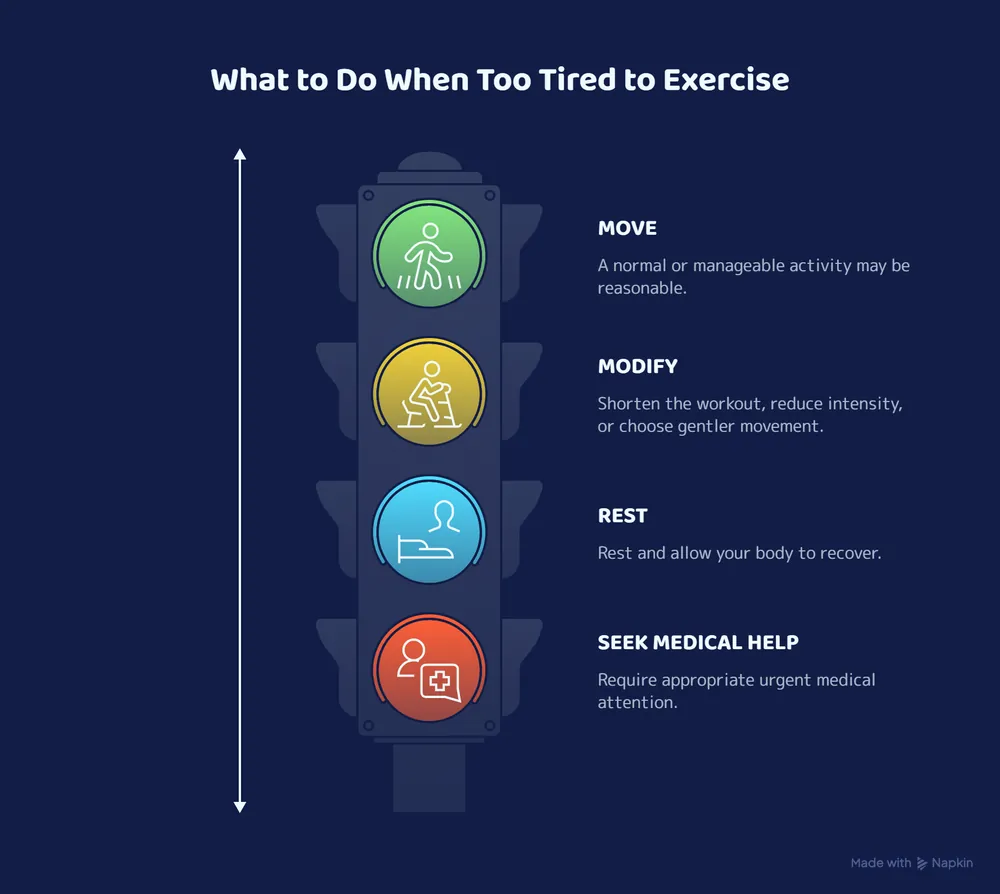
Here’s a way to hold the decision. It’s a BYW decision aid, not a medical or diagnostic tool, and it replaces the old two-option fight (“exercise or quit”) with something that has more room in it.
| Your situation | Possible response |
| Move: Feeling basically well, with ordinary mild tiredness or reluctance, and no concerning symptoms | A normal or manageable activity may be reasonable |
| Modify: Lower on energy than usual but otherwise well | Consider shortening the session, lowering the intensity, simplifying it, or choosing gentler movement |
| Rest: Ill, feverish, unusually exhausted, significantly sleep-deprived, in meaningful pain, or not recovered from a hard stretch of training | Rest or recover. Gentle exercise isn’t mandatory |
There’s one more category, and it’s deliberately not a fourth workout option:
Seek medical help: Chest pain, fainting or feeling like you might faint, severe or unusual breathlessness, a racing or irregular heartbeat, or other symptoms that seem serious. Stop exercising and get appropriate medical attention. Persistent, unexplained tiredness deserves a medical appointment, even without emergency symptoms. Severe or sudden warning symptoms require urgent attention.
None of this is a promise that exercise will always make you feel better. Research reviews of single exercise sessions suggest small-to-moderate average improvements in positive mood and energy, but the effects vary between people, and the evidence on fatigue itself is inconsistent. “You’ll feel better once you start” may be true for some people on some days, but it is not a rule.
When Some Movement May Still Make Sense
For an otherwise healthy person on an ordinary low-energy day, with nothing worrying going on, a lighter or shorter session can be a reasonable choice. That might be an easy walk, a gentle bike ride, some stretching, or the same workout cut down. The World Health Organization’s physical activity guidelines say that some physical activity is better than none, and the 2018 U.S. guidelines note that activity doesn’t have to come in long bouts to count.
It’s still a choice, though, not an obligation. A short walk can be a lovely way to shake off a heavy afternoon. It can also be one more thing on a day that’s already too full, and neither of those is wrong.
Permission to Make the Workout Smaller
Many people treat the decision as all or nothing: the full workout or no workout. But there’s usually a middle option, and it may be the most useful idea in this article. Instead of asking “can I do my planned session?”, ask “what’s the version of movement that fits what I’ve got today?”
Today’s capacity gets today’s version. That might be twenty minutes instead of fifty, or a walk instead of intervals, or just the warm-up and a stretch. This is a decision about today. The bigger question of keeping exercise going across weeks is covered in How to Stay Consistent With Exercise, and one useful point from there applies here: sustainable consistency includes responding sensibly to changes in how much you’ve got to give. A modified day, or an occasional rest day, doesn’t undo your routine.
When Rest Is the Better Call
There are days when pushing through isn’t discipline, just poor judgment.
Mayo Clinic guidance on exercising while unwell is a useful anchor. Its rule of thumb is that if your symptoms are all “above the neck,” like a runny nose, sneezing, or a minor sore throat, light-to-moderate exercise is often fine. If you have a fever, noticeable fatigue, or widespread muscle aches, it advises against exercising, and it suggests easing back gradually afterward. Mayo also advises stopping if you develop pain, shortness of breath, dizziness, or nausea. The neck rule is a handy guideline, not a clinical test, and if you’re unsure, checking with a doctor is the safer move.
The same goes for being run down in other ways. If you feel unusually exhausted, if you’re in meaningful pain, or if you haven’t recovered from a demanding stretch of training, rest is a legitimate decision. It doesn’t mean you lack discipline.
What If You Barely Slept?
One bad night doesn’t come with a single rule. What research does suggest is that acute sleep loss tends to lower exercise performance the next day, to different degrees depending on the type of exercise and how the sleep was lost. A 2022 systematic review and meta-analysis found bigger effects after a night of no sleep or after waking very early than after simply going to bed late. A 2025 meta-analysis suggests sleep loss can make exercise feel harder, with higher ratings of perceived exertion.
In practice, that means a short night often makes a workout feel heavier and less sharp, not necessarily impossible. A gentle walk may feel perfectly fine. Anything that needs coordination, heavy weights, or driving while drowsy is a place to be more cautious. And exercise can’t make up for lost sleep, so a workout isn’t a substitute for it. If poor sleep is a recurring theme, the quality and restfulness of your sleep is its own topic, and a forthcoming article on restorative sleep covers it.
What If You’re Just Sore From Last Time?
Ordinary muscle soreness after a workout is common, and it usually eases over a few days. Gentle movement is often comfortable with it. But soreness is different from sharp, localized, or worsening pain, or pain that changes how you move. Those are signals to take seriously, and if they don’t settle, they’re worth having checked. This isn’t about diagnosing anything, just noticing the difference between “my legs feel like they did something” and “something doesn’t feel right.”
What If You’re Always Too Tired to Exercise?
This is where the question changes. If tiredness keeps getting in the way, week after week, it stops being a workout-decision problem and starts being a question about the tiredness itself, and it shouldn’t be treated as a motivation problem.
Fatigue can have many causes, including not enough sleep, stress, medications, lifestyle factors, and medical conditions. Mayo Clinic suggests seeing a doctor if fatigue hasn’t improved after a couple of weeks of rest, lower stress, and decent eating and fluids. It also lists chest pain, shortness of breath, an irregular or racing heartbeat, and feeling like you might pass out alongside fatigue as reasons to seek urgent help. If any of that applies, call your local emergency number or get care promptly, don’t try to exercise through it.
For the broader picture of why tiredness can linger even when you’re sleeping, Why You Always Feel Tired (Even After Sleeping) explores some of the psychological and behavioral contributors, while being clear that persistent, unexplained fatigue deserves medical attention, not more self-management.