

The plan was Monday, Wednesday, Saturday. Monday happened. On Wednesday a deadline moved up and the session slid to Thursday, then Friday, then nowhere. By Saturday, with a sore throat and a long list of things still undone, the gym bag stayed in the trunk, where it would sit for nine more days.
Nothing dramatic happened that week. There was no injury and no crisis, and nobody decided to quit. But by the following Monday, the question forming isn’t when do I go back? It’s closer to did I just lose it again? There’s a quiet suspicion that a routine which took weeks to build has already evaporated, and that the honest move is to wait for a cleaner start.
That suspicion is worth examining. It can shape what happens next, and it has less to do with the workouts than with what a disrupted week is allowed to mean.
What Consistency Actually Looks Like
Most people carry an unspoken definition of consistency: every planned session completed, same days, same schedule, week after week. By that standard almost everyone fails regularly, because ordinary life doesn’t hold still long enough to allow it.
A more useful definition looks across time instead of across a single week. Staying consistent means exercise remains part of your life through the weeks that don’t go to plan. You adjust and continue, and you don’t disappear and restart. Consistency Over Perfection explores why imperfect repetition tends to outlast flawless but fragile effort. Applied to exercise, a week with one workout instead of three need not mean the pattern has ended.
This is also what separates consistency from rigidity. A rigid routine works only under the conditions it was designed for. Someone who is consistent isn’t necessarily following the plan perfectly. They’ve learned how to bend it without losing contact with it, and that skill is most of what learning how to stay consistent in the gym, at home, or anywhere else comes down to.
Why Staying Consistent Gets Harder After the Start
Starting and maintaining are different behavioral problems. At the start, novelty carries much of the load: a fresh plan, a sense of having made a decision, an unfamiliar gym that feels like progress in itself. A few weeks later the novelty has faded. The schedule that looked workable in week one meets an actual month, and the behavior has to run on something steadier than excitement. Why You Can’t Stay Consistent looks at this broader pattern. Exercise makes it unusually visible because it’s physically effortful, takes real time, and is easy to postpone without anyone noticing.
It helps to know how long the steadier stage can take. In Phillippa Lally’s well-known study of new daily behaviors, the time to reach a plateau of automaticity ranged from 18 to 254 days, with a median of 66. A later systematic review and meta-analysis of health-behavior habit formation, covering 20 studies, similarly points to roughly two to three months or more of consistent repetition, with wide variation between people and behaviors. The popular claim that a habit forms in 21 days isn’t supported by this research. Many people give up in the very weeks when exercise still takes deliberate effort, which is a normal stage and not a sign the routine is failing.
Other things tend to make maintenance harder: a schedule built for ideal weeks, tiredness, competing responsibilities, heavy reliance on willpower, and an all-or-nothing way of reading a missed session. Most of these are design problems, not character flaws.
Two Versions of Your Week
A practical way to protect continuity is to decide in advance what two versions of your week look like.
The ideal week is your normal routine when conditions are good. The minimum viable week is a smaller version you might use when life gets heavier, with fewer or shorter sessions. It should still feel meaningful rather than like ticking a box. These are starting points; the Consistency Range below offers more options, including rest and return.
There’s no universal number for either. A person with a flexible schedule and a person caring for a newborn will have very different minimums, and neither is wrong. The point is to make the decision once, calmly, so it doesn’t have to be negotiated from scratch on the evening when you’re most tired and least inclined to be generous with yourself.
Making the Workout Easier to Repeat
On demanding weeks, effort and decision-making are both in short supply. One way to make maintenance easier is to reduce unnecessary effort and decisions around a session.
A predictable window helps. “After work” is vague, while “when I get home, before I sit down” works as a cue. Research on if-then planning supports the general idea. In an early study of 248 university students, those who wrote down when and where they would exercise were far more likely to report doing so over two weeks than those given motivational information alone. It was a short, self-reported study in a young population, so the broader case for specific planning rests on larger reviews, summarized by the National Cancer Institute, more than on that single result.
Preparation friction matters quietly too. When the bag lives by the door, the shoes are where you can see them, and the first five minutes are already decided, the session is simply easier to begin. A backup option keeps a closed door from becoming a canceled session. That might be a shorter home version for days the gym isn’t happening, or a second window later in the day. Accountability, whether a friend, a class, or a standing appointment, helps some people and feels like pressure to others, so it’s a tool worth testing and not a requirement.
None of this is about designing a routine from scratch, which is a separate question that How to Create a Workout Routine You Can Actually Stick To covers. It’s about taking what you already do and removing the small frictions that make it fragile.
When Motivation Isn’t Showing Up
Motivation fluctuates, and the dips rarely announce themselves in advance. Why Do I Lose Motivation? explains why that’s a normal feature of how motivation works and not a verdict on commitment. What matters here is the practical implication: a routine that needs you to feel like it every time will have gaps, so it helps to make the behavior less dependent on the feeling.
That doesn’t mean forcing yourself through every session regardless of circumstances, and it doesn’t mean motivation is irrelevant. Enjoyment and personal choice can matter for habit strength, as a 2024 review of health-behavior habits suggests. Choosing movement you can tolerate or enjoy is therefore worth considering, rather than relying only on obligation. On low days, treating the setup as the job can carry a session that mood wouldn’t: getting changed, getting there, doing the first few minutes. Sometimes the right adjustment is a lighter session and not more willpower. Starting a workout when you truly don’t feel like it is its own challenge, and No Motivation to Exercise? How to Work Out When You Don’t Feel Like It addresses it directly.
After a Missed Workout
A missed workout is an interruption in the pattern, not a verdict on it. The costly part usually isn’t the missed session. It’s the story that follows: I’ve ruined the week, then I’ll start fresh on Monday, then a gap that quietly grows. The more useful sequence is shorter: missed workout, adjust, next reasonable opportunity, continue.
In practice that means looking at the week ahead and finding the next realistic slot. If it helps, move the missed session there. Don’t try to make it up by doubling the next one. If the plan was three sessions and you did two, the week still happened.
It also helps not to treat every missed session as the same kind of event. Missing a workout because the day got away from you is different from skipping one because your body needed rest, and both are different from an illness or injury. Rest isn’t inconsistency. Pushing through illness or pain to protect a streak is a different problem entirely, and one that calls for appropriate professional guidance, not more resolve.
Busy, Unpredictable Weeks
An unpredictable schedule calls for flexible options rather than a promise that every week will look the same. If a gym visit becomes impossible, a home session or a walk might fit. During a demanding stretch, reducing frequency temporarily may be more realistic than repeatedly trying to catch up.
The World Health Organization’s 2020 guidelines recommend 150–300 minutes of moderate-intensity aerobic activity per week, or 75–150 minutes of vigorous activity, plus muscle-strengthening on at least two days. Those are population-level targets for substantial health benefit. The same guidelines are explicit that some physical activity is better than none, so a light week doesn’t count as zero.
None of this assumes everyone can always “make time.” Caregiving, shift work, health, and sleep are real constraints. The aim is to adapt to the constraints you actually have and not to argue with them.
When Doing Less Keeps the Habit Alive
Reducing the size of a workout can protect the behavior in a way that insisting on the full version sometimes doesn’t. A fifteen-minute session on a hard day keeps exercise inside the week, keeps the cue and routine intact, and keeps the sense of being someone who still does this unbroken.
It’s worth being precise about what that does and doesn’t do, because keeping the behavior going isn’t the same as keeping a particular level of fitness. A 2021 narrative review by Spiering and colleagues found that some measures of endurance and strength could be maintained for limited periods with fewer or shorter sessions, provided training intensity was largely maintained. The findings differed by fitness outcome and age, and the minimum frequency for maintaining longer-duration endurance remains uncertain. This is evidence about preserving physical performance, not proof that any brief workout will do the same.
A shortened session may help preserve some fitness, depending on what you do and how hard you work. A very light five-minute version is better understood as a way to stay connected to the routine, not a guarantee of maintained fitness. Both can be worthwhile, but they serve different purposes.
The Consistency Range
Pulling these ideas together, it can help to think of your routine as a range and not a single standard:
Ideal → your normal workout, when life allows.
Reduced → a shorter, lighter, or adapted version when conditions change.
Minimum → the smallest meaningful version that preserves continuity, used when it genuinely helps.
Return → resuming the normal pattern as circumstances improve.
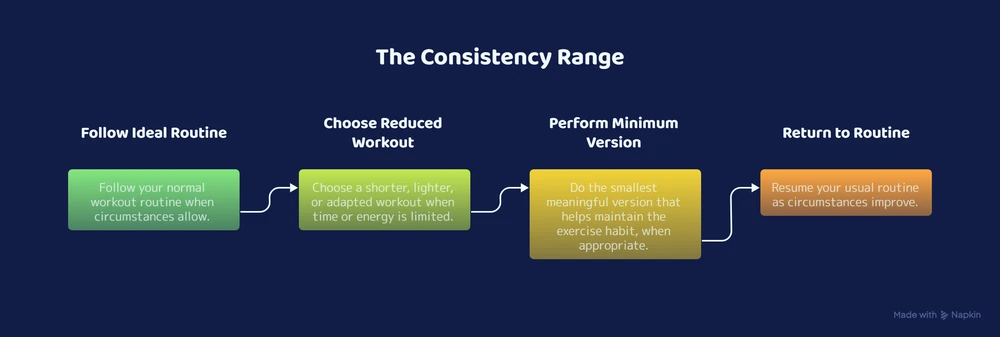
This is a BYW editorial decision aid, not a scientifically validated method or an exercise prescription. Its purpose is to replace perfect or nothing with adjust and continue.
| Situation | Possible response |
| Normal week | Follow the planned routine |
| Time unexpectedly limited | Consider a shorter, adapted session |
| One workout missed | Resume at the next reasonable opportunity |
| Illness, injury, or a genuine recovery need | Rest, or seek appropriate professional guidance |
| Conditions improve | Return toward the normal routine as appropriate |
Notice that not every row asks for a workout. Part of consistency is telling a week that needs adapting from a week that needs rest.
How to Tell Whether You’re Actually Consistent
A streak counter measures one thing: whether a chain stayed unbroken. It can’t see most of what matters. A few other angles are worth looking at. One is the pattern across weeks and months, not days. Another is how often you meet the plan that’s realistic for your life, not the one you’d follow in an ideal season. A third is how quickly ordinary interruptions are followed by a return. A fourth is whether exercise is still part of your life across busy seasons and quiet ones.
There’s no universal percentage that defines consistency, and inventing one would only create a new standard to fall short of.