The car has been parked for fourteen minutes. The engine is off, the gym bag is on the passenger seat, and you’ve answered two emails that didn’t need answering. Through the windshield, a man with forearms the size of bread loaves strides through the glass doors as if he lives there. A woman follows, earbuds in, already moving like she knows exactly which machine is hers.
You tell yourself you’ll go in after this next song ends. Then the song ends, and you start another one.
If you’ve ever done this, you may recognize the feeling. This is one way exercise can get stalled. It isn’t a problem with the exercise, or even with wanting to do it. It’s what happens when a place feels like it comes with a rulebook nobody gave you.
What Gym Anxiety Actually Looks Like
It rarely announces itself as anxiety. More often it looks like small, sensible-seeming habits. You delay leaving the house, or circle the parking lot waiting for it to empty a little. You stick to the one treadmill you know how to use, and you keep your headphones in like armor. You avoid the free-weights area, or the stretch of floor where everyone seems to know what they’re doing. You don’t ask anyone how a machine works, because asking feels like announcing that you don’t belong.
Between sets there’s an odd awkwardness, where you don’t know what to do with your hands or your face. You check your phone more than you need to. You compare yourself with someone who has clearly been doing this for years, and you notice your own body in the mirror a lot more than you’d like.
None of that is a diagnosis, and you don’t need one to take it seriously. It’s a recognizable pattern, and it has understandable causes.
Why a Gym Can Feel Like Walking Into Someone Else’s House
Think about walking into a stranger’s home for a party. You don’t know where the coats go, which door is the bathroom, or whether people take their shoes off. You can manage fine, but you spend a lot of mental energy on small decisions that regulars never think about.
A gym stacks several of those uncertainties on top of each other. The equipment can be baffling: machines with levers and pads and little diagrams that seem to assume you already know the answer. The etiquette is unspoken, so you’re guessing at norms like how long to stay on a machine or whether you can wipe it down while someone’s waiting. Nearly everyone else appears to know what they’re doing.
Then there’s the visibility. Gyms are open spaces full of mirrors, and people wear form-fitting clothes. For some people that intensifies existing worries about their body, which is part of why self-image shows up here so often. How Your Self-Image Predicts Your Behavior explores how the way we see ourselves can quietly shape what we do and avoid. A gym just happens to be a place where those worries get a stage.
Research on this points the same way. A 2026 review describes a study of college women in a campus gym that found that self-consciousness was greatest when the gym was crowded, when other people looked very fit, when they felt they were being watched, and when they felt they didn’t know what they were doing. Research on women and weight lifting has also identified worries about being evaluated as one barrier (Salvatore & Marecek, 2010). In other words, the discomfort tends to come from the setting and the uncertainty about it more than from any flaw in the person walking in.
Is Everyone Really Watching?
When you’re the most self-conscious person in the room, it can feel as though you’re also the most observed. Psychologists have a name for this: the spotlight effect.
In a study by Thomas Gilovich and colleagues (2000), students were asked to walk into a room of their peers wearing an embarrassing T-shirt. They guessed that about half the room would notice it. In reality, about a quarter did. The people wearing the shirt had overestimated how much attention they were getting.
It’s worth being honest about what this does and doesn’t tell you. It was a lab study with students, not a study of gyms. And it doesn’t say that nobody notices you, because some people did notice the shirt. It suggests something narrower and more useful: we tend to overestimate how much of our behavior other people register, and noticing isn’t the same as judging. Someone might glance at you because they’re waiting for the machine, or checking the clock, or because you happened to be in their line of sight.
This is the same pattern explored in Self-Awareness vs Self-Consciousness: paying anxious attention to how you appear to others is a different mental activity from curiously understanding yourself, and the first one tends to make everything feel louder than it is. Seeing the difference between being visible and being evaluated doesn’t make the nervousness vanish, but it can take some of the heat out of it.
Nerves, or a Genuine Problem?
This is where it’s worth slowing down, because “gym anxiety” can describe two quite different situations.
The first is anticipated judgment and unfamiliarity. Nobody has actually said or done anything. You’re imagining what someone might think, or you’re unsure how equipment works, or you don’t know where things are. The discomfort is real, but it’s mostly about uncertainty and what you expect, and preparation, support, and time may help.
The second is a genuine problem in the environment. Someone has made comments about your body or your clothes. A person stands too close, lingers near you, follows you from machine to machine, or won’t take a hint. You’ve been filmed, or staff brush off a complaint. Equipment is broken or unsafe. These aren’t nerves, and they aren’t something to reason yourself out of.
Unwanted attention and harassment in gyms are documented concerns, although survey estimates vary widely and do not establish how often these experiences occur across all gyms. The important point is simpler: sometimes discomfort is a response to what is actually happening, not just a fear of what might happen.
The two can also overlap. You can be nervous about being a beginner and be dealing with someone who’s behaving badly, and one doesn’t cancel the other.
This matters because the advice for each is different. For the first, preparation and gradual familiarity often help. For the second, repeated exposure is not the answer. You don’t have to prove that something is bad enough to count, and you’re not required to tolerate it. Where it’s safe, you can set a clear boundary, tell a staff member, ask how to report it, move to a different area or time, or switch to a different facility altogether. The goal isn’t to force yourself through every gym. It’s to find a safe, workable way to move.
What Exactly Are You Afraid Will Happen?
“Gym anxiety” sounds like one thing, but it’s usually several specific fears wearing the same coat. It helps to finish the sentence: What I’m afraid will happen is…
You’ll use something wrong. People will judge your body. You’ll look inexperienced. You won’t know where to go. Someone will stare. It’ll be crowded. You’ll be the least fit person in the room. You’ll break an unspoken rule. You’ll have to ask for help.
Each of those calls for a different response, and a vague dread is a lot harder to work with than a specific worry. Naming it won’t make the nerves disappear, but it turns “I can’t go to the gym” into “I don’t know how the machines work,” which is something you can actually fix.
The Familiarity Ladder
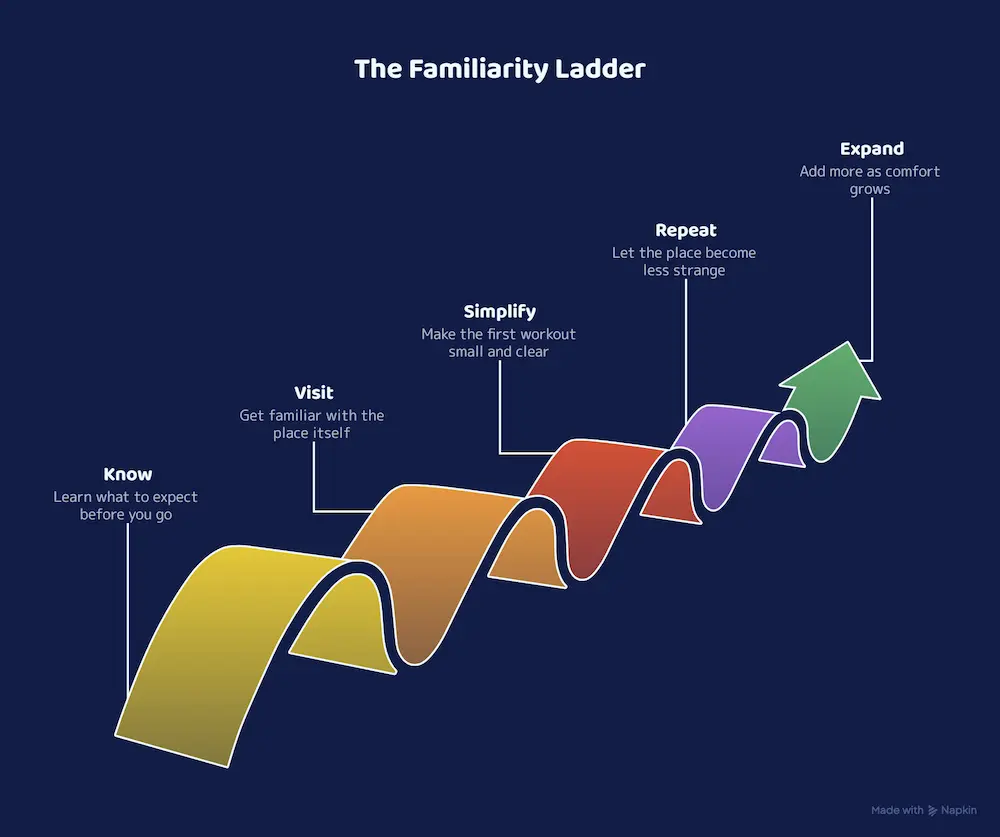
Here’s a way to think about building comfort in a gym that feels suitable for you. It’s a BYW framework, not a psychological treatment or an exposure-therapy protocol. Treat it as an optional, flexible guide. You don’t have to climb every rung, push through distress, or end up loving a commercial gym.
Know. Learn what to expect before you go. Look at the gym’s website and photos, check the layout, and see what classes and hours exist. Call or take a tour, and ask about orientations or an equipment introduction.
Visit. Get familiar with the place itself. A first visit doesn’t have to include a workout. Walking through, locating the changing rooms, and seeing the layout can be a complete first step. If your schedule allows, a quieter time can make early visits feel more manageable. Going with a friend can help too, as long as it’s a support and not a requirement.
Simplify. Make the first workout small and clear. Walk in knowing what you plan to do, so you’re not standing around deciding. If you want help figuring out what that plan should be, How to Create a Workout Routine You Can Actually Stick To walks through building one around your real week. Use equipment you understand, and if something’s unfamiliar, ask a qualified staff member to show you how it works before you use it. You don’t need a personal trainer for this, though it’s an option if you’d like one.
Repeat. Let the place become less strange. With repeated visits, a gym may start to feel less foreign because there is less to figure out. Progress is uneven, and bad days happen. There’s no research-based number of visits after which you’ll feel fine.
Expand. Add more as comfort grows: another area, another machine, a class, a longer session.
A few quick pairings can help you choose the right first step:
| What you’re feeling | A possible first step |
| I don’t know where things are | Consider a tour or orientation |
| I’m afraid of using equipment incorrectly | Ask qualified gym staff for instruction before using it |
| I feel inexperienced compared with others | Choose a manageable activity, and avoid treating comparisons as proof of inadequacy |
| Crowds make the environment overwhelming | Consider a quieter time, or a different setting where practical |
| I worry people are judging me, but there’s no clear evidence | Explore other interpretations instead of assuming every glance is negative |
| Someone is actually harassing, intimidating, or repeatedly bothering me | Prioritize safety, set boundaries where it’s safe, seek staff support, or leave or change facilities |
| The gym still doesn’t suit my needs | Consider home, outdoor, community, or other accessible exercise options |
What to Do With the “Everyone’s Judging Me” Thought
When there’s no sign anyone is actually doing anything, it can help to ask what else a glance might mean. The person might be waiting for your machine, looking for a friend, or just staring blankly between sets, which is what most people do. You can’t be certain what’s in anyone’s head, but you can notice when you’ve decided something with very little evidence. That’s different from dismissing the thought. You’re just holding it a little more loosely.
This only applies when there’s no real evidence. If someone really is staring, commenting, or making you feel unsafe, that’s the second situation described above, and it deserves a different response.
You Don’t Have to Love the Gym to Exercise
It’s easy to slip into the belief that being fit means becoming comfortable in a commercial gym. It doesn’t. Walking, home workouts, outdoor activity, community classes, a pool, or a gym with a quieter or more suitable setup can all be legitimate ways to move, depending on what you want and what works for your life. If the gym stays a barrier, choosing something else isn’t giving up. It’s matching the setting to the person.
It’s also worth noticing whether the gym is the problem at all. If you feel reluctant about exercise in every setting, not just this one, that’s a different challenge, and No Motivation to Exercise? is a better starting point.
When It’s Bigger Than the Gym
Nervousness about a specific unfamiliar setting is common and usually situational. Sometimes, though, anxiety about being judged or watched follows a person through many social situations, lasts a long time, causes significant distress, or starts to interfere with work, relationships, or daily life. The National Institute of Mental Health describes that kind of persistent, intense fear as something more than ordinary shyness or nerves. If that sounds familiar, talking with a doctor or mental-health professional is worth considering. That isn’t a judgment, and it isn’t a diagnosis. It’s a reason to seek support if you need it.