Sometimes anxiety appears:
even when nothing seems wrong externally.
You may be:
- sitting quietly
- trying to relax
- going through a normal day
yet your mind still feels:
- restless
- tense
- overwhelmed
- mentally alert
- emotionally uneasy
And the strangest part is:
you cannot always explain why.
That confusion makes subconscious anxiety emotionally exhausting.
Because consciously, you may know:
- you are safe
- the situation is manageable
- nothing dangerous is happening
Yet your body and mind continue reacting as if:
something bad is about to happen.
This often happens because anxiety is not always created consciously.
Many anxiety patterns operate:
beneath awareness.
According to research from National Institute of Mental Health, anxiety responses are strongly connected to stress conditioning, fear processing, emotional memory, and nervous system activation.
If you already read Why You Keep Thinking the Same Thoughts: Break the Loop, you already understand how repetitive mental patterns can quietly reinforce emotional distress over time.
What Is Subconscious Anxiety?
Subconscious anxiety is anxiety driven by automatic fear patterns, emotional conditioning, stress responses, and subconscious thought loops operating beneath conscious awareness. It can create persistent worry, tension, or fear even without a clear external reason.
The subconscious mind constantly scans for:
- danger
- uncertainty
- emotional risk
- unfamiliar situations
This process happens automatically.
Sometimes the brain continues anticipating danger:
even when no immediate threat exists.
That creates chronic mental and emotional tension.
Why Anxiety Happens Without a Clear Reason
One of the most common questions people ask is:
“Why do I feel anxious for no reason?”
In many cases, there is a reason. It simply is not happening in your conscious awareness.
Subconscious anxiety often develops through:
- accumulated stress
- emotional conditioning
- repeated fear responses
- unresolved emotional experiences
- nervous system sensitization
Over time, the brain learns to stay alert.
Instead of asking,
“Is there danger right now?”
it begins assuming,
“There could be danger, so stay prepared.”
Eventually, that state of alertness becomes automatic.
This is why you can feel anxious even during an ordinary day. Your subconscious mind may still be responding to old emotional patterns rather than your current reality.
Pause and Reflect
Sometimes anxiety is not responding to the present moment.
It is responding to what your subconscious mind has learned to expect.
Why Your Mind Stays Alert Even When You Are Safe
One of the most frustrating parts of anxiety is knowing you are safe while still feeling unsafe.
Logically, you may understand that nothing dangerous is happening.
Yet your body remains tense.
Your thoughts keep scanning.
Your mind keeps preparing for something that never seems to arrive.
This happens because the subconscious mind responds to perceived danger, not only actual danger.
If the brain has learned through repeated stress, uncertainty, criticism, emotional unpredictability, or difficult experiences that the world is unsafe, it may continue operating from that expectation long after the original situation has passed.
The nervous system is trying to protect you.
The problem is that it may be protecting you from a danger that no longer exists.
That is why anxiety can feel confusing.
Part of you is living in the present moment.
Another part is still reacting to patterns learned in the past.
Reflection Pause
Ask yourself honestly:
- Do I spend more time anticipating problems than experiencing the present moment?
- What situations make me feel emotionally alert or on edge?
- Does my mind constantly prepare for something going wrong?
- When was the last time I felt completely relaxed without expecting a problem?
- Does calmness feel natural or unfamiliar to me?
Awareness helps reveal the difference between present reality and subconscious expectation.
Hidden Signs of Subconscious Anxiety
Subconscious anxiety does not always feel like obvious panic or constant worry. Sometimes it stays quietly in the background while affecting your thoughts, body, and daily behavior.
You may notice:
- muscle tension without realizing it
- jaw clenching or tight shoulders
- difficulty relaxing
- feeling mentally exhausted
- overthinking small situations
- irritability without a clear reason
- procrastination or avoidance
- constantly seeking reassurance
- feeling anxious even when life seems calm
These signs do not automatically mean you have an anxiety disorder. They simply show how subconscious fear and nervous system conditioning can influence everyday experiences.
If several of these patterns feel familiar, it may be worth paying closer attention to the emotional habits your mind has learned over time.
The Brain Learns Fear Through Repetition
This is important.
The subconscious mind learns through:
- repeated emotional experiences
- patterns
- associations
- survival-based reinforcement
For example:
If someone repeatedly experiences:
- criticism
- instability
- emotional unpredictability
- pressure
- chronic stress
the nervous system may eventually begin expecting tension automatically.
Even calm situations can start feeling:
emotionally unsafe.
Why the Subconscious Mind Prefers Hypervigilance
The brain evolved to prioritize:
survival over relaxation.
So the subconscious mind often treats:
- uncertainty
- unpredictability
- unfamiliarity
as possible threats.
This creates:
- overthinking
- constant alertness
- excessive worry
- mental scanning
- difficulty relaxing
According to Cleveland Clinic, chronic anxiety can keep the nervous system in heightened stress response states even when external danger is minimal.
A Real Life Example: Anxiety Before Messages or Replies
Someone sends a message.
Minutes later they begin:
- overthinking silence
- imagining rejection
- mentally replaying conversations
- expecting negative outcomes
Logically they may know:
“The person is probably just busy.”
But subconsciously:
fear of rejection activates automatically.
The emotional reaction appears before conscious reasoning fully catches up.
Another Way This Often Appears: Feeling Anxious During Calmness
Some people feel anxious:
when life finally becomes calm.
Why?
Because the subconscious mind became accustomed to:
- stress
- chaos
- constant stimulation
- emotional unpredictability
Calmness feels unfamiliar.
And unfamiliarity sometimes triggers subconscious alertness.
The Hidden Connection Between Anxiety and Thought Loops
Subconscious anxiety often strengthens repetitive thinking patterns.
The mind repeatedly scans:
- future scenarios
- possible mistakes
- worst case outcomes
- social interactions
- uncertainties
The brain mistakenly believes:
“If I keep thinking about the problem, I can prevent danger.”
But repetitive thinking usually increases anxiety instead.
This is why overthinking and subconscious fear patterns often reinforce each other continuously.
This pattern also explains why anxiety and negative thinking often feed each other. When the mind repeatedly expects problems, criticism, rejection, or worst case outcomes, negative thoughts begin feeling normal and automatic. If you’ve noticed this happening in your own life, explore Why Your Mind Is Always Negative: How to Stop the Cycle to understand how these mental patterns develop and how they can gradually change.
One Misconception About Anxiety
Many people believe:
“If I cannot identify the exact reason, my anxiety makes no sense.”
Not true.
Subconscious anxiety is often:
- pattern based
- emotionally conditioned
- nervous system driven
The brain may react to:
- emotional associations
- remembered fear
- subconscious anticipation
without fully conscious explanation.
That does not make your anxiety imaginary.
It makes it:
automatic.
Why the Body Reacts Before Conscious Thought
One reason subconscious anxiety feels so confusing is that the body often reacts before the mind understands why.
You may notice:
- a racing heart
- muscle tension
- tightness in your chest
- shallow breathing
- stomach discomfort
- restlessness
even when you cannot identify an obvious cause.
This happens because subconscious fear processing can activate the nervous system extremely quickly. Your brain is trying to protect you based on learned patterns rather than carefully evaluating the present moment.
In other words, your body may respond to perceived danger before your conscious mind has had time to decide whether a real threat exists.
That is why subconscious anxiety often feels physical before it feels logical.
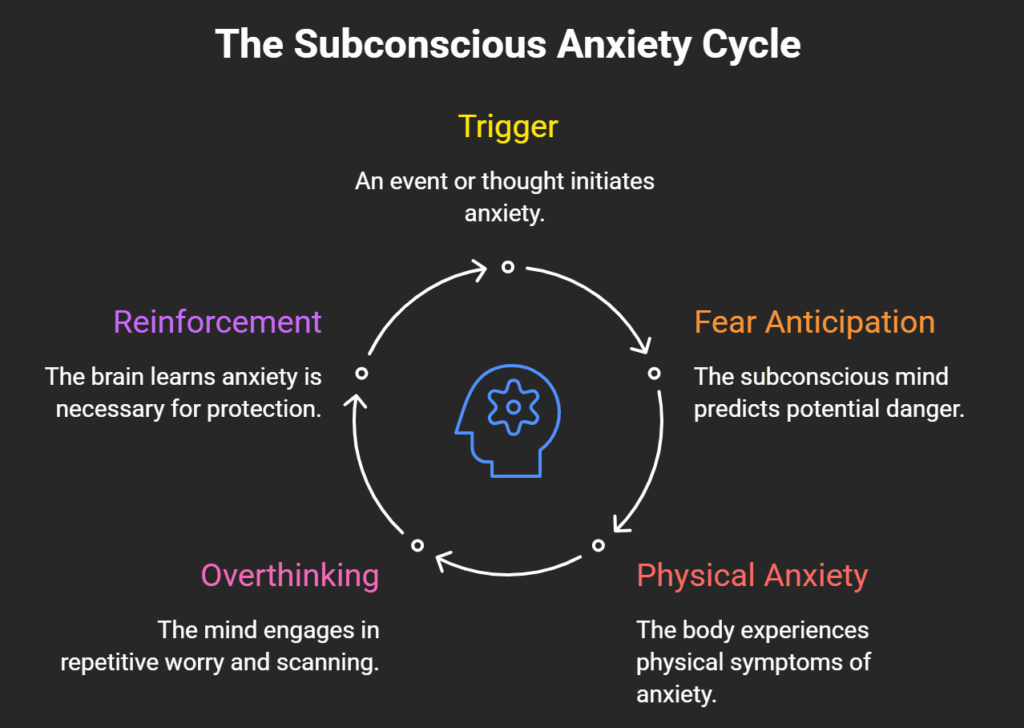
The Subconscious Anxiety Cycle
Trigger → Fear Anticipation → Physical Anxiety → Overthinking → Reinforcement
Example:
Trigger
Uncertainty
↓
Fear Anticipation
“Something bad could happen.”
↓
Physical Anxiety
Tension and nervous system activation
↓
Overthinking
Mental scanning and worry
↓
Reinforcement
Brain learns anxiety is necessary for protection
Over time the cycle strengthens automatically.
Reflection Pause
Ask yourself honestly:
- What situations trigger anxiety most often?
- Does your mind constantly anticipate problems?
- What emotional pattern repeats repeatedly?
- Does calmness feel uncomfortable sometimes?
- What fears does your mind continuously prepare for?
Awareness helps separate present reality from subconscious anticipation.
How Anxiety Quietly Shapes Daily Behavior
Subconscious anxiety does not only affect how you feel. It also influences how you behave, often without you realizing it.
Many people assume they are simply being careful, responsible, or perfectionistic. In reality, these behaviors may be quiet attempts to reduce anxiety or regain a sense of control.
Common signs include:
- overpreparing for situations
- procrastinating difficult tasks
- avoiding uncomfortable conversations
- checking messages repeatedly
- seeking constant reassurance
- struggling to make decisions
- people pleasing to avoid conflict
- overthinking small interactions
These behaviors often provide temporary relief.
But over time, they teach the brain that these protective habits are necessary to stay safe. As a result, the anxiety cycle becomes stronger instead of weaker.
This is one reason subconscious anxiety can feel so persistent. The brain begins repeating behaviors that reduce discomfort in the short term but reinforce fear in the long term.
The goal is not to criticize yourself for these patterns.
The goal is to recognize them.
Because once a pattern becomes visible, it becomes much easier to change.
How to Reduce Subconscious Anxiety
Subconscious anxiety usually does not disappear overnight.
Because it develops through repetition, it is often reduced through repetition as well. Small, consistent changes are usually more effective than trying to force yourself to stop feeling anxious.
-
Notice Repetitive Fear Patterns
Pay attention to:
- recurring worries
- repeated assumptions
- emotional triggers
- predictable fears
Patterns reveal what your subconscious mind has learned to expect.
-
Question Automatic Thoughts
When anxiety appears, gently ask yourself:
“Is my mind responding to what is happening now, or to what it expects might happen?”
This small pause helps interrupt automatic fear patterns.
-
Calm Your Nervous System
Constant stimulation can keep the brain in a state of alertness.
Reducing excessive scrolling, information overload, chronic stress, and poor sleep gives your nervous system more opportunities to feel safe again.
-
Create Repeated Experiences of Safety
The subconscious mind learns through experience.
Every time you respond calmly, set a healthy boundary, or tolerate uncertainty without avoiding it, you teach your brain that not every situation is dangerous.
-
Reinforce New Emotional Patterns
Long-term change happens through repetition.
As healthier thoughts, behaviors, and emotional responses are repeated, your subconscious mind gradually begins treating them as the new normal.
If you want to learn more about changing deeply learned mental patterns, continue with How to Reprogram Your Subconscious Mind.
Do Affirmations Actually Help Anxiety?
Affirmations alone are not magic.
But repeated emotionally believable thoughts can gradually influence:
- subconscious expectations
- emotional patterns
- self-perception
The key is:
repetition + emotional realism.
Unrealistic affirmations often create internal resistance.
If you want a grounded explanation, Do Affirmations Really Work on Your Subconscious? explores this more deeply.
Final Thoughts
Subconscious anxiety is not a sign that you are weak or broken.
It is often the result of emotional patterns, repeated stress, and a nervous system that has learned to stay alert.
That is why you can feel anxious even when life seems calm or when you cannot identify a clear reason.
The encouraging part is that learned patterns are not permanent.
As you become more aware of your triggers, thoughts, and automatic reactions, you give your subconscious mind new experiences to learn from.
Change rarely happens through one moment of motivation.
It happens through small moments of awareness repeated over time.
And that is where lasting emotional change begins.