The Hidden Causes of a Negative Mindset
Negative thinking rarely appears randomly. There are usually deeper emotional roots underneath it.
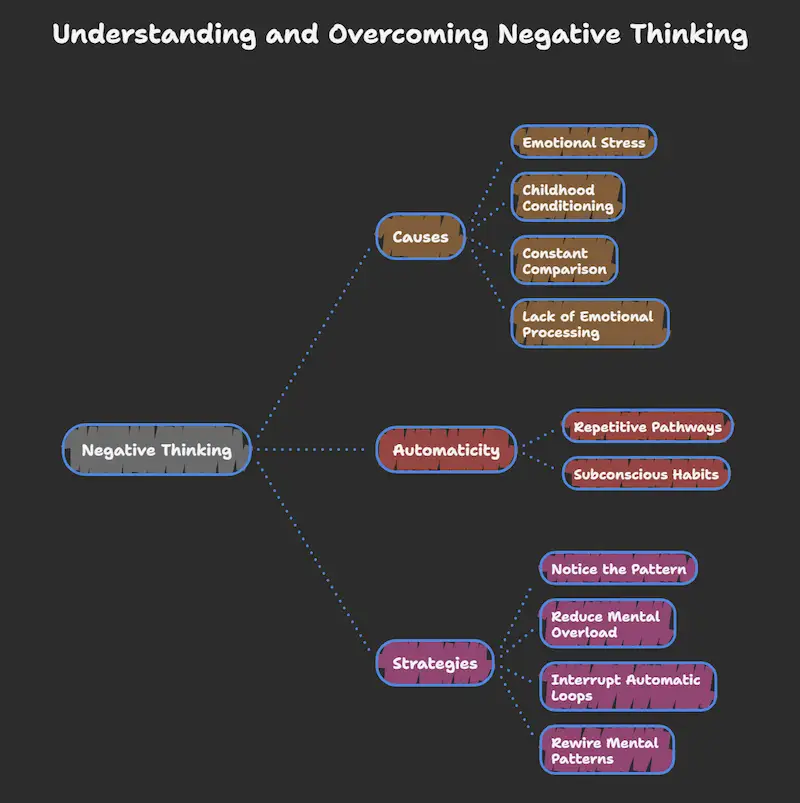
1. Emotional Stress
When your nervous system stays under constant stress for too long:
- the brain scans for danger more often
- overthinking increases
- emotional exhaustion grows
The mind becomes hyper alert.
2. Childhood Conditioning
Some people grew up around:
- criticism
- unpredictability
- emotional instability
- fear based environments
As adults, their minds stay mentally prepared for problems because it learned to see uncertainty as emotionally unsafe.
3. Constant Comparison
Social media and comparison culture quietly train the brain to focus on:
- personal flaws
- feeling not good enough
- fear of falling behind
Over time this creates chronic dissatisfaction.
4. Lack of Emotional Processing
Many people suppress emotions instead of processing them.
But unprocessed emotions often return as:
- disturbing thoughts
- irritability
- overthinking
- mental negativity
Real Life Examples of the Negativity Loop
Relationship Overthinking
Someone takes longer than usual to reply to your message. Consciously, you know, “They’re probably busy.”
But your mind instantly creates:
- rejection stories
- fear scenarios
- emotional assumptions
Why?
Because the subconscious brain often prioritizes emotional protection over logic.
Fear of Failure
A person wants to start something meaningful:
- a business
- a new routine
- a healthier life
But before starting, their mind floods with:
- “What if I fail?”
- “What if people judge me?”
- “What if I embarrass myself?”
The negativity feels personal. But often it is simply the brain trying to avoid emotional discomfort.
Negative thoughts often feel true because fear makes them feel urgent and convincing
The Relationship Between Overthinking and the Subconscious Mind
Many negative thoughts are not fully conscious decisions. They are repeated subconscious patterns.
Your subconscious mind stores:
- emotional memories
- fears
- repeated reactions
- learned beliefs
And once certain thinking styles repeat long enough, they become automatic mental habits.
That is why awareness matters.
If you have not yet explored this deeply, read
What Is the Subconscious Mind? Meaning, Examples, and How It Works
Why Positive Thinking Alone Usually Fails
This is where many self-help approaches become unrealistic.
People are told, “Just think positively.”
But if your nervous system still expects danger then forced positivity often feels fake.
Real change happens when:
- awareness increases
- emotional patterns are understood
- subconscious habits are interrupted gradually
Not through pretending everything is fine.
The Negative Thought Loop Framework
Here is a simple framework to understand how overthinking habits form.
The Negative Loop
Trigger
A situation creates uncertainty or emotional discomfort
↓
Automatic Interpretation
The mind predicts worst-case outcomes
↓
Emotional Reaction
Fear, stress, anxiety, shame
↓
Repetitive Thinking
Over analysis and mental replay
↓
Reinforcement
The brain learns to repeat the pattern faster next time
This loop strengthens with repetition.
But awareness interrupts it.
Why My Mind Is Always Thinking Negative Thoughts
If you feel like your mind is trapped in a constant loop of worst case scenarios, criticism, or anxiety, it is easy to assume something is fundamentally wrong with your character. However, from a behavioral psychology perspective, a persistently negative mind is usually just an overactive survival mechanism.
Your brain’s primary evolutionary directive is not to keep you happy, it is to keep you alive.
To do that, it constantly scans your environment for threats, a pattern known as a negativity bias.
When you experience prolonged stress or emotional conditioning, your subconscious mind begins to mistake routine daily challenges for existential dangers.
It defaults to negative thinking as a misguided way to shield you from being caught off guard.
Breaking out of this loop requires moving away from self blame and practicing mindful, grounded observation.
By recognizing these negative patterns as outdated survival responses rather than absolute truths, you can begin to gently retrain your mind to perceive safety.
Four Steps to Stop Negative Thinking Naturally
You do not stop negative thinking by fighting every thought. That usually creates more mental tension.
Instead, focus on changing your relationship with the pattern itself.
Step 1: Notice the Pattern Without Immediately Believing It
Negative thoughts often feel factual. But thoughts are not always reality.
Practice noticing:
- “My mind is predicting again.”
- “This is fear speaking.”
- “This is a familiar loop.”
Awareness creates separation.
Step 2: Reduce Mental Overload
An overstimulated brain becomes more reactive.
Pay attention to:
- excessive scrolling
- emotional content overload
- sleep deprivation
- chronic stress
- constant multitasking
Mental exhaustion intensifies negativity.
According to National Institute of Mental Health, chronic stress can significantly affect emotional regulation and cognitive patterns.
Step 3: Interrupt Automatic Thought Loops
Create small pauses during overthinking moments.
Examples:
- take a short walk
- slow breathing intentionally
- write thoughts down
- redirect attention physically
The goal is not suppression.
It is interruption.
Step 4: Rewire Repeated Mental Patterns
Your brain changes through repetition.
Small repeated shifts matter:
- calmer self talk
- reduced catastrophizing
- healthier routines
- emotional honesty
- intentional reflection
That is how thinking patterns gradually change.
Your mind is not your enemy. It is repeating what it learned would keep you emotionally safe.
If you want practical rewiring strategies, continue with
How to Rewire Your Thinking Patterns: Step-by-Step
Reflection Questions for Daily Self Check
Pause for a moment and ask yourself:
- What situations trigger my negativity most often?
- Which fears repeat constantly in my thinking?
- What emotional pain may my mind still be protecting me from?
- Which thoughts feel automatic rather than intentional?
- What would emotional safety feel like for me?
These questions matter more than temporary motivation.
Small Awareness Actions
- Notice one repetitive negative thought today
- Reduce one overstimulating habit
- Pause before spiraling into overthinking
- Journal emotional triggers honestly
- Spend 10 quiet minutes without distraction
Small awareness creates mental change slowly.
A Common Misconception About Negative Thinking
Many people think, “If my thoughts are negative, my personality must be negative.”
Not necessarily.
Thought patterns are often conditioned responses. And conditioned responses can change.
What you repeatedly think, feel, and focus on gradually shapes your brain.
That means your current thinking style is not necessarily your permanent identity or in simpler words, the way you think right now does not define who you will always be.
Final Thoughts
If your mind feels stuck in negativity, it does not always mean something is wrong with you. Often, your brain is repeating old protective patterns it learned over time. Although this realization still does not make the experience easy yet it makes it understandable.
And understanding changes everything.
Because once you begin recognizing:
- automatic overthinking
- subconscious fear patterns
- emotional conditioning
You stop believing that every thought your mind produces defines you. And that awareness becomes the beginning of real mental change.
To continue learning how repetitive mental patterns are rewired, read
How to Rewire Your Thinking Patterns: Step-by-Step
Continue Your Journey
Negative thinking is only one part of the bigger picture. These articles will help you understand the deeper mental patterns that shape the way you think and respond.
Why You Keep Thinking the Same Thoughts
What Is the Subconscious Mind? Meaning, Examples, and How It Works
How to Rewire Your Thinking Patterns: Step-by-Step
Frequently Asked Questions
Why is my mind always negative and overthinking?
Negative thinking often develops through stress, emotional conditioning, fear, and repeated overthinking habits. The brain naturally focuses on potential threats as part of its survival system.
Can negative thinking become a habit?
Yes. Repeated thought patterns strengthen neural pathways over time, making certain mental reactions feel automatic and subconscious.
How do I stop negative thinking naturally?
Start with awareness. Notice repetitive thought loops, reduce overstimulation, improve emotional regulation, and gradually interrupt automatic overthinking patterns.
Is negative thinking caused by anxiety?
Sometimes. Anxiety can intensify overthinking and negative predictions because the brain stays hyper-alert for possible danger or uncertainty.
Why does my brain focus on worst case scenarios?
The brain has a natural negativity bias designed to prioritize safety and survival. Emotional stress and past experiences can strengthen this tendency further.
Why am I so negative all the time?
Constant negativity is often linked to repeated thought habits, chronic stress, emotional conditioning, or a brain that has become highly focused on potential threats. It doesn’t necessarily mean you’re a negative person—it often means your mind has learned to stay on high alert.