

You may already know your thoughts are unhealthy.
Yet somehow, they keep returning.
The same:
- worries
- fears
- assumptions
- worst-case scenarios
- self-critical thoughts
- repetitive mental loops
continue repeating automatically.
Many of these recurring thoughts are known as automatic negative thoughts. They appear quickly, often without conscious awareness, and quietly shape how you interpret yourself, other people, and everyday situations.
Even when part of you consciously wants to think differently.
That is what makes negative thinking patterns emotionally exhausting.
You may tell yourself:
“I should stop thinking this way.”
But your mind keeps returning to the same mental pathways again, making you wonder how to change thinking patterns that seem impossible to control.
This happens because thinking patterns eventually become:
- conditioned mental habits.
And the brain naturally repeats familiar pathways automatically.
The good news is that these patterns are not permanent. Thanks to the brain’s ability to adapt through repetition, it is possible to gradually begin rewiring your brain and replacing old mental habits with healthier ways of thinking.
According to neuroplasticity research hosted by the National Institutes of Health, repeating the same thoughts, feelings, and behaviors systematically increases synaptic connectivity, physically strengthening the neural networks behind our habits.
If you already read Why You Keep Thinking the Same Thoughts: Break the Loop, you already understand how repetitive thought loops quietly reinforce emotional distress and subconscious conditioning.
Why Thinking Patterns Become Automatic
Thinking patterns become automatic when the brain repeatedly reinforces the same emotional responses, interpretations, and mental pathways over time. Through repetition, the brain strengthens familiar thought loops and begins triggering them subconsciously.
The brain constantly searches for:
- efficiency
- prediction
- familiarity
So repeated thoughts eventually become:
default mental pathways.
This means your mind begins reacting automatically through:
- learned interpretations
- emotional expectations
- conditioned mental habits
without fully conscious awareness.
The Brain Repeats Familiar Mental Paths
This is important to understand.
The brain does not automatically distinguish between:
- helpful thinking
and - harmful thinking.
It mainly notices:
repetition.
So if someone repeatedly thinks:
- “Something will go wrong.”
- “I am not good enough.”
- “People will judge me.”
- “I always fail.”
those mental patterns become increasingly familiar neurologically.
Eventually the brain begins triggering them automatically.
Pause and Reflect
Sometimes your thoughts are not:
objective reality.
They are:
rehearsed mental pathways the brain learned to repeat.
Why Negative Thinking Feels So Strong
Negative thinking often becomes emotionally powerful because the brain prioritizes:
survival and threat detection.
The mind naturally pays more attention to:
- danger
- criticism
- uncertainty
- rejection
- mistakes
This is sometimes called:
negativity bias.
According to Cleveland Clinic, repeated negative thinking can strongly affect emotional wellbeing, stress levels, and behavior patterns over time.
Why Certain Thoughts Become Stronger Than Others
Not every thought becomes a thinking pattern.
The thoughts that repeat most often usually carry emotional significance.
The brain pays closer attention to thoughts connected to:
- fear
- shame
- rejection
- uncertainty
- embarrassment
- disappointment
This is why emotionally charged experiences often create the strongest mental habits.
The mind remembers what feels emotionally important.
Not simply what is logically true.
That distinction explains why some thought patterns survive for years.
A Real Life Example: Social Overthinking
Someone sends a message and receives no reply for several hours.
Immediately the mind begins:
- imagining rejection
- replaying conversations
- expecting something negative
- assuming they did something wrong
Logically they may know:
“There are many possible explanations.”
But the brain automatically activates:
familiar emotional thinking patterns.
Another Way This Often Appears: Failure Expectations
A person repeatedly tells themselves:
“I probably won’t succeed anyway.”
Eventually they begin:
- avoiding opportunities
- procrastinating
- expecting disappointment automatically
The thought pattern slowly shapes:
- behavior
- confidence
- emotional reactions
This is how thinking patterns quietly influence daily life.
The Connection Between Thoughts and Emotions
Thoughts do not exist separately from emotions.
Repeated thinking patterns influence:
- nervous system activation
- emotional responses
- stress levels
- behavior
- self perception
For example:
Thought
“I will fail.”
↓
Emotion
Anxiety
↓
Behavior
Avoidance or procrastination
↓
Reinforcement
Brain associates fear with the situation
Over time the cycle strengthens.
One Misconception About Positive Thinking
Many people believe rewiring the mind means:
forcing positivity constantly.
That usually backfires.
Because unrealistic positivity often creates:
- internal resistance
- emotional suppression
- self judgment
Healthy mindset change is not:
pretending negative emotions do not exist.
It is learning:
more balanced and conscious thinking patterns.
How to Change Automatic Negative Thoughts
Many negative thinking patterns begin as automatic negative thoughts. These are quick, habitual thoughts that appear without conscious effort, often shaping how you interpret yourself, other people, and everyday situations.
For example, you might automatically think:
- “I’m going to fail.”
- “They must be judging me.”
- “Nothing ever works out for me.”
Because these thoughts happen so quickly, they often feel like facts rather than assumptions.
One of the most effective ways to change them is through a psychological technique called cognitive restructuring.
Cognitive restructuring is the process of identifying and gradually changing distorted or unhelpful thinking patterns.
It helps you:
- challenge automatic assumptions
- interrupt negative thought loops
- create more balanced interpretations
- reduce emotional reactivity
Rather than forcing yourself to think positively, cognitive restructuring encourages you to question whether your automatic thoughts are completely accurate and replace them with more realistic, balanced perspectives.
Common Thinking Distortions to Notice
Automatic negative thoughts often follow predictable patterns known as cognitive distortions. These are mental shortcuts that make a situation appear more negative, threatening, or certain than it really is.
Common examples include:
- All-or-nothing thinking: Seeing something as a complete success or total failure.
- Catastrophizing: Assuming the worst possible outcome will happen.
- Mind reading: Believing you know what someone else thinks without clear evidence.
- Overgeneralizing: Turning one difficult experience into a broad rule about your life.
- Emotional reasoning: Assuming something must be true because it feels true.
Recognizing the pattern helps you create distance from the thought.
Instead of immediately believing, “I always fail,” you can begin noticing, “This may be all-or-nothing thinking rather than the complete truth.”
This approach is widely used in cognitive behavioral therapy (CBT) because our thoughts strongly influence our emotions and behavior.
Why Your Brain Keeps Returning to Old Thoughts
Because old thought patterns are:
neurologically efficient.
The brain prefers familiar pathways because they require:
- less effort
- less uncertainty
- predictable emotional responses
This is why changing thought patterns initially feels:
- uncomfortable
- unnatural
- mentally difficult
The brain is adapting to unfamiliar mental pathways.
How Thinking Patterns Become Part of Your Identity
Many people assume thoughts are temporary.
But repeated thoughts often become something deeper.
Over time, the mind stops saying:
“I am having this thought.”
And starts saying:
“This is who I am.”
Examples:
- “I am an anxious person.”
- “I am a negative thinker.”
- “I always overthink.”
- “I lack confidence.”
At that point, the pattern is no longer just a thought.
It has become part of self-perception.
The subconscious mind begins looking for evidence that supports that identity.
Thoughts reinforce identity.
Identity reinforces thoughts.
And the cycle becomes self-sustaining.
This is one reason changing thinking patterns often requires more than changing thoughts.
It requires changing the story you believe about yourself.
How the Subconscious Mind Reinforces Thinking Patterns
Many people assume thoughts create themselves.
But the subconscious mind quietly strengthens patterns through repetition.
Every time a familiar thought appears and receives attention, emotional energy, or mental rehearsal, the subconscious mind treats it as important information.
Over time, repeated thoughts become:
- easier to access
- faster to activate
- more automatic
This is one reason certain worries seem to appear instantly.
The subconscious mind has practiced them repeatedly.
If this feels familiar, 10 Subconscious Behaviors You Didn’t Realize Control You explores how automatic mental patterns quietly influence everyday behavior.
Reflection Pause
Ask yourself honestly:
- Which thoughts repeat most often?
- What emotional state usually triggers them?
- Are your thoughts helping you or protecting old fears?
- Which assumptions feel automatic in your mind?
- What mental story keeps replaying daily?
Awareness weakens automatic thinking patterns.
How to Change Thinking Patterns Step by Step
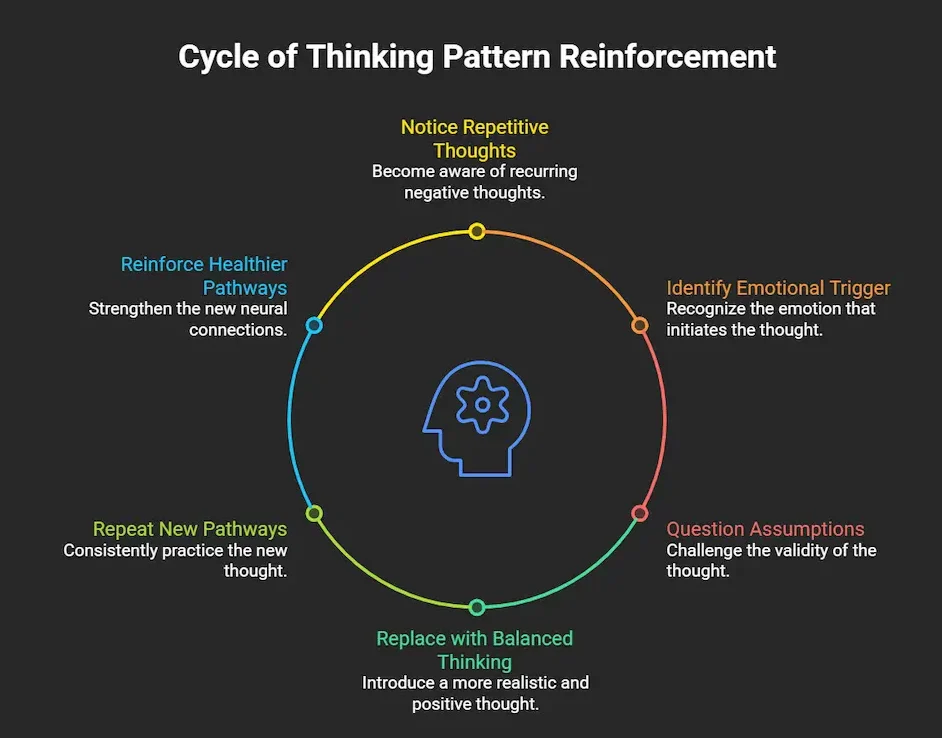 The Cycle of Thinking Pattern Reinforcement: A 6-step cognitive framework to systematically rewrite automatic mental loops.
1. Notice Repetitive Thoughts Earlier
Start observing:
- recurring fears
- automatic assumptions
- self critical narratives
- worst case thinking
Awareness creates interruption.
Without awareness:
thoughts continue automatically.
2. Identify the Emotional Trigger
Many thought loops begin after:
- uncertainty
- rejection
- criticism
- stress
- emotional discomfort
The trigger matters as much as the thought itself.
3. Question Automatic Assumptions
Most negative thoughts appear so quickly that they feel like facts instead of interpretations.
Instead of immediately accepting them, pause and ask a few simple questions:
- Is this thought completely true?
- What evidence actually supports it?
- What evidence challenges it?
- Am I assuming the worst without proof?
- How would I view this situation if a friend were experiencing it instead?
The goal is not to force positive thinking.
The goal is to replace automatic reactions with more balanced and realistic thinking.
For example:
Automatic thought: “I made one mistake. I’m terrible at this.”
Balanced thought: “I made a mistake, but one mistake doesn’t define my ability. I can learn from it and improve.”
Each time you challenge an automatic thought instead of accepting it as truth, you weaken the old mental pathway and strengthen a healthier one.
Over time, this repeated process helps your brain respond differently to familiar situations.
4. Replace Extreme Thinking With Balanced Thinking
Instead of:
“Everything is ruined.”
try:
“This situation is difficult, but not permanent.”
Balanced thoughts feel more believable to the brain than forced positivity.
5. Repeat New Mental Pathways Consistently
The brain changes through:
repetition.
One new thought does not rewire the mind instantly.
Repeated mental practice matters.
This is how neuroplasticity works psychologically.
How Long Does It Take to Rewire Thinking Patterns?
There is no exact timeline because every thinking pattern develops differently.
Some unhelpful thought patterns formed over months, while others have been reinforced for many years. The longer a pattern has been repeated, the more familiar it becomes to the brain.
The encouraging news is that the brain remains capable of change throughout life through a process known as neuroplasticity. Every time you interrupt an old thought pattern and choose a healthier response instead, you strengthen a different neural pathway.
Progress usually happens gradually rather than all at once.
You may first notice that negative thoughts still appear, but they no longer feel as convincing. Later, you may catch them earlier, recover more quickly, and eventually respond differently without needing as much conscious effort.
The goal is not to erase every negative thought.
The goal is to make healthier thinking your brain’s new default over time.
How to Rewire Your Brain and Change Thinking Patterns
Changing your thinking patterns is not about forcing positive thoughts. It is about teaching your brain a different response through repeated practice.
Most lasting change follows the same psychological process:
Awareness
↓
Notice an automatic negative thought.
Interruption
↓
Pause before reacting or accepting it as true.
Replacement
↓
Choose a more balanced and realistic interpretation.
Repetition
↓
Practice responding this way whenever the old thought returns.
Reinforcement
↓
Over time, the brain strengthens healthier mental pathways until they begin to feel more natural.
This process is how repeated practice gradually changes automatic mental habits.
The Thought Identity Loop
Thinking patterns rarely stay as thoughts.
When they repeat often enough, they begin shaping how you see yourself.
The cycle often looks like this:
Thought
↓
Emotion
↓
Behavior
↓
Evidence
↓
Belief
↓
Thought
For example:
“I’ll fail.”
↓
Anxiety
↓
Avoid trying
↓
Missed opportunity
↓
“I knew I wasn’t capable.”
↓
The original thought feels even more true.
Over time, this cycle becomes automatic because the brain keeps collecting evidence that supports the beliefs it already holds.
Breaking the loop means changing both your thinking and the small actions that reinforce those thoughts. Each healthier action gives your brain new evidence that a different story may also be true.
Why Environment Shapes Thinking Patterns
Many people assume their thinking patterns come entirely from within.
In reality, your surroundings constantly influence how you think and feel.
Certain environments, people, routines, and even specific places can trigger familiar mental patterns without you realizing it.
For example:
- checking work emails may trigger anxiety
- scrolling social media may trigger comparison
- returning to a stressful environment may activate old beliefs
- spending time with highly critical people may reinforce self-doubt
These cues remind the brain of past experiences, making old thinking patterns easier to repeat.
Changing your environment alone will not completely change your thinking.
However, reducing unnecessary triggers while creating healthier daily routines makes it easier to practice new mental habits.
Sometimes changing the environment is the first step toward changing the mind.
Why Thought Loops Keep Returning
Many people become discouraged because old thoughts return even after making progress.
This is completely normal.
A familiar thought returning does not mean you have failed.
It simply means your brain is revisiting a pathway it has used many times before.
Each time you notice the thought without automatically believing it, you weaken the old pattern and strengthen a healthier response instead.
Progress is not measured by never having negative thoughts again.
It is measured by how quickly you recognize them, challenge them, and return to a more balanced perspective.
Over time, those healthier responses begin happening with less conscious effort.
If repetitive mental loops still feel overwhelming, How to Break Toxic Thought Loops: Even If You Tried Before explores this more deeply.
Daily Habits That Help Change Thinking Patterns
1. Reduce Mental Overstimulation
Constant stimulation increases:
- mental noise
- anxiety
- reactive thinking
2. Journal Repetitive Thoughts
Writing creates:
- awareness
- pattern recognition
- emotional clarity
3. Practice Cognitive Pauses
Even brief pauses weaken automatic thought reinforcement.
4. Strengthen Emotionally Safe Habits
Sleep, movement, and emotional regulation influence thinking patterns strongly.
5. Reinforce New Thinking Repeatedly
The brain learns through consistency.
Not occasional motivational moments.
If you want practical exercises for daily mindset rewiring, continue with 3 Simple Ways to Rewire Your Brain for Positive Thinking.