

Sometimes an identity crisis does not arrive loudly. It begins quietly.
You wake up one morning and realize:
- your routines feel empty
- your goals no longer excite you
- your reactions feel unfamiliar
- even your relationships feel emotionally distant
You are functioning externally, but internally something feels disconnected. And that feeling can be deeply unsettling.
While everyone experiences it differently, the early signs of an identity crisis often begin as a quiet internal shift.
An identity crisis is not always a sign that your life is falling apart. Sometimes it reflects the tension between who you were and who you are becoming.
What Is an Identity Crisis?
An identity crisis is a period of deep confusion in which you feel disconnected from your sense of self, values, purpose, beliefs, or direction in life. It can leave you questioning who you are, what matters to you, and whether the life you are living still feels like your own.
Identity crises often develop during major life changes, emotional stress, personal growth, relationship shifts, career transitions, or long periods of internal dissatisfaction.
The term was originally developed by psychologist Erik Erikson, who studied how identity develops across different stages of life.
What Does an Identity Crisis Feel Like?
If you are trying to understand what an identity crisis feels like in everyday life, many people describe the experience as:
- feeling lost in life
- identity confusion
- emotional numbness
- lack of purpose
- not knowing who they are anymore
But here is something important:
Although it feels deeply uncomfortable, an identity crisis can also be the beginning of a healthier and more authentic sense of self.
If you have recently been questioning yourself deeply, you may also relate to
How to Reinvent Yourself: Without Faking It
Why Do You Feel Lost in Life and Confused?
Most people think identity confusion appears suddenly. It usually does not. It builds slowly through repeated emotional disconnection.
You adapt.
You perform.
You survive.
You become what life demands.
And eventually, you stop checking whether that version still feels like you.
The Hidden Habit Behind Identity Confusion
Many people unknowingly build identities around:
- pleasing others
- avoiding rejection
- staying emotionally safe
- meeting expectations
- surviving stress
Over time, these protective patterns can become automatic. Repeated thoughts, emotional responses, and coping behaviors strengthen familiar mental pathways, making old reactions easier to repeat.
You may stop choosing consciously and begin functioning through an outdated survival script. That is why an identity crisis can feel so confusing. You are not only questioning your future. You are questioning the personality you built to survive your past.
Sometimes the hardest part is not feeling lost.
It is realizing that you may have been disconnected from yourself for years.
Signs You May Be Going Through an Identity Crisis
Common identity crisis symptoms can include:
- You no longer feel connected to your goals.
- Your personality feels inconsistent or unfamiliar.
- You constantly compare yourself to others.
- You feel emotionally tired without understanding why.
- You experience a loss of identity or lack of daily purpose.
- You feel disconnected in relationships.
- You keep asking, “What am I doing with my life?”
- Your routines feel meaningless.
- You secretly feel as though you are pretending.
An identity crisis can easily trigger anxiety, emotional exhaustion, and chronic overthinking. Clinical insights from the Cleveland Clinic highlight that when these stressful, self-critical internal loops are left unaddressed, they warp our self-perception and compromise our long-term mental well-being.
The Relationship Impact Nobody Talks About
Identity confusion rarely stays internal. It affects relationships too.
When you do not fully understand yourself:
- communication becomes harder
- emotional reactions become inconsistent
- resentment builds silently
- isolation increases
You may notice:
- withdrawing emotionally
- becoming unusually irritable
- needing constant reassurance
- feeling unseen even around people you love
Not because people do not care. But because you no longer feel connected to yourself.
When your sense of identity weakens, emotional stability can weaken as well.
Why an Identity Crisis Often Happens After Growth (And Success)
An identity crisis is not always caused by failure. It can also appear after growth, success, or the achievement of a long-term goal.
For years, you may have known yourself as the person who was striving, building, proving, or overcoming. That pursuit gave your life structure and gave your identity a clear role.
But when the goal is finally reached, the role that carried you there may no longer feel necessary. The chase ends, and an unexpected emotional emptiness can appear.
You may begin wondering:
“Who am I now that I am no longer working toward the thing that defined me?”
This does not mean success was a mistake. It means your external life changed faster than your internal sense of self.
Your old identity helped you reach one stage of life. Now your mind is trying to understand who you are becoming next.
If you reached an important milestone but still felt empty afterward, you are not broken. The identity that helped you pursue the goal may simply no longer fit the life you have entered.
Read next: The Real Reason You Sabotage Your Own Success
What This Can Look Like in Real Life
- The Validation Loop: A woman spends years being “the responsible one.” She sacrifices her needs, takes care of everyone, and never complains. People praise her constantly, but privately, she feels emotionally invisible. One day she suddenly feels exhausted by her own life, not because she is weak, but because her identity was built entirely around external validation. Her exhaustion came from losing connection with herself beneath the role she carried.
- The Achievement Void: A man spends years chasing career success. He achieves what he once wanted, but after reaching it, he feels entirely empty. Why? Because the identity driving him was built around proving his worth to the world, rather than understanding himself. An identity crisis often begins when achievement no longer distracts you from internal disconnection. Success changes your external reality, but it does not automatically upgrade your subconscious self image.
The Identity Crisis Loop
Here is a simple framework for understanding how protective roles can gradually lead to an identity crisis.
1. Emotional Experience
Pain, rejection, pressure, loneliness, insecurity
↓
2. Protective Identity Forms
People pleaser, achiever, perfectionist, caretaker
↓
3. Repeated Behaviors
Automatic habits reinforce identity
↓
4. Emotional Disconnection
You lose connection with your authentic needs
↓
5. Identity Crisis
You no longer recognize yourself emotionally. This is why identity change is deeper than motivation. It involves rebuilding internal patterns.
These patterns also explain why changing behavior can feel difficult when your deeper identity remains unchanged. Read You Don’t Change Habits: You Change Identity First to understand why lasting change often begins with the way you see yourself.
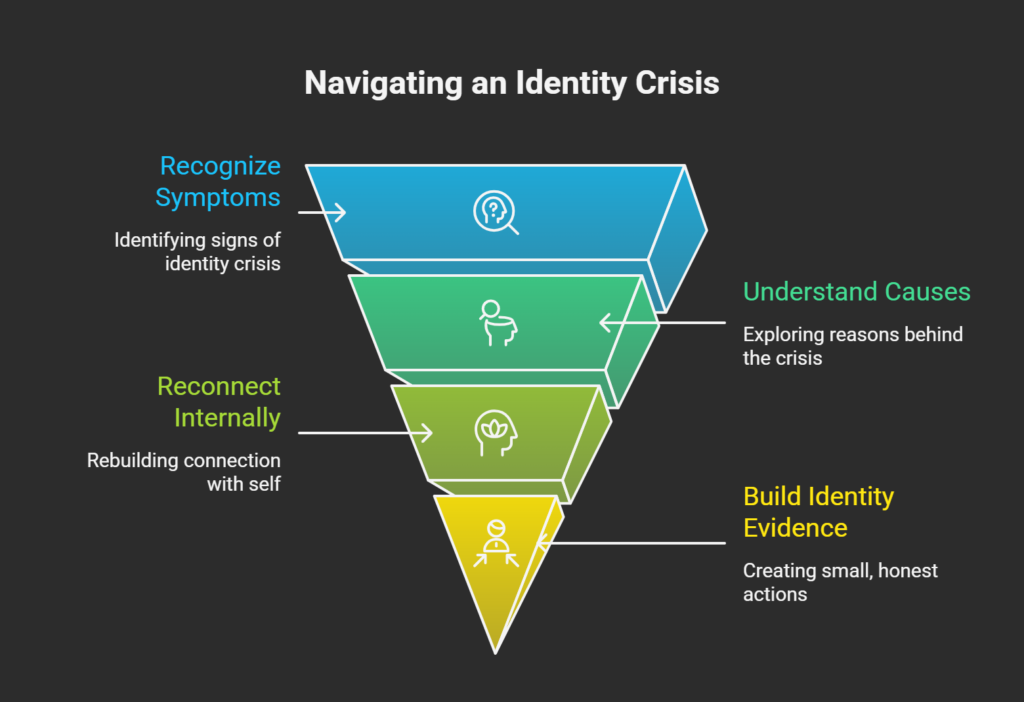
How to Solve an Identity Crisis (And Find Yourself Again)
This is the part most people rush. But rebuilding identity is not about inventing a fake “new you.”
It is about reconnecting with what already feels true underneath survival patterns.
Step 1: Stop Forcing Immediate Answers
People panic during identity confusion because they want certainty instantly.
But clarity usually comes after observation, not before it. Instead of asking:
“Who am I supposed to become?”
Ask:
“What feels emotionally honest lately?”
That question changes everything.
Step 2: Notice Your Automatic Roles
Pay attention to:
- who you become around different people
- what behaviors feel performative
- where you constantly seek approval
- where you silence yourself
Identity patterns often hide inside relationships and routines.
Step 3: Reconnect With Internal Signals
Many people experiencing an identity crisis have become disconnected from:
- emotional needs
- physical signals
- personal preferences
- intuition
Start rebuilding awareness slowly:
- journaling
- quiet walks
- reduced overstimulation
- intentional solitude
Research from Harvard Health Publishing suggests self reflection and emotional awareness improve long term psychological resilience and emotional regulation.
Step 4: Build Small Identity Evidence
Affirmations may inspire change, but evidence is what makes the mind believe it. Instead of saying:
“I am confident.”
Create evidence:
- speak honestly once
- set one boundary
- follow through on one promise
- make one aligned decision
Small actions rebuild self trust.
If you feel emotionally stuck in old patterns, read:
How to Change Your Identity When You Feel Stuck
You do not rediscover yourself in one dramatic breakthrough.
You reconnect through repeated moments of honesty.
A Common Misconception About Identity Crises
Many people think, “If I feel lost, something must be wrong with me.” Not necessarily.
Sometimes confusion is a transition phase between:
- who you were conditioned to be
and - who you are becoming consciously
That in between stage feels unstable because certainty is disappearing before clarity fully forms.
But uncertainty is often part of growth.
Reflection Questions
Pause for a moment and ask yourself:
- Which parts of my personality feel genuine?
- Which parts feel performative?
- Where do I abandon myself most often?
- What version of me feels emotionally exhausted?
- What would honesty look like in my life right now?
Do not rush these questions. Let them sit.
You may also realize that some parts of your identity were shaped so gradually that you never consciously chose them. To explore that process more deeply, read Why You Don’t Know Yourself as Well as You Think.
Small Actions That Help During an Identity Crisis
Awareness Actions
- Spend 10 minutes each day without distraction.
- Journal about recurring emotional patterns.
- Reduce social media content that fuels comparison and self-doubt.
- Notice when you automatically seek approval.
- Make one small, honest decision each day.
Identity clarity grows through awareness, not pressure.
Final Thoughts
An identity crisis can feel deeply unsettling because it shakes the internal story you once depended on.
But feeling lost does not mean something is wrong with you.
Often, it means your mind is beginning to recognize that your current identity no longer fully aligns with your emotional reality. And while that process can feel confusing and uncomfortable, it can also become the beginning of a more conscious and authentic life.
The goal is not to become someone else. It is to reconnect with the person you were underneath years of survival patterns.
If you are ready to understand how identity shifts actually happen psychologically, continue with
How to Reinvent Yourself: Without Faking It
Continue Your Journey
If this article helped you understand why you feel lost, these guides will help you rebuild a stronger sense of self.
1. How to Reinvent Yourself: Without Faking It
Discover how lasting personal change happens without pretending to be someone you’re not.
2. How to Change Your Identity When You Feel Stuck
Learn how small, consistent actions reshape the way you see yourself and create lasting identity change.
3. You Don’t Change Habits: You Change Identity First
Understand why sustainable habits begin with identity rather than motivation or willpower.
If You’re Still Trying to Understand This
What is an identity crisis?
An identity crisis is a period of deep confusion in which you feel disconnected from your sense of self, values, purpose, or direction in life. It often happens during major life changes, emotional stress, personal growth, or prolonged internal dissatisfaction.
Why do I feel lost in life and confused?
Feeling lost often happens when your external life no longer reflects your internal values, needs, or sense of identity. Major life transitions, burnout, emotional suppression, and living according to other people’s expectations can all contribute to identity confusion.
How do I find myself again after an identity crisis?
Start by slowing down instead of forcing immediate answers. Reconnect with your values, notice the roles you automatically play, and take small actions that feel honest and aligned with who you are. Finding yourself again is usually a gradual process of rebuilding self-awareness and self-trust, not reinventing yourself overnight.