

You finally start making progress.
You become:
- more consistent
- more disciplined
- more focused
- emotionally stronger
And then suddenly:
something changes.
You procrastinate.
You avoid important work.
You stop showing up consistently.
You create distractions.
You emotionally withdraw.
Sometimes the pattern becomes so repetitive that you begin asking:
“Why do I keep sabotaging myself?”
That question usually carries frustration and shame.
Because consciously:
you WANT success.
You WANT change.
Yet another part of you keeps resisting it automatically.
This contradiction confuses many people.
But self sabotage is rarely random.
And it is usually deeper than laziness or lack of motivation.
According to research from Psychology Today, self sabotaging behaviors are often connected to subconscious emotional patterns, fear responses, and protective psychological conditioning.
If you already read Why Do I Self-Sabotage? The Hidden Reasons You Keep Holding Yourself Back, you already understand how automatic emotional patterns can quietly interfere with growth.
Why Do People Self Sabotage?
Self sabotage happens when your own thoughts or behaviors repeatedly interfere with goals you genuinely want to achieve. Instead of moving you forward, these patterns quietly hold you back, often without you fully realizing it.
People self sabotage when subconscious emotional fears, limiting beliefs, identity conflicts, or protective psychological patterns create resistance against change, success, vulnerability, or uncertainty. These behaviors often operate automatically beneath conscious awareness.
Self sabotage usually appears through:
- procrastination
- inconsistency
- emotional avoidance
- perfectionism
- distraction
- withdrawal
- negative self talk
- abandoning progress
The behavior often feels irrational because:
consciously you want success.
But subconsciously:
part of the brain may associate success with:
- pressure
- exposure
- rejection
- expectations
- emotional risk
- change
And the brain naturally resists what feels emotionally threatening.
Common Examples of Self-Sabotage
Self-sabotage doesn’t always look dramatic. Most of the time, it appears through everyday behaviors that quietly interfere with your goals, relationships, or personal growth.
Common examples include:
- Procrastinating until the last minute, even when something is important.
- Quitting just as progress starts becoming visible.
- Waiting for perfect conditions before taking action.
- Constantly criticizing yourself or assuming you’ll fail.
- Avoiding opportunities because you don’t feel ready.
- Pulling away from healthy relationships when they become emotionally close.
- Creating distractions instead of facing uncomfortable tasks.
- Giving up after small setbacks instead of trying again.
Although these behaviors look different on the surface, they often serve the same purpose: protecting you from emotional discomfort, uncertainty, or the fear of change.
The Brain Prefers Familiarity Over Growth
This is one of the most important psychological truths about self sabotage.
The brain prioritizes:
familiarity.
Not transformation.
That means even unhealthy patterns can feel emotionally safer simply because they are known and predictable.
Someone may consciously want:
- confidence
- success
- healthier habits
- emotional stability
while subconsciously remaining attached to:
- familiar struggle
- emotional protection
- predictable patterns
This creates internal resistance.
Pause and Reflect
Sometimes the real problem is not:
“I don’t want success.”
Sometimes it is:
“Success feels emotionally unfamiliar.”
The Hidden Fear Behind Self Sabotage
Many people believe self sabotage means:
“I secretly hate myself.”
Not necessarily.
More often:
self sabotage functions as:
emotional protection.
The brain may fear:
- disappointment
- failure
- judgment
- visibility
- vulnerability
- losing control
- increased expectations
So when progress begins, subconscious resistance appears automatically.
Why Success Can Feel Emotionally Unsafe
Success is usually presented as something everyone wants.
But psychologically, success can also represent change.
And change creates uncertainty.
Success can also bring new expectations, greater responsibility, increased visibility, and pressure to maintain your progress. If the subconscious mind associates those changes with emotional discomfort or uncertainty, it may begin resisting the success itself rather than the goal.
For some people, success may unconsciously feel connected to:
● higher expectations
● greater visibility
● fear of disappointing others
● fear of losing relationships
● pressure to maintain results
● responsibility
The subconscious mind often prefers familiar discomfort over unfamiliar uncertainty.
That is why someone can genuinely want success while simultaneously resisting it.
The resistance is not always against success itself.
Sometimes it is against everything success appears to bring with it.
A Real Life Example: Success Suddenly Feels Heavy
Someone works hard toward a goal for months.
Eventually opportunities begin appearing.
Instead of feeling excited, they suddenly:
- procrastinate
- avoid important tasks
- stop responding
- distract themselves constantly
Why?
Because success can trigger:
- visibility
- responsibility
- pressure
- fear of failing publicly
The subconscious mind interprets these as:
emotional risk.
So resistance increases.
Another Way This Often Appears: Relationship Self Sabotage
A person deeply wants love and emotional closeness.
But once a relationship becomes emotionally serious, they:
- pull away
- overthink constantly
- create unnecessary conflict
- emotionally withdraw
Consciously they want connection.
Subconsciously vulnerability feels unsafe.
So self protective patterns activate automatically.
Why Self Sabotage Often Happens During Progress
This surprises many people.
Self sabotage often intensifies:
right before growth.
Because growth creates:
- uncertainty
- identity change
- emotional exposure
- unfamiliarity
The subconscious mind begins asking:
- “What if this changes everything?”
- “What if I fail after succeeding?”
- “What if people expect more from me now?”
The brain sometimes prefers predictable struggle over unfamiliar success.
According to Cleveland Clinic, fear based emotional patterns and low self worth can strongly influence self defeating behavior cycles.
The Connection Between Identity and Self Sabotage
Identity plays a huge role here.
If someone subconsciously believes:
- “I always fail.”
- “I am inconsistent.”
- “I don’t deserve success.”
- “I never follow through.”
then success may psychologically conflict with their identity story.
The brain seeks consistency between:
- identity
and - behavior
So old patterns quietly return.
This is why identity change matters more than temporary motivation.
When Success Conflicts With Self Worth
Sometimes the resistance is not about the goal itself.
It is about what the goal says about you.
If someone has repeated beliefs such as:
● “I am not capable.”
● “People like me don’t succeed.”
● “I always mess things up.”
● “I am not good enough.”
then progress can create internal conflict.
The subconscious mind tends to protect familiar identity stories.
So when reality begins challenging those stories, resistance often appears.
This is one reason growth can feel uncomfortable even when it is positive.
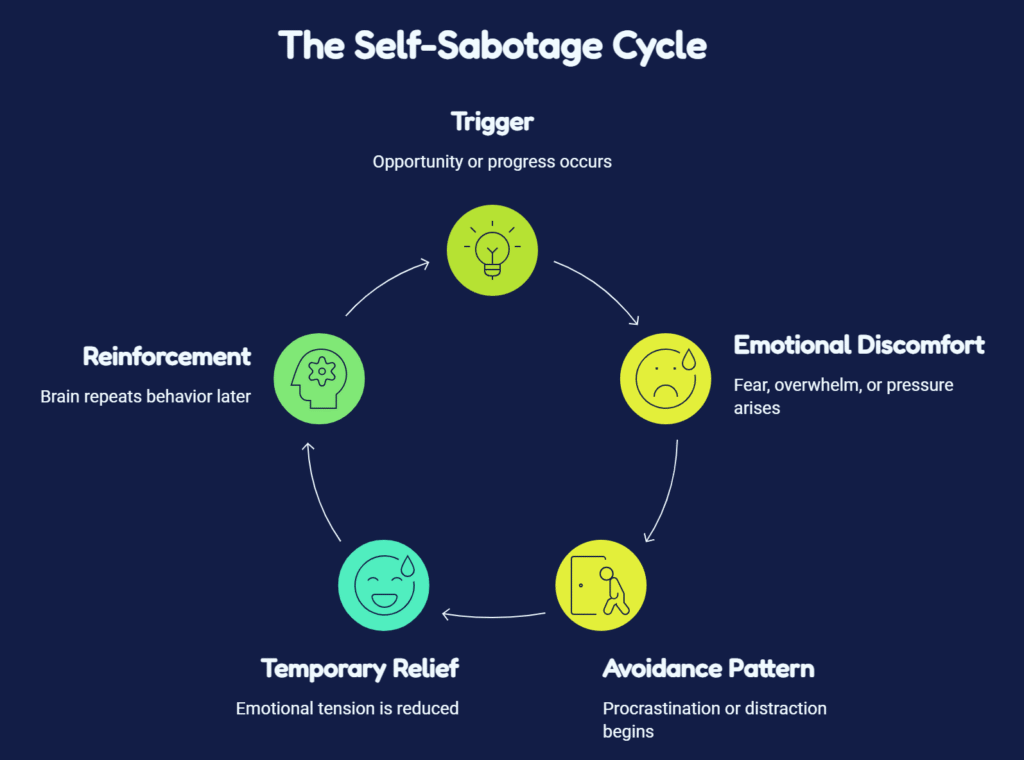
The Self Sabotage Cycle
Trigger → Emotional Discomfort → Avoidance Pattern → Temporary Relief → Reinforcement
Example:
Trigger
Opportunity or progress
↓
Emotional Discomfort
Fear, overwhelm, pressure
↓
Avoidance Pattern
Procrastination or distraction
↓
Temporary Relief
Reduced emotional tension
↓
Reinforcement
Brain repeats behavior later
Over time this becomes automatic.
One Misconception About Fear of Success
Many people think:
“Fear of success sounds ridiculous.”
But success can psychologically represent:
- visibility
- responsibility
- pressure
- social judgment
- emotional exposure
So the subconscious mind may unconsciously resist it.
This does not mean:
you do not want success.
It means part of your nervous system associates success with emotional risk.
Why Self Sabotaging Habits Feel Automatic
Because repeated avoidance eventually becomes:
conditioned behavior.
The brain learns:
discomfort → avoidance → relief
So whenever emotional discomfort appears:
the subconscious mind automatically pushes toward:
- distraction
- procrastination
- emotional escape
- familiar coping behaviors
This is why many self destruction habits repeat despite conscious awareness.
Reflection Pause
Ask yourself honestly:
● What usually happens right before progress begins falling apart?
● What feels emotionally uncomfortable about succeeding?
● What expectations appear when things start going well?
● What familiar pattern keeps repeating?
● If success became permanent tomorrow, what would feel different?
● What part of you is trying to stay safe?
Awareness often reveals fears that motivation alone cannot uncover.
How to Stop Self Sabotaging Yourself
1. Identify the Emotional Fear Underneath
The visible behavior is rarely the real problem.
Ask:
“What feels emotionally threatening about growth or success?”
That question changes everything.
2. Stop Treating Yourself Like an Enemy
Harsh self criticism often increases:
- overwhelm
- avoidance
- emotional shutdown
Understanding patterns works better than attacking yourself constantly.
3. Build Smaller Sustainable Progress
Extreme pressure often activates resistance.
Smaller consistent actions create less subconscious fear.
This helps the nervous system adapt gradually.
4. Separate Old Identity From Current Growth
Old patterns are not permanent identity.
Behavioral conditioning can change through:
- awareness
- repetition
- emotional safety
- new evidence
5. Interrupt Avoidance Earlier
Notice:
- distraction urges
- procrastination patterns
- emotional withdrawal
- perfectionism loops
before they fully take over.
Perfectionism often disguises itself as high standards, but it can become another form of avoidance when the fear of making mistakes prevents you from taking action. Progress almost always creates more growth than waiting for perfect conditions.
Small interruptions weaken automatic cycles.
If you want practical strategies for breaking these patterns, continue with How to Stop Self-Sabotaging Yourself.
Why Self Sabotage Is Not Fixed Permanently
Many people fear:
“Maybe this is just who I am.”
But self sabotage is:
learned behavior.
Not permanent identity.
The subconscious mind changes through:
- repeated emotional experiences
- safer behavioral patterns
- new self perception
- consistent reinforcement
That process takes time.
But it is possible.
How to Break the Self Sabotage Cycle for Good
Lasting change usually requires:
- awareness of triggers
- emotional regulation
- identity shifts
- behavioral consistency
- reduced nervous system overwhelm
Not motivational intensity alone.
If you want deeper long term strategies, continue with How to Break the Self Sabotage Cycle for Good.
Final Thoughts
Self sabotage is rarely about laziness or lack of desire.
It is often connected to:
- subconscious emotional conditioning
- fear based protection patterns
- identity conflict
- nervous system familiarity
- emotional avoidance
That is why people sometimes resist:
the very things they consciously want most.
The goal is not becoming perfectly fearless overnight.
The goal is understanding:
why the resistance exists. What emotional fear drives it. How awareness gradually weakens the cycle.
Sometimes people spend years fighting themselves. Trying harder. Pushing harder.
Judging themselves more harshly. Yet the pattern continues.
Not because they lack discipline.
But because they are trying to solve an emotional pattern with self criticism.
Self sabotage often begins as protection.
The mind is attempting to avoid something it perceives as unsafe.
The more clearly you understand that pattern, the less power it quietly holds over your decisions.
Because awareness does not eliminate resistance overnight.
But it does make change possible.