

Some thoughts disappear almost as quickly as they arrive.
Others seem impossible to escape.
You replay the same conversations.
You imagine the same worst-case scenarios.
You question the same decisions.
You criticize yourself in the same familiar ways.
Even when you know those thoughts are making you feel worse.
You tell yourself:
“Stop thinking about it.”
Yet minutes later, your mind quietly returns to the exact same place.
That is what makes thought loops so exhausting.
The problem is rarely that you enjoy overthinking.
The problem is that your brain has learned to return to the same mental pathway automatically.
Over time, repetitive thoughts become easier to access than new ones.
Eventually, your mind begins revisiting them without asking for permission.
If you’ve already read Why You Keep Thinking the Same Thoughts: Break the Loop, you’ve seen how repetitive thinking develops. This article focuses on what happens next—how to interrupt those loops before they quietly become your brain’s default response.
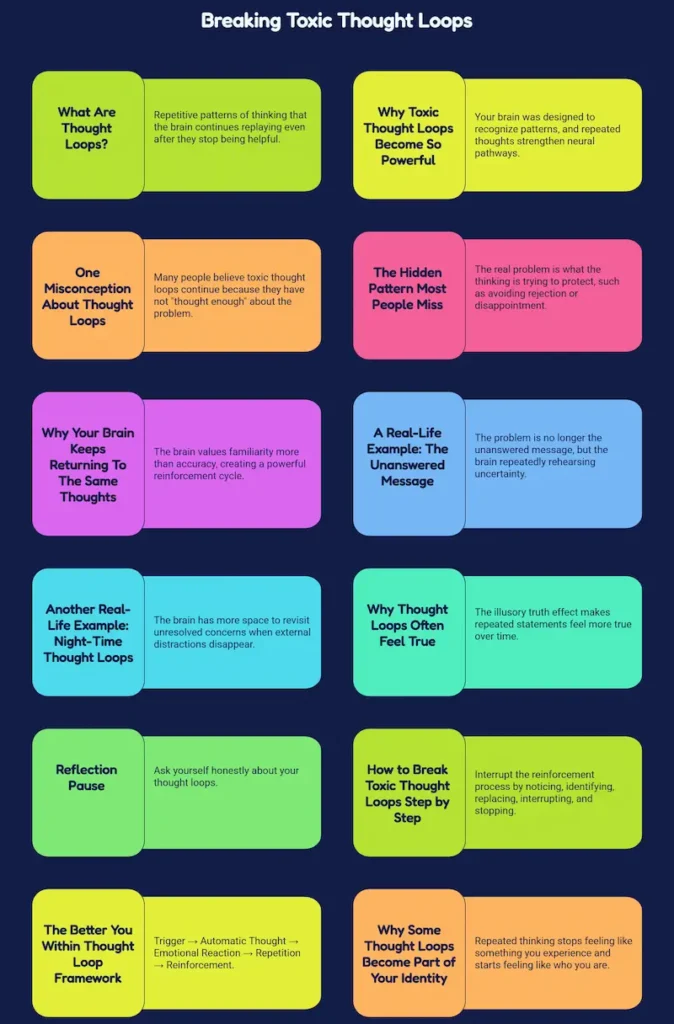
What Are Thought Loops?
Thought loops are repetitive patterns of thinking that the brain continues replaying even after they stop being helpful. They often develop through emotional reinforcement, anxiety, uncertainty, or repeated mental rehearsal, making certain thoughts feel automatic over time.
Unlike ordinary thoughts, toxic thought loops rarely solve problems.
Instead, they repeatedly recycle the same emotional experience.
That is why they often leave people feeling mentally drained without creating clarity.
Why Toxic Thought Loops Become So Powerful
Your brain was designed to recognize patterns.
It constantly searches for:
- familiarity
- prediction
- efficiency
- emotional significance
When certain thoughts repeatedly appear alongside strong emotions like fear, shame, uncertainty, or regret, the brain begins treating those thoughts as important.
Eventually it starts replaying them automatically.
This is one reason toxic thought loops often feel impossible to control.
They are no longer simply thoughts.
They have become conditioned mental habits.
Research from Harvard Health explains that repeated thoughts strengthen neural pathways through neuroplasticity, making frequently used mental patterns increasingly automatic over time. Learn more about how to train your brain through neuroplasticity at Harvard Health.
The more often a pathway is used, the easier it becomes for the brain to access it again.
One Misconception About Thought Loops
Many people believe toxic thought loops continue because they have not “thought enough” about the problem.
The opposite is usually true.
Most thought loops are not attempts to solve a problem.
Psychologists sometimes describe this kind of repetitive thinking as rumination, especially when the mind repeatedly circles the same distressing thoughts without moving toward a solution. While not every thought loop is rumination, the two often overlap.
They are attempts to find certainty.
The brain keeps asking:
“What if I missed something?”
“What if I make another mistake?”
“What if something goes wrong?”
It mistakes repetition for preparation.
But repeating the same thought rarely produces a better answer.
It usually produces more emotional exhaustion.
That distinction matters.
Because you cannot think your way out of a loop that is being reinforced emotionally rather than logically.
The Hidden Pattern Most People Miss
Many people assume their biggest problem is overthinking.
Often it is not.
The real problem is what the thinking is trying to protect.
For example:
Someone repeatedly imagines failure. Someone else constantly replays conversations.
Another person endlessly worries about the future.
On the surface, these appear to be different problems.
Underneath, they often protect the same emotional needs:
- avoiding rejection
- preventing disappointment
- reducing uncertainty
- staying emotionally prepared
- feeling safe
The thoughts are different. The emotional purpose is remarkably similar.
This is why simply replacing negative thoughts with positive ones rarely works.
The protective pattern underneath remains unchanged.
Until the brain feels safer without the loop, it often continues returning to it.
Why Your Brain Keeps Returning To The Same Thoughts
The brain values familiarity more than accuracy.
If certain thoughts have repeated hundreds or thousands of times, they become the brain’s preferred route.
Not because they are true. Because they are familiar.
This creates a powerful reinforcement cycle:
Thought
↓
Emotion
↓
Attention
↓
Repetition
↓
Stronger neural pathway
↓
More automatic thoughts
Each repetition quietly strengthens the next one.
According to the American Psychological Association, repetitive negative thinking is associated with increased stress, emotional distress, and reduced psychological flexibility, making these mental patterns increasingly difficult to interrupt when left unchallenged.
The brain is simply following the path it knows best.
A Real-Life Example: The Unanswered Message
Someone sends an important message.
Hours pass without a reply.
Immediately the mind begins creating explanations.
“They’re upset.”
“I said something wrong.”
“They’re ignoring me.”
The person checks their phone repeatedly.
Replays previous conversations.
Imagines worst-case scenarios.
None of those thoughts are confirmed.
Yet each repetition strengthens the emotional loop.
The problem is no longer the unanswered message.
The problem is the brain repeatedly rehearsing uncertainty.
Yet Another Hidden Pattern: Night-Time Thought Loops
Many people notice their thought loops becoming stronger late at night.
The environment becomes quieter.
External distractions disappear.
The brain suddenly has more space to revisit unresolved concerns.
Someone who felt relatively calm during the day may begin replaying:
- awkward conversations
- future worries
- financial concerns
- relationship fears
- unfinished tasks
The thoughts feel urgent.
But urgency is not always accuracy.
Sometimes it is simply a tired brain trying to create certainty when emotional resources are lowest.
Why Thought Loops Often Feel True
This surprises many people.
The brain does not measure truth by evidence alone.
It also measures familiarity.
A thought repeated hundreds of times begins feeling believable simply because it has become familiar.
Psychologists call this the illusory truth effect—the tendency for repeated statements to feel more true over time simply because they have been encountered repeatedly.
This helps explain why deeply ingrained self-beliefs can feel unquestionably true even when objective evidence suggests otherwise.
The feeling of certainty often comes from repetition.
Not from reality.
Reflection Pause
Ask yourself honestly:
- Which thought returns most often during difficult moments?
- What emotion usually appears before that thought?
- What uncertainty is your mind trying to eliminate?
- What does the loop promise to protect you from?
- If the thought disappeared tomorrow, what feeling would remain?
Sometimes awareness begins weakening a thought loop long before the loop disappears.
How to Break Toxic Thought Loops Step by Step
Breaking toxic thought loops is rarely about forcing yourself to “stop thinking.”
The goal is to interrupt the reinforcement process before the loop strengthens itself again.
Every time you respond differently, you teach your brain that it no longer needs to rely on the same mental pathway.
Over time, this weakens the loop and strengthens a healthier alternative.
1. Notice the Loop Before You Enter It
Every thought loop has an entry point.
It may begin with:
- uncertainty
- criticism
- an uncomfortable memory
- a physical sensation
- a stressful situation
Most people only notice the loop after they have already spent twenty minutes inside it.
Instead, practice recognizing the first few thoughts.
Examples:
- “Here we go again.”
- “I’m starting to replay this.”
- “My mind is looking for certainty.”
This small moment of awareness creates psychological distance.
You are no longer completely inside the loop.
You are observing it.
That shift alone weakens automatic reinforcement.
2. Identify What the Thought Is Trying to Protect
Every toxic thought loop usually serves a purpose.
Ask yourself:
“If my brain keeps returning here, what is it trying to prevent?”
Often the answer is not the thought itself. It is the emotion underneath.
For example:
Someone repeatedly imagines failure.
The hidden fear may actually be:
- embarrassment
- rejection
- disappointment
- losing control
Someone constantly replays conversations.
The real concern may be:
- wanting acceptance
- avoiding conflict
- fearing judgment
The thought is rarely the real problem.
The emotion it protects usually is.
Once you identify that emotional need, the loop often begins losing some of its power.
3. Replace Certainty-Seeking With Curiosity
This is where many people unknowingly strengthen thought loops.
Your mind desperately wants certainty. But life rarely provides complete certainty.
Instead of asking:
“What if something goes wrong?”
Ask:
“What evidence do I actually have right now?”
Or:
“Is there another explanation I haven’t considered?”
Curiosity creates enough space for catastrophic thinking to loosen its grip. It encourages flexibility instead of fear.
Psychologically, flexible thinking reduces emotional rigidity and helps your mind explore possibilities rather than repeatedly rehearsing one frightening conclusion.
4. Interrupt the Loop Physically
Thought loops do not exist only in the mind.
They often involve the nervous system too.
Many people notice that repetitive thinking becomes stronger when they remain physically inactive.
Simple actions help interrupt the cycle:
- stand up
- take a short walk
- stretch
- breathe slowly
- change your environment
- focus briefly on your surroundings
These actions are not distractions.
They signal to the nervous system that the perceived threat may not require continuous mental rehearsal.
Changing physical state often changes mental state.
5. Stop Treating Every Thought Like a Fact
One of the healthiest psychological shifts is learning that thoughts are events.
Not evidence.
Your brain produces thousands of thoughts every day.
Not all deserve equal attention.
Some thoughts are useful.
Some are outdated.
Some are simply familiar.
Instead of asking:
“Why am I thinking this?”
Try asking:
“Do I need to believe this thought?”
That distinction changes your relationship with your own mind.
Don’t mistake the return of a familiar thought for failure. Recovery isn’t measured by whether the thought appears again, but by how differently you respond when it does.
The Better You Within Thought Loop Framework
Most toxic thought loops follow the same invisible sequence.
Trigger → Automatic Thought → Emotional Reaction → Repetition → Reinforcement
Example:
Trigger
An unanswered email
↓
Automatic Thought
“I’ve done something wrong.”
↓
Emotional Reaction
Anxiety
↓
Repetition
Checking emails repeatedly.
Replaying conversations.
Imagining outcomes.
↓
Reinforcement
your nervous system becomes even more likely to repeat the same loop next time.
Breaking the cycle means interrupting any one of these stages.
The earlier you interrupt it, the easier it becomes.
Why Some Thought Loops Become Part of Your Identity
This is one of the most overlooked reasons people remain trapped.
Eventually, repeated thinking stops feeling like something you experience.
It starts feeling like who you are.
People begin saying:
- “I’m an overthinker.”
- “My brain never stops.”
- “This is just how I think.”
Notice the shift.
The thought pattern has become part of identity.
That makes change feel far more difficult.
Because your mind naturally tries to protect identity.
Not just habits.
If you’ve explored How to Change Your Identity When You Feel Stuck, you’ve already seen that lasting change becomes easier when you stop defining yourself by old patterns.
You are not your thought loops.
If this distinction feels unfamiliar, You Don’t Change Habits: You Change Identity First explores how separating your identity from your automatic patterns makes lasting change more sustainable.
You are someone experiencing them.
That difference creates room for change.
Why Your Environment Quietly Reinforces Thought Loops
The mind does not operate in isolation.
Your environment constantly influences how often certain thoughts appear.
For example:
Constant exposure to:
- stressful news
- endless social media
- comparison
- constant notifications
- lack of quiet time
keeps the nervous system activated.
An activated nervous system finds it harder to disengage from repetitive thinking.
Meanwhile environments that encourage calmness often make mental flexibility easier.
Examples include:
- quiet walks
- journaling
- reading
- mindfulness
- time in nature
- reducing unnecessary digital stimulation
Your environment cannot eliminate thought loops.
But it can make them easier—or harder—to interrupt.
One Uncomfortable Truth About Thought Loops
Many people secretly believe:
“If I keep thinking about this long enough, eventually I’ll feel safe.”
Unfortunately, the opposite often happens.
Every repetition teaches the brain:
“This must be important.”
So the loop returns again. And again.
The mind confuses repetition with protection.
But repetitive thinking rarely creates peace.
It usually creates familiarity.
And familiarity is not the same as healing.
Real change begins when you stop measuring safety by how much you have thought about a problem.
Instead, you begin measuring it by how differently you respond when the thought returns.
That is where lasting change begins.
Final Thoughts
Toxic thought loops do not disappear because you become mentally stronger overnight.
They weaken because you stop reinforcing them in the same way.
Every moment of awareness interrupts automation.
Every balanced interpretation weakens old pathways.
Every repeated response teaches your nervous system something new.
The goal is not eliminating every negative thought.
The goal is changing your relationship with them.
Over time, thoughts that once felt impossible to escape begin losing their emotional intensity.
Not because they never appear again.
But because they no longer control how you respond.
If you’re ready to continue strengthening healthier thinking patterns, 3 Simple Ways to Rewire Your Brain for Positive Thinking explores practical daily habits that reinforce new mental pathways long after the thought loop has been interrupted.
Questions You May Quietly Be Asking Yourself
Why do the same thought loops keep coming back?
Thought loops return because repetitive thinking strengthens mental pathways that are repeated frequently, especially when they are linked to strong emotions like fear or uncertainty. The more often a loop is rehearsed, the more automatic it can become.
Can you completely stop overthinking?
The goal is not to eliminate every unwanted thought. It is to notice repetitive thinking sooner, respond differently, and gradually weaken the mental habits that keep the loop alive.
How long does it take to break toxic thought loops?
There is no fixed timeline. Some thought loops begin weakening within weeks of consistent practice, while deeply reinforced patterns may take longer. Lasting change comes through repeated awareness, balanced thinking, and emotional reinforcement rather than quick fixes.