
Three weeks without checking your phone before getting out of bed. Three weeks of actual mornings — quiet ones, unhurried, the kind you’d been trying to build for a year. Then a genuinely bad week arrives, the kind with too much happening at once, and your hand finds the phone before your eyes have even fully opened. No decision involved. It just happened, the way it used to happen every single morning for years before this one.
It can feel like a full reset, as though those three weeks simply evaporated. That interpretation is understandable. It’s also based on a common misunderstanding about how learned behavior actually works.
Why Old Habits Can Return After Progress
The old pattern returning doesn’t mean the new one was never real. It means something more specific about how the brain stores learned behavior in the first place — something that has nothing to do with how much willpower was available that particular morning.
How the Brain Stores Habit Patterns
When a well-learned behavior changes, the earlier learning doesn’t necessarily disappear. New learning can compete with it, while the older response may remain capable of returning under certain conditions. Building three weeks of quiet mornings, then, doesn’t necessarily mean erasing the tendency to reach for the phone. It means repeatedly practicing a different response that can become easier to access over time.
This matters because it changes what those three weeks actually accomplished. The newer behavior doesn’t have to eliminate the older learning for real change to have occurred. Each repetition gives the newer response more practice, while the older pattern may still remain capable of resurfacing in certain contexts.
Why New Habits Don’t Erase Old Ones
This isn’t just a reasonable guess about how habits work — it’s a well-established finding in learning research. Psychologist Mark Bouton’s decades of work on what’s known as the renewal effect has repeatedly found that when a learned behavior is “extinguished” through new learning, the original response can still return under the right conditions — particularly when the context shifts back toward the one where the original behavior was first learned. As Bouton’s research puts it, extinction is not the same as erasure. It’s new learning layered on top of the old, and earlier learning can remain capable of influencing behavior under certain conditions.
This offers a useful way to understand something that otherwise feels contradictory: genuine new learning can occur while an older learned response remains capable of reappearing later. Applied to everyday habits, it suggests that three weeks of practicing a different morning routine can represent real progress without requiring the older pattern to have disappeared completely. This broader pull of familiar, established patterns is explored in Why Is Change So Hard?
How Stress and Familiar Cues Reactivate Old Behaviors
Certain conditions make this reactivation considerably more likely. Familiar cues — the same environment, the same time of day, the same emotional state present when the old habit was originally learned — can act as a trigger for the older pathway, especially when the newer pattern hasn’t yet had as much repetition behind it.
Stress appears to play a specific role here as well. Research by Lars Schwabe and Oliver Wolf found that acute stress shifted participants’ behavior away from more deliberate, goal-directed responding and toward more automatic, habitual responding — suggesting that, under stress, behavior may sometimes become more influenced by well-practiced habitual responses and less guided by current goals. It’s worth noting that more recent attempts to replicate this specific finding have produced mixed results, so this connection should be treated as a plausible contributing factor rather than a fully settled mechanism. Even with that caveat, it fits a pattern many people recognize directly: the phone reaches for your hand most easily on exactly the mornings — the stressful, chaotic ones — when the newer, less-practiced behavior may be harder to maintain.
Why Relapse Doesn’t Mean Your Change Has Failed
Given how this mechanism actually works, a temporary return to an old pattern isn’t evidence that change has failed. It’s a predictable consequence of how two competing pathways coexist, with the newer one gradually needing enough repetition to become the more automatic default, especially under difficult conditions.
This reframes what actually needs to happen after a relapse occurs. It isn’t a signal to start over from nothing, because nothing was actually erased in the first place. This is exactly the distinction How to Get Back on Track Without Starting Over addresses directly — the newer learning hasn’t simply been erased by one return to the old behavior. What matters now is continuing to practice the newer response rather than treating the lapse as a return to zero. This is a different kind of gap than the one covered in Why You Know What to Do But Still Don’t Do It, which looks at intention never translating to action in the first place — here, the action was already happening. It just met a stronger competing pathway on a hard morning.
The BYW Habit Relapse Framework
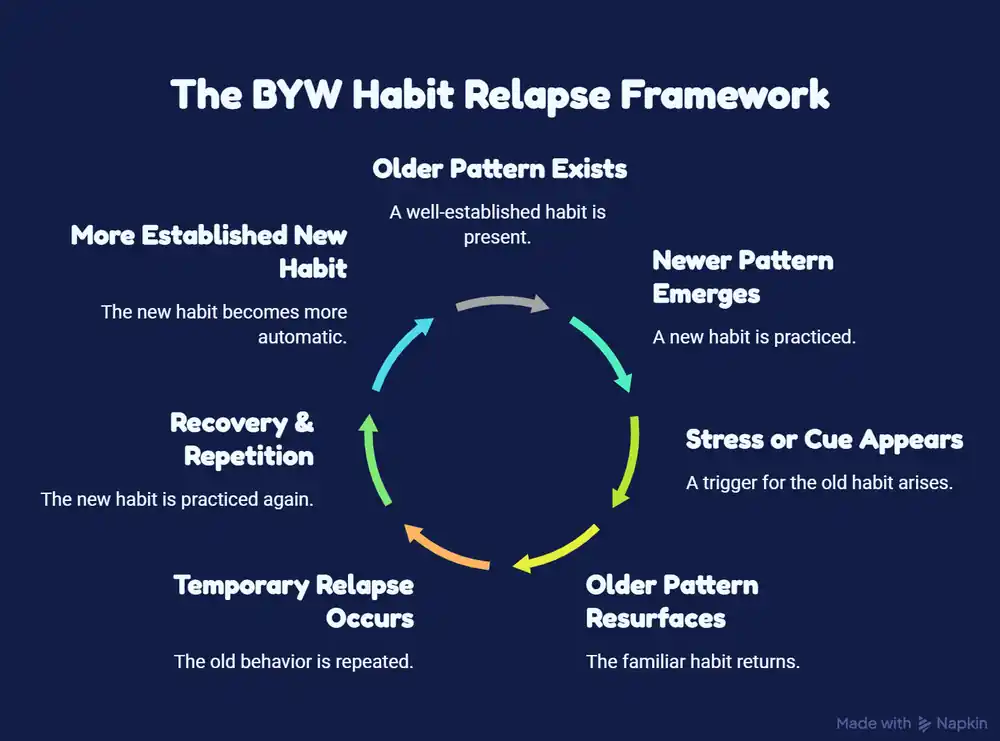
Put together, this offers a practical way to understand habit relapse as a recoverable process rather than a linear failure:
Earlier Learned Pattern + Newer Learned Pattern → the newer behavior can become established without necessarily eliminating the earlier learned response.
Stress or Familiar Cue → certain conditions may make the older, well-practiced response more likely to reappear.
Older Pattern Resurfaces → the familiar behavior returns, sometimes with little deliberate thought.
Temporary Relapse → the old behavior occurs, often bringing frustration or discouragement with it.
Recovery & Repetition → returning to the newer behavior provides further practice rather than requiring you to begin again from zero.
More Established New Habit → with continued practice across different situations, the newer behavior can become easier and more likely to recur, including when familiar cues or difficult conditions arise.
Understanding why the older pattern can feel so instantly available connects to something covered in How Habits Are Formed — well-practiced behaviors can become easier to repeat in familiar contexts, while newer behaviors often need continued practice across different situations to become more established.