

The invitation comes through, and for the first time in longer than you can remember, the answer forming in your mouth is no. You’ve said yes to this exact kind of thing a hundred times before, the reliable one, the one people count on to show up. The word comes out anyway, polite and short. And then, almost immediately, a strange discomfort settles in — not regret, exactly. Something closer to having betrayed someone. It just takes a second to realize the someone is you.
Why Identity Change Can Feel Like Loss
Most people assume this feeling means the change is somehow wrong, or that they’re not handling it well. But discomfort doesn’t necessarily mean the new direction is a mistake. One useful way psychology helps explain the experience is through narrative identity — the ongoing story through which we make sense of who we’ve been, who we are, and who we’re becoming. When a new behavior no longer fits comfortably into that familiar story, change can feel surprisingly personal.
How We Build a Continuing Sense of Self
Identity isn’t simply a static list of traits or preferences. Psychologist Dan McAdams’s work on narrative identity describes one important part of identity as an internalized, evolving life story — a way of connecting the reconstructed past with the imagined future to create a sense of unity and purpose.
Seen this way, identity isn’t a fixed snapshot. We interpret experiences and weave them into a larger understanding of who we’ve been, who we are now, and who we may become. That narrative perspective helps explain how a person can change considerably over time while still experiencing a meaningful connection between earlier and later versions of themselves.
Why Familiar Identities Can Feel Comfortable
A familiar identity can feel surprisingly comfortable simply because it already makes sense within the story you tell about yourself. “I’m the reliable one” may be exhausting at times, but after years of living that role, it can feel deeply recognizable: you know what it asks of you, how other people respond to it, and where it fits in your understanding of yourself.
Saying no introduces something that doesn’t fit as neatly yet. If you’ve always understood yourself as the person who shows up, one small refusal can raise a strangely large question: If I’m not always that person anymore, then who am I becoming? Through the lens of narrative identity, that tension makes sense. The old version already has a place in your self-story; the newer one may still be finding hers.
Why Personal Growth Can Feel Uncomfortable
Personal growth can become especially uncomfortable when a new direction no longer fits neatly with the way you’ve understood yourself. Through the lens of narrative identity, part of that tension may come from trying to make sense of new behaviors and priorities alongside the story you already hold about who you’ve been and who you’re becoming.
There’s another psychological idea that can help explain some of this tension: cognitive dissonance. Leon Festinger used the term for the discomfort that can arise when psychologically inconsistent cognitions — such as beliefs, attitudes, or behavior — come into conflict. Later self-consistency work, including research associated with Joshua Aronson, explored how such inconsistency can become especially meaningful when it touches an important part of how someone sees themselves. If “I’m the person who always shows up” is central to your self-concept, saying no may therefore feel uncomfortable for reasons that go beyond the decision itself: the action doesn’t fit easily with an established understanding of who you are.
This connection between repeated behavior and self-perception also works in the other direction: You Don’t Change Habits: You Change Identity First explores how the identity you already hold can shape the behaviors that feel natural to repeat.
Through a narrative-identity lens, this can help explain why change sometimes feels surprisingly close to loss. The old identity wasn’t necessarily better, but it was familiar and already woven into the story you understood about yourself. The newer version is still being written — less familiar, less settled, and not yet as easy to recognize as you.
Why Identity Continuity Can Matter
Part of what can make identity change disorienting is the challenge of maintaining a sense of continuity while becoming different. Research on narrative identity has linked greater coherence in people’s life stories with aspects of psychological functioning, suggesting that how we connect our experiences into a meaningful whole can matter for well-being.
This adds an important nuance to conversations about personal growth. Resistance or discomfort doesn’t always have to be treated as something to overpower. Sometimes it may be worth asking whether a new direction simply hasn’t found a comfortable place yet within the way you understand your past, present, and future.
How Identity Gradually Reorganizes Over Time
A new way of behaving may feel less unfamiliar as you gain experience with it. Each time you act in the new direction, you also create another piece of evidence that this behavior can belong to you — another experience your understanding of yourself can potentially incorporate.
Saying no once may feel strangely unlike you. Saying no across a dozen ordinary moments may begin to feel less like a departure from who you are and more like something you sometimes do now. Through the lens of narrative identity, those accumulated experiences can help the newer version of your self-story feel less unfamiliar and more connected to the person you’ve already been.
If you’re intentionally trying to build a different relationship with who you are, How to Change Your Identity When You Feel Stuck explores the practical side of turning new choices into a more established sense of self.
The BYW Identity Continuity Framework
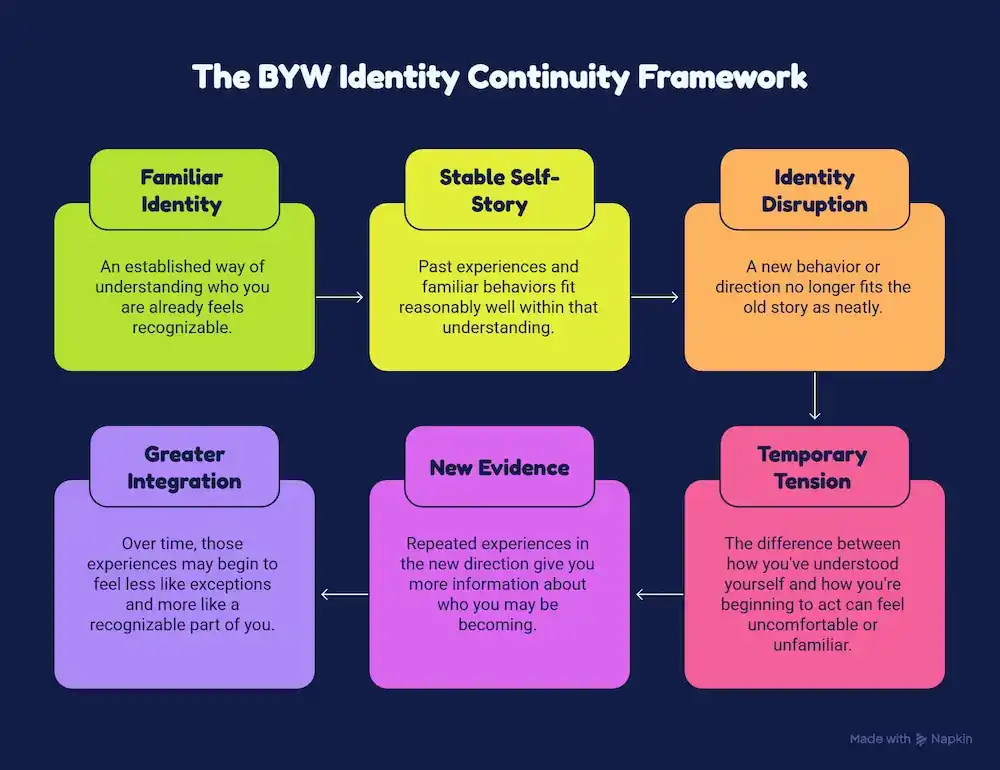 One way to understand this experience is through the BYW Identity Continuity Framework:
Familiar Identity → an established way of understanding who you are already feels recognizable.
Stable Self-Story → past experiences and familiar behaviors fit reasonably well within that understanding.
Identity Disruption → a new behavior or direction no longer fits the old story as neatly.
Temporary Tension → the difference between how you’ve understood yourself and how you’re beginning to act can feel uncomfortable or unfamiliar.
New Evidence → repeated experiences in the new direction give you more information about who you may be becoming.
Greater Integration → over time, those experiences may begin to feel less like exceptions and more like a recognizable part of you.