

There’s a new option on the board today, something you’ve been meaning to try for weeks. You read it twice. And then, when it’s your turn, the same order comes out of your mouth as always — the one you could recite in your sleep, the one that stopped being interesting years ago.
It’s such a small moment that it barely registers as a decision at all. That’s exactly the point.
Why Change Feels So Difficult
Wanting something different rarely feels difficult. Deciding to try a new order, a new route, a new way of responding to something — the decision itself usually comes easily, sometimes with real enthusiasm behind it. What comes next is where the difficulty shows up: an odd pull back toward the familiar option, appearing almost before any real thought has happened.
Most people interpret this pull as a problem with themselves — insufficient willpower, insufficient discipline, insufficient desire. But familiar options can have advantages that have little to do with how much you genuinely want to change. They’re already known, require less uncertainty, and may involve behaviors that have become easier through repetition. Research on status quo bias also shows that people often favor an existing option simply because it is already the status quo.
Sometimes the problem goes one step further: you may know exactly what you want to do and still struggle to act on it. Why You Know What to Do But Still Don’t Do It explores that separate gap between intention and action.
Why the Brain Prefers Familiarity
This preference has a well-documented counterpart in behavioral research: status quo bias, formally studied by economists William Samuelson and Richard Zeckhauser. Their research found that people can disproportionately favor an existing or default option when choosing among alternatives, and that this tendency can become stronger when more alternatives are available.
Part of what drives this, their work suggests, is a closely related finding from psychologists Daniel Kahneman and Amos Tversky: loss aversion, the tendency for losses to feel considerably heavier than equivalent gains feel good.
One explanation that can contribute to status quo bias is loss aversion, associated with the work of psychologists Daniel Kahneman and Amos Tversky. In decisions involving potential gains and losses, losses can carry greater psychological weight than comparable gains. When changing from an existing option involves giving something up — certainty, familiarity, convenience, or another valued feature — that potential loss can make staying with the status quo more attractive. But loss aversion is one contributor to status quo bias, not a complete explanation for why every familiar behavior persists.
How Familiar Behaviors Become Automatic
Familiar behaviors earn their low cost over time, through repetition. A behavior performed often enough eventually requires less conscious oversight to execute — it becomes automatic, running with minimal deliberate attention rather than requiring active decision-making at every step.
This matters because repetition can change how much deliberate attention a behavior requires. What once involved conscious decisions can become increasingly cued by familiar situations and carried out with less deliberate thought. That’s one reason an established behavior can feel easier to repeat than a new alternative: the familiar response has already been practiced in that context, while the new one has not.
Why New Behaviors Feel Mentally Hard
Unfamiliar options haven’t earned that efficiency yet, which means they require active, effortful processing every single time — deciding, monitoring whether it’s going well, adjusting when it doesn’t match expectations. This is measurably more demanding than executing something automatic, and the brain treats it accordingly.
Uncertainty can add another layer to unfamiliar choices. Neuroeconomic research by Hsu and colleagues found differences in neural activity when people made decisions under ambiguity — where relevant information was missing or uncertain — compared with decisions involving known risks. The findings help show that the brain does not process uncertainty in exactly the same way as situations where probabilities are known. They don’t mean every unfamiliar behavior is inherently more cognitively expensive, but they help explain why uncertainty can meaningfully shape decision-making.
The Role of Uncertainty in Brain Resistance
Uncertainty can make a change harder to choose because a new option doesn’t yet have the same history of known outcomes as the familiar one. You may know what usually happens when you follow the old pattern, while the alternative carries questions you can’t answer yet. When that uncertainty appears alongside the familiarity of the status quo — and, in some decisions, a sense that changing means giving something up — staying with what you already know can become especially appealing.
This is worth sitting with, because it explains something that otherwise feels contradictory: you can genuinely want something different and still feel pulled toward the familiar option. Those experiences aren’t mutually exclusive. Wanting the new outcome doesn’t erase the familiarity of the old pattern, the uncertainty surrounding the alternative, or whatever you may feel you’re giving up by changing. Resistance doesn’t necessarily mean you don’t want the change.
How the Brain Eventually Adapts to Change
New behaviors don’t necessarily remain equally difficult forever. With repetition, a behavior can become more familiar and increasingly automatic, requiring less deliberate thought than it did at the beginning.
That’s useful to remember when something new initially feels awkward or effortful. Early difficulty doesn’t tell you how difficult the behavior will always feel. Repeated practice can change your familiarity with the action and make the response easier to initiate over time — although how quickly that happens varies by behavior, person, and context.
When the goal is to make that new behavior easier to repeat consistently, How to Build Habits That Actually Stick explores the practical psychology of turning repeated actions into more established patterns.
The BYW Brain Resistance Framework
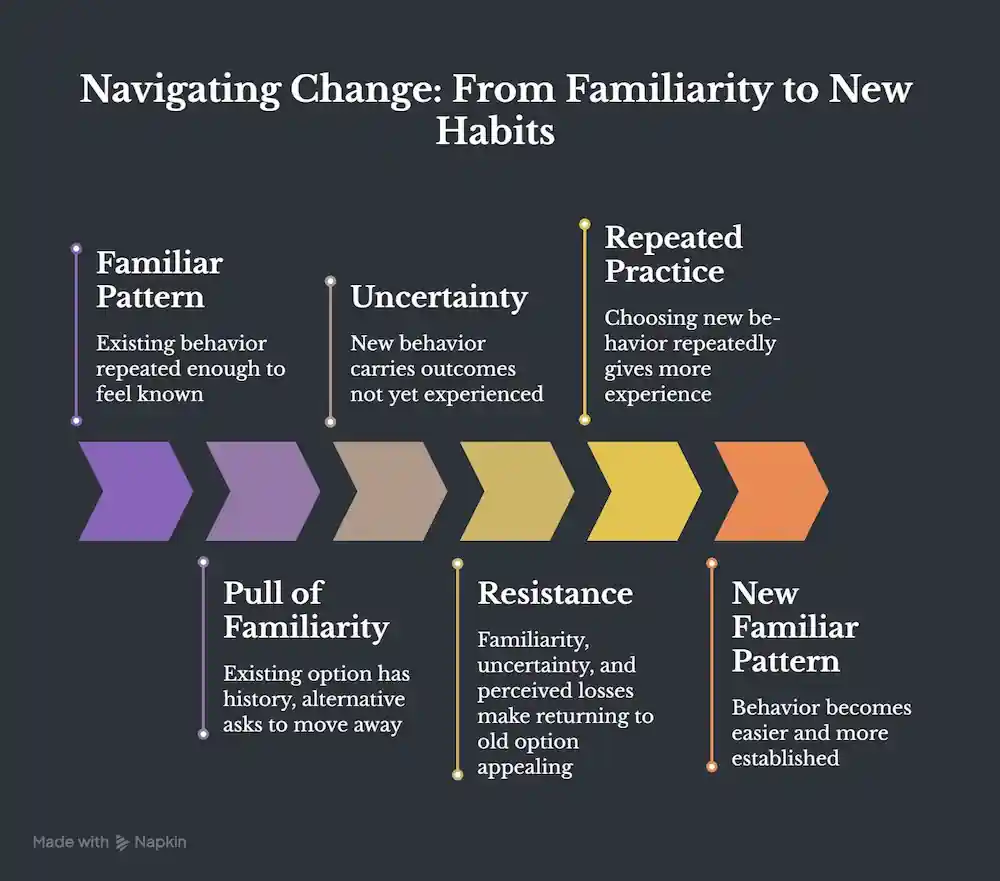
Put together, resistance to change can be understood as a progression rather than a single hidden mechanism:
Familiar Pattern → an existing behavior has been repeated enough to feel known and easier to initiate.
Pull of Familiarity → the existing option already has a history, while the alternative asks you to move away from what you know.
Uncertainty → the new behavior carries outcomes you haven’t experienced or learned to predict yet.
Resistance → familiarity, uncertainty, existing automatic patterns, and sometimes perceived losses can make returning to the old option more appealing.
Repeated Practice → choosing the new behavior repeatedly gives you more experience with it and can strengthen its automaticity.
New Familiar Pattern → over time, the behavior that once felt unfamiliar can become easier and more established.













2 Responses