

Two days pass before you reply to the text. It wasn’t intentional — life got busy, the notification slid down the list, and by the time you remembered, enough time had gone by that replying felt strange. Your friend mentions it lightly, no real edge to it: “Oh, thought you’d forgotten about me.” A joke, clearly. You laugh, apologize, move on.
Except you don’t, not really. The comment sits there for the rest of the afternoon, replaying at odd moments, taking up far more space than a two-day delay and a gentle joke should reasonably occupy.
What Emotional Recovery Actually Means
That gap — between how minor the moment was and how much room it’s taking up — is the exact shape of the question this article is trying to answer: not why setbacks happen, but why recovering from small ones can sometimes feel disproportionately slow. In this article, emotional recovery means the process of regaining psychological stability after an ordinary emotional disruption. That’s different from the longer-term healing that may follow trauma or significant emotional wounds. The distinction gives us a useful way to focus on something much more everyday: how we find our footing again after criticism, disappointment, rejection, or a mistake.
Why Setbacks Affect Us So Deeply
The same comment rarely affects two people identically, and psychologist Richard Lazarus’s research on cognitive appraisal helps explain why. According to Lazarus and Folkman’s influential framework, an event’s emotional impact isn’t determined by the event alone — it’s shaped partly by how the person appraises what is happening. Primary appraisal concerns whether the situation threatens or affects something that matters, while secondary appraisal concerns the person’s perceived resources and options for coping with it.
A gentle joke appraised as a real question about whether you’re a reliable friend — and paired with a sense of not having much to say in your own defense — produces a much stronger reaction than the identical comment appraised as exactly what it was: a passing remark. The comment itself barely changes. What changes is the meaning the person assigns to the comment and how able they feel to cope with what it seems to imply. This kind of appraisal shows up constantly in how emotional triggers work more broadly, something explored further in What Is an Emotional Trigger? Why You Get Triggered So Easily and 10 Emotional Triggers That Control Your Behavior.
Why Some People Recover Faster Than Others
Appraisal explains part of the variation. What happens after the initial reaction matters too — and this is where self-compassion research becomes directly relevant. Psychologist Kristin Neff’s work, along with subsequent research on self-compassion and responses to difficult emotional experiences, suggests that self-compassion can support healthier emotional coping and recovery after distress.
This connects to a broader concept worth naming directly: psychological flexibility, a term developed by psychologist Steven Hayes as part of Acceptance and Commitment Therapy. It describes the capacity to stay present with a difficult thought or feeling — to let it exist without being dominated by it — while still acting in line with what actually matters. Someone with more psychological flexibility can hold “that stung a little” and “I’m still a reliable friend” at the same time, without needing to resolve the tension immediately. The comment is the same either way. The path back to stability is not.
Common Mistakes That Slow Recovery
One of the most well-documented obstacles to emotional recovery is rumination — repetitive, self-focused dwelling on a setback and what it might mean. Psychologist Susan Nolen-Hoeksema’s research, across experimental and longitudinal studies, found that rumination can prolong negative mood and is associated with greater emotional distress rather than necessarily producing the insight or resolution people may be seeking.
This is worth naming directly, because rumination often masquerades as productive reflection. Replaying the comment repeatedly — was it really just a joke, does she actually think that — can feel like processing it. Research suggests it usually isn’t. It’s closer to keeping the moment freshly reopened, mistaking repetition for progress.
How Emotional Recovery Actually Works
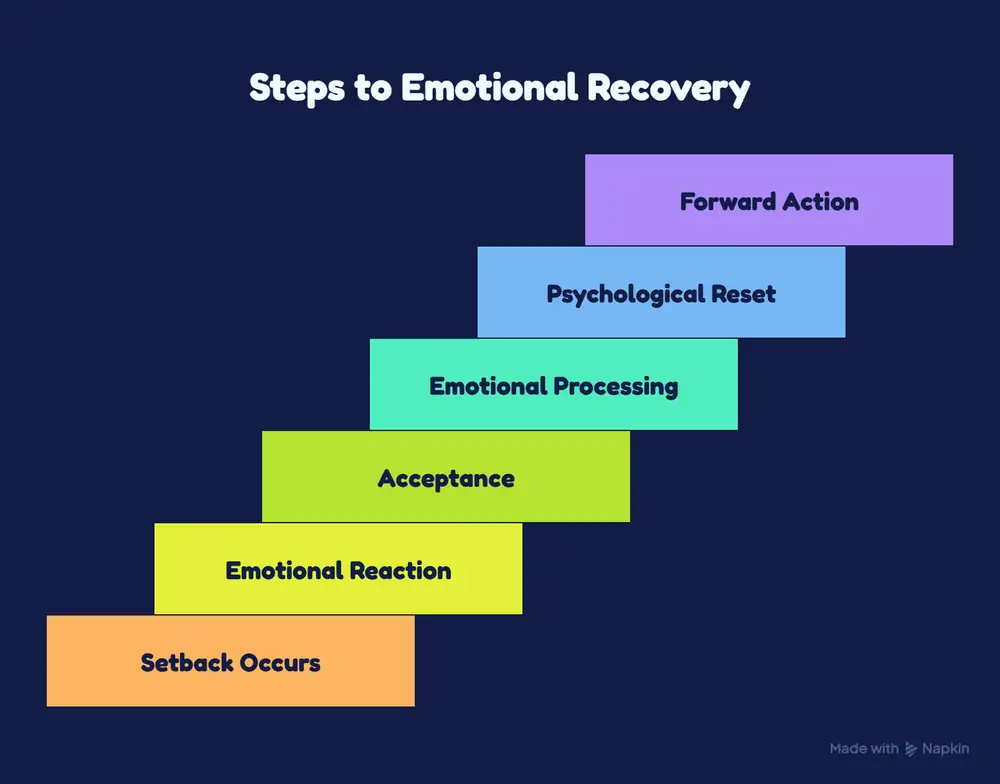 Recovery isn’t a single event. It moves through a sequence, and skipping a stage tends to stall the ones that follow it.
Setback → an event occurs that the mind appraises as some form of threat, loss, or harm. Emotional Reaction → a genuine emotional response follows — embarrassment, self-doubt, a flicker of shame. Acceptance → the reaction is allowed to be present without immediately resisting, suppressing, or judging it — an expression of the psychological flexibility described above. Emotional Processing → the setback and its meaning are considered without becoming stuck in repetitive dwelling. Psychological Reset → emotional intensity settles enough that clear thinking becomes possible again. Forward Action → attention and energy redirect toward what comes next.
The stage most often skipped is acceptance. Many people move straight from reaction toward trying to “fix” the feeling — distracting from it, forcing a joke back, insisting to themselves it doesn’t matter — without first acknowledging that the reaction itself was a reasonable response. Moving straight into trying to fix or suppress the feeling can add another layer of struggle to the original reaction, rather than giving you space to respond to it more deliberately.
Practical Ways to Recover After Setbacks
Naming the appraisal directly is often the most useful starting point — not just “I feel bad,” but “this felt like a question about whether I’m reliable” or “I don’t feel like I have much of a defense right now.” That specificity does real work, because it turns an ambiguous, ongoing distress into something identifiable enough to actually process.
From there, treating the reaction with the same basic understanding you’d offer someone else in the same situation — rather than immediately auditing yourself for weakness — tends to shorten recovery meaningfully, consistent with the self-compassion research described above.
Finally, it helps to notice the difference between processing a setback and rehearsing it. Genuine processing tends to move — a new detail considered, a slightly different angle taken. Rumination tends to loop, returning to the same point without progressing. This same distinction matters in higher-stakes settings too — Why Work Triggers You More Than You Think looks at how this exact pattern plays out when the setback happens somewhere with more riding on it. When a reflection has started circling rather than moving, that’s usually the moment to deliberately redirect attention elsewhere, even briefly.
Why Recovery Becomes Easier With Practice
Emotional recovery can become more manageable as you develop and practice the skills that support it. Learning to acknowledge an emotional reaction, distinguish processing from rumination, and redirect attention deliberately can give you more ways to respond when the next setback arrives.
This is useful to remember when recovery still feels slow or effortful. Difficulty finding your footing after a setback doesn’t necessarily mean you’re bad at coping. These are skills that can be developed and strengthened rather than fixed qualities you either have or don’t.