
The group project wraps up, and it went fine, mostly. You did your part, showed up to the calls, contributed when it mattered. It’s only later, almost by accident, that you learn there was a second group chat the whole time — one without you in it, where the actual planning happened.
Nobody was being cruel. They’d just learned, somewhere along the way, that decisions moved faster without looping you in on every detail. You never noticed. They’d stopped expecting you to.
Why We All Have Blind Spots
That gap — between what you thought was true about your role and what everyone else had quietly adjusted around — is the exact shape of a psychological blind spot. It isn’t a lie you told yourself. It’s a pattern that was visible to everyone except the one person it belonged to.
This happens more than most people realize, and rarely with anything as clear as a hidden chat. A friend mentions you always deflect compliments with a joke. A partner notes you get defensive the moment plans change. Each observation lands with a small jolt, not because it’s wrong, but because it’s somehow both obviously true and completely invisible from where you’re standing.
What Is Blind Spot Psychology?
A psychological blind spot is an aspect of your own thinking, behavior, or emotional pattern that stays outside your awareness while still shaping what you do. The term draws directly from a well-documented finding in psychology called the bias blind spot — first demonstrated by researchers Emily Pronin, Daniel Lin, and Lee Ross, who found that people consistently rate themselves as less susceptible to cognitive and motivational biases than other people, even when they can accurately describe how those same biases work in general.
What makes this finding genuinely useful is what it rules out. It isn’t that people don’t know biases exist — most can describe confirmation bias or self-serving bias accurately when asked to define them in the abstract. The blind spot is specifically about applying that knowledge to yourself. Knowing a bias exists doesn’t prevent it from operating in your own thinking, and it doesn’t make you any more likely to notice when it’s happening.
Why Blind Spots Can Be So Hard to See
Here’s the part that explains why this isn’t simply a matter of paying closer attention.
One reason blind spots persist comes from an asymmetry in how we understand ourselves and other people. We have access to our own thoughts, intentions, and explanations, while other people are more likely to judge us from what they can actually observe — what we repeatedly say, do, and react to.
That difference can make the same behavior look very different depending on which side you’re standing on.
You may experience yourself as trying to explain your point clearly. Someone else may repeatedly experience you as becoming defensive whenever you’re challenged. From the inside, your intention is immediately available to you. From the outside, the repeated behavior may be easier to see.
Research on the bias blind spot adds another layer. People can understand that cognitive and motivational biases exist while still seeing themselves as less affected by those biases than other people. Knowing about a bias, in other words, doesn’t automatically make it visible when it’s operating in your own thinking.
And sometimes self-protective processes may make that gap even harder to close.
Research on motivated reasoning suggests that what we want to believe can influence how we access, interpret, and evaluate information. A conclusion such as “I get defensive because criticism threatens how I see myself” may therefore be harder to accept than “I just have strong opinions” — particularly when one explanation requires revising a comfortable belief about who we are.
This doesn’t mean every blind spot exists because your brain is deliberately hiding an uncomfortable truth from you.
It means several psychological processes can make self-perception less objective than it feels. Limited access to our own underlying mental processes, the different information we use to judge ourselves versus others, self-enhancement, and motivated reasoning can all contribute to patterns being easier to recognize from the outside than from within.
That’s what makes psychological blind spots so persistent: the interpretation that feels most obvious from inside your own mind isn’t necessarily the pattern other people can see.
Common Examples of Psychological Blind Spots
Someone might believe they’re easy to work with, while consistently missing that they interrupt colleagues before an idea is finished — visible to a whole team, invisible to them.
Someone might see themselves as low-maintenance in relationships, while a partner has quietly learned to soften bad news, because the same person reacts more strongly than they realize.
Someone might believe they handle criticism well, pointing to how calmly they respond in the moment, while missing that the same feedback resurfaces as irritability for the rest of the day.
In each case, the gap isn’t between honesty and dishonesty. It’s between what’s observable to the people around someone and what their own mind has quietly filtered out of the picture.
How Blind Spots Affect Everyday Life
When a pattern remains outside your awareness, it can influence your decisions and reactions without being recognized as part of the problem.
A recurring conflict may be attributed entirely to “difficult people” even when one of your own reactions keeps appearing across different relationships. A stalled goal may seem to be caused only by circumstances while a recurring avoidance pattern is also playing a role.
This matters because it’s difficult to deliberately change something you haven’t yet recognized.
You might work hard on the version of the problem you can see — trying to be more patient, more consistent, or more open — while continuing to miss a pattern that helps explain why the same outcome keeps returning.
Sometimes the repetition itself becomes the clue.
When different situations keep producing a strangely familiar result, it may be worth asking what remains constant besides the circumstances.
How to Recognize Your Own Blind Spots
Because a blind spot is something you don’t readily recognize from your usual point of view, finding one often requires evidence that interrupts the way you’ve been explaining a pattern to yourself.
Sometimes that evidence comes from another person. Specific, honest feedback from someone whose judgment you trust can reveal behavior that’s much easier to observe from the outside.
But feedback isn’t the only route. Pay attention when the same problem keeps appearing in different circumstances: similar conflicts across different relationships, the same reaction to certain kinds of criticism, or an outcome that keeps repeating even when the people or situation change.
Instead of asking “What’s wrong with me?”, ask a more useful question:
“What keeps happening here that my usual explanation doesn’t fully account for?”
And when asking someone else for feedback, make the question concrete. “What do I do during disagreements that I might not notice?” is much more useful than “Do I have any blind spots?”
The goal isn’t to distrust your own perspective or automatically accept someone else’s. It’s to become willing to examine evidence your usual point of view may have missed.
The BYW Blind Spot Awareness Model
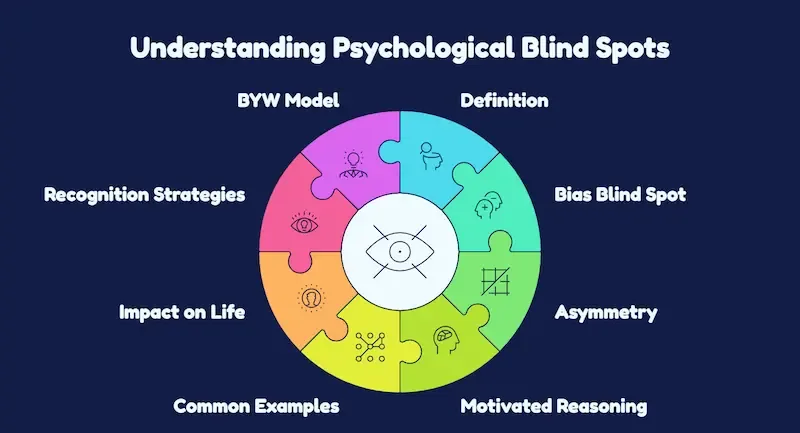 Blind spots don’t always become visible in the same way, but the process can often look something like this:
Automatic Pattern → a behavior, interpretation, or reaction repeats without being fully recognized.
Limited Self-View → the way you understand the pattern is shaped by incomplete access to your own mental processes, existing beliefs about yourself, and sometimes self-protective reasoning.
Hidden Blind Spot → the pattern remains difficult to recognize from your usual point of view.
Disrupting Evidence → feedback, repeated consequences, an unexpected reaction, or another perspective challenges your existing explanation.
Conscious Awareness → you begin to recognize a pattern that previously felt normal, justified, or simply invisible.
Intentional Change → once the pattern becomes visible, you can examine it more deliberately and decide whether something needs to change.
The turning point is disrupting evidence.
Sometimes that comes from another person saying something you don’t particularly want to hear. Sometimes it comes from noticing the same conflict appearing across several relationships, seeing the same outcome follow different decisions, or catching a contradiction between how you see yourself and what repeatedly happens.
External feedback can be especially useful because another person doesn’t share your exact internal point of view. But feedback isn’t automatically correct, and another person’s interpretation shouldn’t replace your own judgment.
The value lies in allowing new evidence to challenge an explanation that previously felt obvious.