

Thirty-one days of journaling.
You genuinely enjoyed it. You looked forward to those few quiet minutes every evening.
Then you got sick.
For a week, your journal stayed closed. You were exhausted, uncomfortable, and focused on getting better.
Perfectly understandable.
But something unexpected happened after you recovered.
Another week passed.
Then another.
Two months later, the journal was still sitting where you’d left it.
The illness had ended long ago.
So why hadn’t you returned?
Perhaps somewhere during that interrupted week, a small conclusion had formed:
Well, I’ve broken the habit now.
And suddenly, writing one more journal entry felt less like continuing something familiar and more like starting an entirely new commitment.
But does a break really mean you have to start over?
Why One Setback Can Feel Like Complete Failure
When we commit to a habit, we often imagine progress as an uninterrupted sequence.
Day one.
Day two.
Day three.
And eventually, a satisfying streak that proves we’re becoming consistent.
But real life rarely follows a perfect sequence.
We get sick.
Travel interrupts our routines.
Responsibilities change.
Some days simply don’t go as planned.
The interruption itself may be unavoidable.
What happens afterward can depend partly on how we interpret it.
One possible response is:
I missed a week. I’ll return when I’m feeling better.
Another is:
I’ve ruined my progress. I might as well stop.
The second response reflects all-or-nothing thinking — evaluating an experience in extremes, with little room for partial success or imperfect progress.
When we view consistency as something that only counts if it’s uninterrupted, even a reasonable break can feel like failure.
And that interpretation may make returning emotionally harder than it needs to be.
Why We Sometimes Believe We Have to Start Over
Think about what an unbroken streak represents.
It offers visible evidence of commitment.
Thirty-one consecutive days can feel like an achievement.
Then one day gets missed.
The streak counter resets.
Suddenly, thirty-one successful days seem less important than the single interruption.
But nothing about that missed day changes the fact that those thirty-one days happened.
This connects with Consistency Over Perfection: Which Actually Creates Lasting Change?
Research on self-regulation has examined how people respond when they violate a personal rule or goal.
One related concept is the abstinence violation effect, originally discussed in relapse-prevention research. It concerns how interpreting a lapse as a serious personal failure may increase the risk of further lapses in certain contexts.
Popular discussions sometimes connect this with the what-the-hell effect — the tendency to abandon restraint after a perceived rule violation.
These findings don’t mean that missing one journal entry will predictably cause someone to abandon journaling.
They illustrate a more limited point:
The meaning we assign to a setback can influence what we choose to do afterward.
A missed day can remain one missed day.
Or it can become part of a larger story about failure.
That story isn’t always accurate.
What Actually Happens After Missing a Habit?
Here’s an important distinction.
Stopping a behavior temporarily does not erase the fact that you’ve practiced it.
But that doesn’t mean every habit remains fully established and ready to resume at its previous strength.
Research on habit formation suggests that repeated behavior in consistent contexts can contribute to automaticity — the tendency for an action to become easier to initiate with less deliberate thought.
In a well-known study, Lally and colleagues examined how everyday habits develop through repeated performance.
The researchers found substantial variation in how automaticity developed across participants and behaviors.
Their findings also suggested that missing a single opportunity to perform a behavior did not materially disrupt the habit-formation process in that study.
This is encouraging, but it needs to be interpreted carefully.
It doesn’t establish that every established habit survives weeks or months of interruption unchanged.
Habit strength, context, the type of behavior, and the length of the break can all matter.
Related learning research, discussed in Why Do I Keep Going Back to Old Habits?, also shows that previously learned responses can sometimes reappear after periods without being expressed.
However, research on the return of learned responses — often studied in conditioning and extinction — cannot simply be treated as proof that a positive journaling routine remains intact.
The practical distinction is this:
You may need to rebuild some consistency after a break, but you aren’t approaching the behavior without any previous experience.
You already know what journaling involves.
You’ve discovered when it fits into your day.
You’ve experienced what you liked about it.
And you have a history of practicing it.
That history still matters.
Why Previous Progress Is Not Erased
Imagine learning to cook a new recipe.
The first time, you need to read every instruction.
The second time, some steps feel more familiar.
After several attempts, you understand the process better.
Then you don’t make the recipe for a month.
When you return, you may need to check the instructions again.
You might be slower.
You might forget a step.
But you’re not approaching the recipe with no experience whatsoever.
Habits are not identical to cooking skills, but the example illustrates an important difference between losing some fluency and losing all previous learning.
The same distinction can be useful when returning to a routine.
After a break, your old schedule might no longer fit.
The behavior may require more conscious effort.
Your motivation may have changed.
You might even need to simplify the routine.
None of these possibilities means the earlier effort was meaningless.
Progress doesn’t have to remain perfectly preserved to have been valuable.
How to Return Without Perfectionism
One reason returning can feel difficult is that we imagine we must immediately resume at our previous level.
If you were exercising five days a week, you think you need to return to five days.
If you journaled every evening, you feel you must immediately rebuild an uninterrupted daily streak.
If you had a detailed morning routine, you assume every part must return together.
But that expectation can make the first step unnecessarily demanding.
Instead, consider a smaller question:
What would a reasonable return look like today?
For journaling, perhaps it’s writing three sentences.
For exercise, perhaps it’s taking a short walk.
For reading, perhaps it’s opening the book for five minutes.
A smaller return isn’t proof that you’ve lowered your standards permanently.
It’s a practical way to resume participation without demanding an immediate return to full intensity.
And if your circumstances have changed, the original routine may need adjusting.
The goal isn’t to recreate the past perfectly.
It’s to find a workable way forward.
Practical Ways to Rebuild Consistency
Getting back on track doesn’t require a dramatic comeback.
Often, it begins with making the next attempt manageable.
1. Separate the interruption from your identity
Missing a habit doesn’t automatically mean you’re undisciplined.
It means the behavior wasn’t performed during a particular period.
Those are different statements.
Instead of:
I’m someone who never follows through.
Try:
My routine was interrupted. I can decide how to return.
The second statement leaves room for action without turning a temporary event into a permanent judgment about yourself.
2. Choose a realistic return point
You don’t need to wait for Monday.
Or the beginning of a new month.
Or the moment when everything feels perfectly organized.
Choose a reasonable opportunity to resume.
If you’re still recovering from illness or dealing with significant demands, that may mean waiting until the activity is appropriate again.
Returning sooner isn’t always better if your circumstances genuinely require rest.
The important thing is avoiding an unnecessary delay simply because your original streak has ended.
3. Make the first action smaller
Ask yourself:
What is the simplest meaningful version of this habit?
One journal entry.
A few pages.
A short exercise session.
A basic meal prepared at home.
The first attempt doesn’t need to prove that your old routine has been completely restored.
It only needs to be an appropriate next step.
4. Reduce obstacles to returning
Sometimes a break changes the practical conditions surrounding a habit.
Your schedule may be different.
Your materials may no longer be ready.
Your old routine may conflict with new responsibilities.
This is where Behavioral Friction: Why Small Obstacles Stop Big Goals becomes relevant.
Look at what now stands between intention and action.
Can you prepare the materials in advance?
Choose a simpler time?
Reduce unnecessary steps?
Adjust the environment?
Returning may become more manageable when the process fits your current circumstances.
5. Respond to disappointment without self-punishment
It’s natural to feel disappointed when something important to you gets interrupted.
But disappointment doesn’t have to become harsh self-judgment.
Psychologist Kristin Neff’s research on self-compassion describes an approach involving self-kindness, recognition of shared human imperfection, and mindful awareness of difficult experiences.
This doesn’t mean excusing every decision or avoiding responsibility.
It means responding to difficulty without automatically turning it into a verdict about your worth.
How to Recover Emotionally After a Setback explores this distinction in greater depth.
Self-compassion may help create a more constructive emotional context for returning, although it shouldn’t be presented as a guaranteed way to restore a habit faster.
6. Focus on the next repetition
After returning once, consider what would make the next repetition practical.
Do you need a reminder?
A different time?
A smaller commitment?
A more flexible schedule?
How to Build Habits That Actually Stick explores how repetition and context contribute to habit development.
You don’t need to prove consistency in a single day.
You build a new pattern through what happens across many opportunities.
How Repeated Returns Can Support Lasting Change
A useful routine needs to work in real life.
And real life includes interruptions.
That means sustainability isn’t necessarily about maintaining an unbroken streak forever.
It’s also about having a workable response when the routine doesn’t happen.
Imagine two people who miss a planned workout.
One decides the entire plan has failed and postpones returning indefinitely.
The other acknowledges the missed session, checks whether the original schedule still works, and resumes when practical.
The difference isn’t that one person never experiences difficulty.
It’s that their responses to interruption differ.
This doesn’t establish that returning quickly always creates stronger habits.
But repeated opportunities to practice a behavior, supported by suitable circumstances, are relevant to habit development.
Why You Can’t Stay Consistent Even When Motivated and Why You Can’t Stick to Habits Long Term explore other reasons routines can become difficult to sustain.
Together, these ideas point toward a practical goal:
Build a routine that allows you to return after an interruption, rather than one that only feels successful when nothing interrupts it.
The BYW Return Path Framework
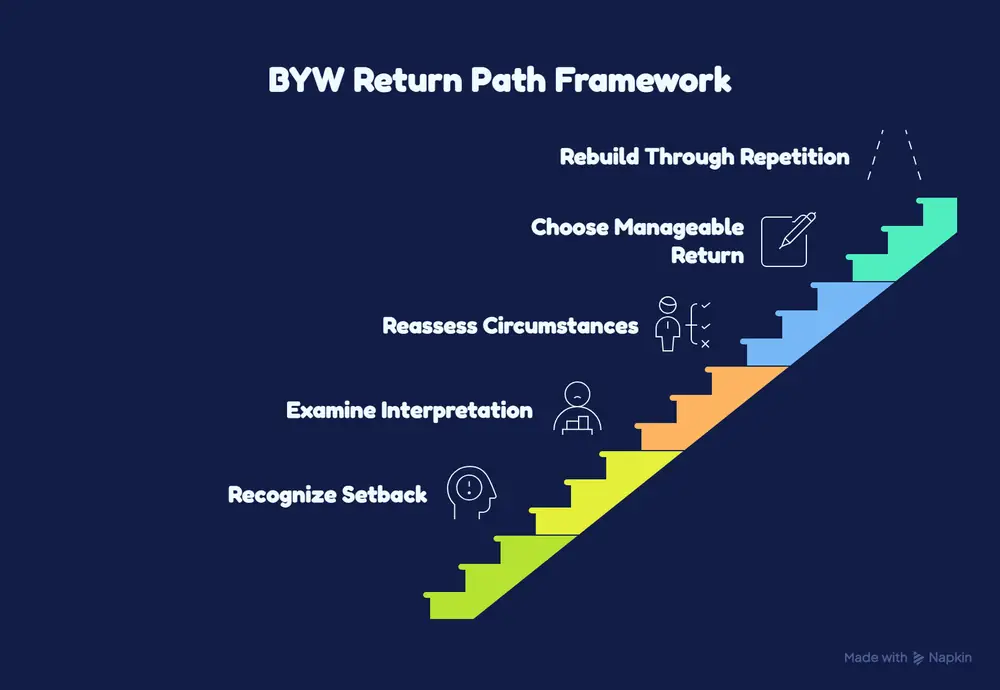 BYW Return Path Framework showing five steps to resume a habit after a setback: recognize the setback, examine interpretation, reassess circumstances, choose a manageable return, and rebuild through repetition.
The BYW Return Path Framework is a practical reflection tool, not a validated psychological model or a guaranteed sequence of behavior change.
It offers five steps for approaching an interrupted habit.
1. Recognize the Setback
Notice what interrupted the routine.
Was it illness, changing responsibilities, lack of time, or something else?
2. Examine Your Interpretation
Ask what you’re telling yourself about the interruption.
Am I treating one missed week as evidence that the entire effort failed?
3. Reassess Your Circumstances
Consider whether the previous routine still fits your life.
Can I return to the same schedule, or do I need to adjust it?
4. Choose a Manageable Return
Identify a realistic next action.
Could I write a short journal entry tonight?
5. Rebuild Through Repetition
Continue practicing where circumstances allow, reviewing and adjusting the routine as needed.
What would make it easier to journal again tomorrow?
Not every setback involves all-or-nothing thinking.
Not every return will immediately restore consistency.
And sometimes the right decision is to change or discontinue a habit that no longer serves you.
The framework is simply a way to approach a valued routine without automatically treating an interruption as total failure.
 BYW Insight
Getting back on track doesn’t require pretending the interruption never happened. It means accepting that it happened — and deciding that your earlier effort can still be part of what comes next.
 A Quiet Realization
The journal wasn’t asking for another thirty-one-day streak.
It didn’t need an explanation for the missed week.
It didn’t require a perfect comeback.
It was simply available for another entry.
And perhaps that was enough for today.