

The meeting gets pushed an hour before it starts, no real reason given.
In one version of this moment, the freed hour gets used almost immediately — an errand run, an email finally answered, something rearranged without much friction.
In another version, the same hour disappears into a low simmer of annoyance, replaying the inconvenience, unable to quite settle into anything else even once the schedule is technically clear again.
Same cancellation.
Same freed hour.
Same amount of actual disruption.
But very different responses to a plan that suddenly stopped being true.
Why Some People Adapt More Easily Than Others
It’s tempting to explain the difference through personality.
Some people are just easygoing.
Others aren’t.
But adaptability also involves psychological capacities that can vary and, importantly, can be developed.
One of the most relevant is cognitive flexibility — our ability to shift perspectives or approaches when circumstances and demands change.
Understanding that capacity gives us a more useful question than:
Why can’t I just go with the flow?
The better question is:
What allows the mind to stop working from the old version of events and respond to the one that exists now?
What Mental Flexibility Really Means
“Mental flexibility” is a useful everyday umbrella term, but it’s worth distinguishing two established psychological concepts that help explain it.
The first is cognitive flexibility.
Psychologist Adele Diamond identifies cognitive flexibility as one of three core executive functions, alongside working memory and inhibitory control.
Cognitive flexibility includes being able to change perspectives, think about something in a different way, and adapt flexibly when circumstances change.
In plain language, it’s part of what allows you to think:
The original plan isn’t happening. What makes sense now?
rather than continuing to mentally operate from a plan that no longer exists.
The second concept is psychological flexibility, particularly associated with Acceptance and Commitment Therapy (ACT).
Psychological flexibility is broader. It involves remaining in contact with present experience — including difficult thoughts and feelings — while being able to persist with or change behavior when doing so serves valued goals.
That emotional dimension connects naturally with How to Recover Emotionally After a Setback.
Throughout this article, when I use the broader phrase mental flexibility, I’m using it as a BYW umbrella for this practical ability to adjust how you think and respond when circumstances no longer match what you expected.
Why Rigid Thinking Can Make Change Harder
Imagine the canceled meeting again.
The calendar says the hour is free.
But mentally, you’re still inside the original plan.
This shouldn’t have happened.
They should have told me sooner.
Now the whole afternoon is ruined.
Some frustration may be entirely reasonable.
The problem comes when the mind becomes so attached to the version of events that should have happened that it struggles to respond to the version happening now.
Cognitive flexibility helps us shift perspective and adapt to changed circumstances.
That doesn’t mean flexible people never become irritated.
It means irritation doesn’t necessarily prevent the next mental move:
Okay. This is what happened. What can I do with the hour now?
This connects with Why Is Change So Hard?
Change repeatedly creates situations in which yesterday’s plan, strategy, expectation, or behavior no longer fits perfectly.
Mental flexibility becomes relevant precisely at that point.
How Mental Flexibility Supports Lasting Growth
Real change rarely follows the original plan exactly.
You decide you’ll exercise every morning.
Then work changes.
You plan to cook every evening.
Then family responsibilities shift.
You create the perfect routine.
Then ordinary life refuses to cooperate with it.
Without flexibility, every disruption can start looking like evidence that the plan has failed.
With greater flexibility, disruption can become information:
The original approach isn’t working under these conditions. What could I change?
This is one reason mental flexibility fits naturally within the broader system explored in Why Most Behavior Change Fails.
Behavior change doesn’t only require motivation.
It also requires adapting when reality stops cooperating with the original plan.
That is different from Mental Conditioning.
Mental conditioning focuses more broadly on strengthening patterns and capacities through repeated practice.
Mental flexibility concerns the ability to change the response or approach when the existing one no longer fits.
Sometimes growth requires staying with something.
Sometimes it requires changing course.
Knowing which one the situation calls for matters.
How Flexibility Supports Emotional Regulation
Flexibility also matters when the disruption isn’t only practical.
Sometimes the plan changes and your emotions arrive first.
Annoyance.
Embarrassment.
Anxiety.
Disappointment.
Anger.
In those moments, flexibility doesn’t mean forcing yourself to immediately feel differently.
Psychological flexibility, in particular, emphasizes being able to remain in contact with difficult internal experiences while still choosing behavior in relation to the situation and what matters to you.
That makes it relevant to How to Control Emotional Triggers Before They Control You.
A pause after an emotional trigger can create an opportunity to notice what you’re experiencing before acting.
Flexibility matters in what comes next:
Is my first interpretation the only possible one?
Does my first impulse fit what this situation actually needs?
Is there another response available to me?
The goal isn’t to eliminate the original reaction.
It’s to avoid treating it as the only response you are capable of making.
Mental Flexibility Isn’t the Same as Mental Toughness
This distinction matters.
Mental Toughness vs Mental Conditioning: What’s the Difference? explores the capacity to remain steady and continue under pressure.
Mental flexibility asks a different question:
Should I continue in exactly the same way?
Imagine you’ve planned to run five kilometers.
Halfway through, your knee begins hurting.
Persistence might say:
Keep going.
Flexibility asks:
Does continuing this way still make sense?
Sometimes the right response is persistence.
Sometimes it’s adjustment.
Sometimes it’s stopping.
A psychologically useful approach isn’t simply to become better at pushing through everything.
It’s to become better at responding to what the current situation actually requires.
The BYW Mental Flexibility Framework
The following is a BYW practical framework, not a scientifically established sequence proposed by Diamond or ACT researchers.
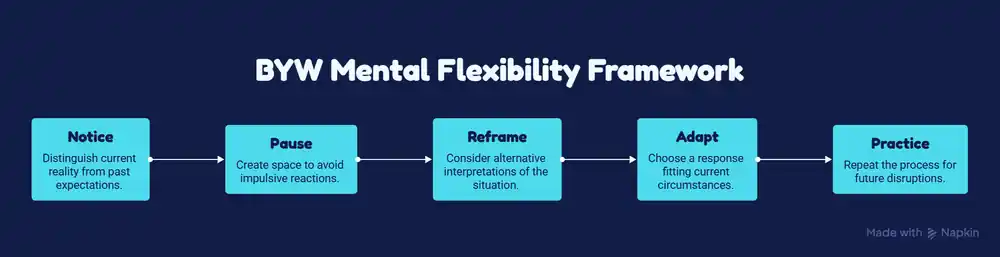 It translates the broader research on flexibility into five questions you can use when you notice yourself becoming stuck:
Notice → Am I responding to what’s happening now, or still reacting to what I expected to happen?
Pause → Can I create enough space to avoid treating my first reaction as my only option?
Reframe → Is there another reasonable way to understand this situation?
Adapt → What response fits the circumstances as they actually are now?
Practice → Can I repeat this process when the next disruption appears?
Diamond’s review gives us good reason to reject the idea that executive functions are simply fixed capacities we either possess or lack. It reviews evidence that executive functions can be improved through practice and intervention.
That doesn’t mean repeatedly following this exact five-step BYW framework has been experimentally shown to make the sequence automatic.
It means flexibility is something we can work on rather than treating every rigid response as permanent personality.