

Years ago, going for a run required an argument with yourself most mornings.
Reasons to skip appeared and had to be dismissed one by one before the shoes actually went on.
These days, the shoes go on.
There’s much less negotiation.
Part of that change may be familiar habit formation. Behaviors repeated in stable contexts can become increasingly automatic.
But something else can change alongside the habit:
the way you see yourself.
At first, you may be someone trying to become a runner.
After enough experience, you may simply think:
I run.
That shift doesn’t magically guarantee tomorrow’s behavior.
But it reveals an important relationship between what we repeatedly do and who we believe ourselves to be.
Why Lasting Change Can Eventually Feel More Natural
We often explain consistency by saying someone became more disciplined.
Sometimes that’s useful.
But it doesn’t tell the whole story.
Repeated behavior doesn’t happen separately from self-perception.
Psychological research gives us several different ways of understanding that relationship.
Daryl Bem’s self-perception theory proposed that, particularly when internal cues are weak or ambiguous, people can partly infer their own attitudes and internal states by observing their behavior and the circumstances in which it occurs.
Hazel Markus’s research on self-schemas showed that our accumulated experiences can contribute to cognitive structures about the self that organize how self-related information is processed.
William Swann’s self-verification research, especially in social contexts, shows another side of the relationship: people can seek, elicit and remember feedback that confirms existing self-conceptions.
And Bénabou and Tirole developed a theoretical model in which past behavior can carry information about one’s own willpower when forming expectations about future self-control.
These are different theories addressing different processes.
They do not collectively prove one universal identity-behavior mechanism.
But taken together, they give us a useful way to think about why repeated behavior and self-perception can begin supporting one another.
How Behavior Can Become Information About the Self
This starts with an idea explored more fully in You Don’t Change Habits: You Change Identity First.
We don’t only act from beliefs about ourselves.
What we do can also contribute to how we understand ourselves.
Bem’s self-perception theory is especially relevant here. It proposes that people can sometimes infer their own internal states partly by observing their behavior, particularly when their internal cues aren’t already clear.
Think about the difference between these two experiences:
I’m trying to make myself exercise.
and:
I’ve exercised four mornings this week.
The second statement doesn’t automatically transform your identity.
Four workouts don’t scientifically prove:
I am now an active person.
But repeated experiences give you something the aspiration alone cannot:
behavioral evidence.
Over time, those experiences can become part of the information from which you understand yourself.
How Self-Perception Can Influence What Comes Next
The relationship can also run in the other direction.
Once you have an established view of yourself, that self-view can influence how you process experiences related to it.
This is where How Your Self-Image Predicts Your Behavior becomes especially relevant.
Hazel Markus described self-schemata as cognitive generalizations about the self, derived from past experience, that organize and guide the processing of self-related information.
So if being physically active has become part of the way you understand yourself, relevant experiences don’t arrive on completely neutral ground.
You already have a mental structure through which some of that information is interpreted.
That is different from saying:
identity automatically causes matching behavior.
People behave inconsistently with their self-image all the time.
Context matters.
Motivation matters.
Opportunity matters.
Habits and environmental cues matter.
But self-perception is one part of the psychological context in which the next behavior occurs.
What Self-Verification Adds — and What It Doesn’t
William Swann’s self-verification theory adds another useful piece, but it needs to be described carefully.
The original draft treated self-verification as though it meant the mind generally makes everyday actions conform to identity.
That’s broader than the research supports.
Self-verification theory is strongly concerned with social self-verification — people’s tendency to prefer and sometimes actively obtain feedback and responses from others that confirm established self-views, even when those self-views are negative.
That tells us something important about identity:
once a self-view becomes established, people don’t necessarily approach every new piece of self-relevant information as a blank slate.
Existing self-views can have a degree of psychological continuity.
That helps explain why identity can sometimes feel remarkably stable.
But it doesn’t mean Swann demonstrated that identifying as “a runner” automatically makes running easier tomorrow.
That stronger everyday behavioral claim would go beyond the evidence.
Why Your Previous Actions Can Affect What You Expect From Yourself
Another part of this picture appears in Why You Keep Breaking Promises to Yourself.
Bénabou and Tirole developed a theoretical model of personal rules based on self-reputation over one’s willpower.
Because people may imperfectly remember their previous motives and circumstances, the model proposes that they can draw inferences about their own willpower from previous actions. A lapse can therefore become a precedent that affects future self-restraint.
Notice what this does — and doesn’t — tell us.
It doesn’t establish that:
every workout strengthens your identity.
Or:
every skipped workout weakens it.
And it doesn’t establish a universal psychological scoreboard in which every action casts an equal vote for the person you are becoming.
The idea is narrower.
Past behavior can sometimes become information we use when forming expectations about ourselves.
That distinction matters.
One skipped run after a sleepless night doesn’t suddenly make you “someone who quits.”
Likewise, one workout doesn’t permanently establish an athletic identity.
Patterns become meaningful in context.
How Identity and Habit Can Work Alongside Each Other
Now we can bring habit formation back into the picture.
How to Build Habits That Actually Stick explores how repeated behavior in recurring contexts can become more automatic.
That’s an important process in its own right.
If you put your running shoes beside the door every night and run at the same time each morning, repetition and stable contextual cues can help the behavior require less conscious deliberation.
Identity doesn’t need to replace that explanation.
Instead, the two can coexist.
The behavior may become easier partly because it is becoming habitual.
At the same time, repeated experiences may contribute to a self-understanding such as:
Running is something I do.
That self-understanding may then become part of the psychological context surrounding future choices.
This is a much more realistic picture than saying identity alone makes habits automatic.
Why Consistency Can Feel Easier Over Time
This also helps explain why established consistency can feel so different from beginning.
Early on, several things may still be unsettled.
The behavior isn’t habitual yet.
The routine isn’t stable.
You may not know whether you’ll maintain it.
And the new behavior may not fit comfortably into your existing self-concept.
Later, some of those conditions may change.
The routine becomes familiar.
Contextual cues become established.
You accumulate real experiences of following through.
And the behavior may become increasingly compatible with the way you understand yourself.
That’s very different from saying willpower eventually becomes unnecessary.
There will still be difficult mornings.
There will still be interruptions.
There will still be circumstances in which behavior and identity don’t align.
But the starting psychological landscape may no longer be the same.
This is also why identity doesn’t have to remain permanently fixed.
How to Change Your Identity When You Feel Stuck explores that process more directly.
A long-standing self-concept may be strongly established through years of experience, interpretation and reinforcement.
But strongly established isn’t the same thing as permanently true.
New experiences can give the mind new information to work with.
The BYW Identity Reinforcement Framework
The following is a BYW synthesis, not a scientifically established causal sequence.
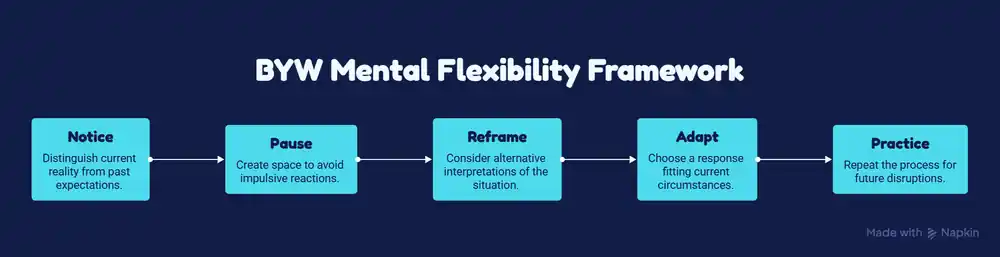
It brings several research traditions together to illustrate one practical way identity and repeated behavior may interact:
Existing Identity → You begin with some beliefs and expectations about yourself.
Action → You behave in a particular way within a particular context.
Experience → That behavior becomes part of your accumulating history.
Self-Interpretation → Some repeated experiences may contribute to how you understand and describe yourself.
Future Context → That self-understanding becomes one of many influences surrounding the next decision.
Repetition → Further experiences can reinforce, complicate or gradually change that self-understanding.
And then the relationship continues.
Not every action changes identity.
Not every identity belief produces matching behavior.
And the strength of these relationships will differ across people, situations and behaviors.
The value of the framework is not that it gives us a literal psychological mechanism.
It’s that it reminds us of something easy to miss:
behavior and self-perception don’t have to be separate stories.