

You decide to stretch for five minutes every morning.
Nothing complicated. No demanding workout. Just five minutes before the day begins.
But the exercise mat is folded away in the closet, behind the winter coats.
Most mornings, the stretching doesn’t happen.
You tell yourself you’ll do it tomorrow.
And tomorrow, the mat is still in the closet.
It’s tempting to assume you simply don’t want the habit badly enough.
But there’s another possibility worth considering.
Sometimes, the obstacle between an intention and an action matters more than we realize.
Why Small Obstacles Can Have Big Effects
We often think of behavior change in terms of motivation and discipline.
If something matters enough, surely we’ll find a way to do it.
But wanting an outcome and taking the steps required to reach it are different things.
Consider two versions of the same morning.
In the first, you need to find your mat, move a few things aside, unfold it, and clear some floor space.
In the second, the mat is already waiting beside your bed.
The stretching itself hasn’t changed.
The goal hasn’t changed.
But the effort required to begin has.
That difference is what we’re exploring through the idea of behavioral friction.
What Behavioral Friction Really Means
Behavioral friction is a practical term for the obstacles, effort, or inconvenience involved in performing an action.
It can involve physical effort, mental effort, time, unnecessary steps, or difficulty getting started.
For example:
-
- Searching for workout clothes before exercising.
-
- Completing several unnecessary steps before preparing a healthy meal.
-
- Having to remember where you saved an important document.
-
- Navigating a complicated process to complete a simple task.
These obstacles don’t necessarily prevent behavior.
But they can make one action less convenient than another.
Research on effort-based decision-making helps explain why this matters.
In a series of experiments, researchers Wouter Kool, Joseph McGuire, Zev Rosen, and Matthew Botvinick investigated how people respond to differences in cognitive demand.
Their study, Decision Making and the Avoidance of Cognitive Demand, found that participants tended to avoid more cognitively demanding options, even when the task structure reduced other reasons to prefer one option over another.
The findings support the idea that cognitive effort can carry a subjective cost.
That doesn’t mean every small inconvenience has the same effect.
Nor does the study directly test everyday obstacles such as retrieving exercise equipment.
But it gives us an important insight:
Effort itself can matter when people choose what to do.
How Friction Can Influence Everyday Decisions
Think about how often you choose between two actions that are both available.
You could prepare something nutritious.
Or eat whatever requires the least preparation.
You could open the book you intended to read.
Or continue scrolling through the phone already in your hand.
You could begin your workout.
Or postpone it until the equipment is ready.
These choices involve more than effort alone.
Hunger, fatigue, interest, priorities, habits, and circumstances can all influence the outcome.
But convenience may be one contributing factor.
BJ Fogg’s Behavior Model offers a useful practical way to think about this.
The model describes behavior as occurring when motivation, ability, and a prompt come together.
Within that framework, making an action easier can increase the opportunity for it to happen, particularly when motivation is limited.
This is a practical behavior-design model rather than direct experimental proof that removing any particular obstacle will change someone’s behavior.
It connects naturally with How Does Your Environment Affect Your Behavior?
Our surroundings can make some actions easier to notice, access, or perform than others.
Behavioral friction focuses on one part of that relationship:
How much effort does the environment require before you can act?
Why Motivation Doesn’t Always Overcome Friction
You can genuinely want something and still struggle to do it.
That’s an important distinction.
Wanting to exercise doesn’t guarantee that every morning will feel equally manageable.
Wanting to eat better doesn’t eliminate the work involved in planning meals.
Wanting to read more doesn’t mean you’ll always choose reading over a more immediately convenient activity.
Motivation can influence whether effort feels worthwhile.
But effort requirements also matter.
This connects with Why Do I Lose Motivation?
Initial excitement can make a new routine feel easier to begin. When that excitement settles, the same routine may require more deliberate effort.
That doesn’t mean motivation inevitably disappears.
It means a behavior that depends on feeling enthusiastic every time may become difficult to maintain.
Consider the stretching mat again.
On an energetic morning, retrieving it may feel trivial.
On a tired morning, the same task may feel like one more thing to do.
The obstacle hasn’t changed.
But your willingness or capacity to deal with it may have.
This is also relevant to Why You Can’t Stay Disciplined.
Rather than assuming every missed action reflects insufficient discipline, it’s worth examining whether the routine contains avoidable difficulties.
Sometimes the better question isn’t:
How can I force myself to try harder?
It’s:
What is making this harder to begin than it needs to be?
How Reducing Friction Can Make Consistency Easier
Reducing friction means identifying and simplifying unnecessary effort involved in a desired behavior.
You aren’t necessarily changing the goal.
You’re changing the conditions surrounding the action.
For example, if you want to stretch in the morning, you could leave the mat in an accessible place.
If you want to read before bed, you could keep your book beside the bed rather than somewhere you have to search for it.
If you want to prepare healthier meals, you could organize ingredients so the first step requires less preparation.
None of these adjustments guarantees that the behavior will happen.
But they remove some of the obstacles that might otherwise discourage it.
The same principle can work in reverse.
In How to Eliminate Distractions and Stay Disciplined, we explore ways to make unwanted behaviors less immediately accessible.
For instance, moving your phone away from your workspace introduces an extra step before checking it.
Whether that extra step changes your behavior will depend on context and other influences.
But it can interrupt the convenience of acting immediately.
This connects with the broader behavior-change system discussed in Why Most Behavior Change Fails.
Motivation matters.
Habits matter.
Environment matters.
And the effort required to act deserves attention too.
The BYW Friction Reduction Framework
The following is a BYW practical synthesis, not a scientifically established causal sequence.
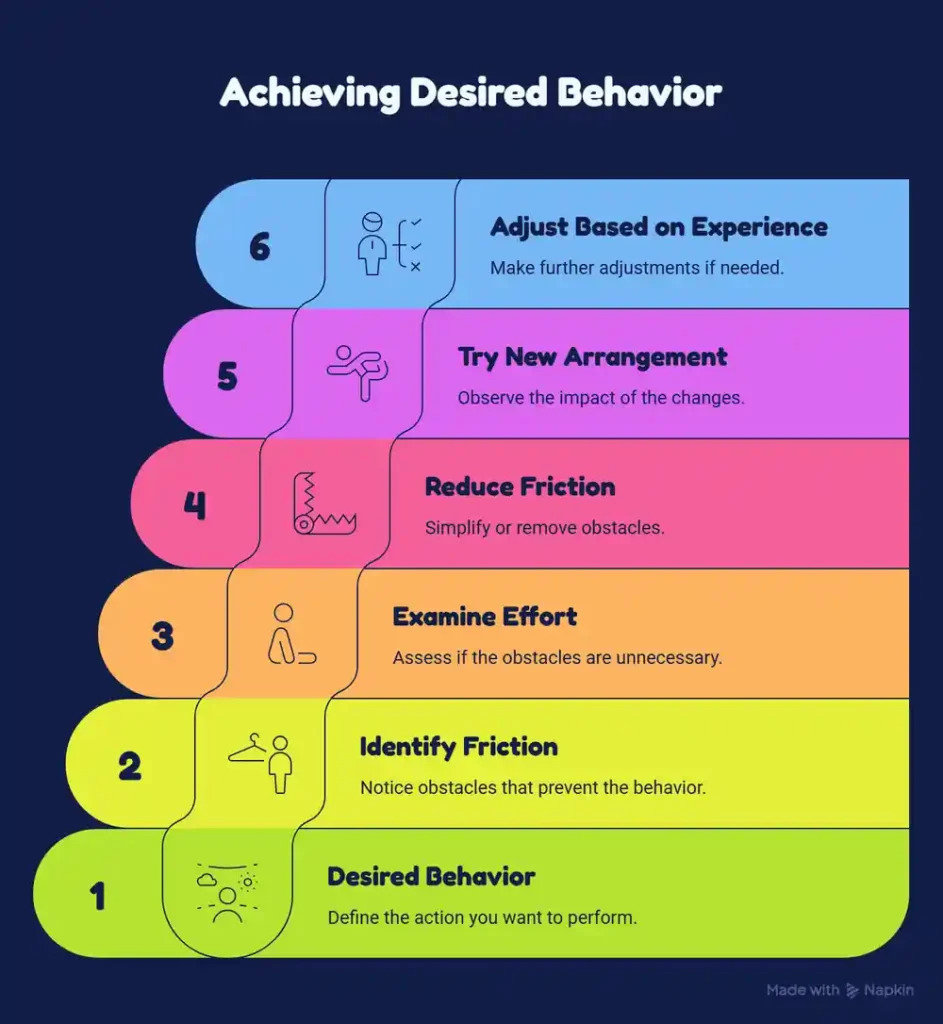 BYW Friction Reduction Framework showing six steps: desired behavior, identify friction, examine effort, reduce friction, try a new arrangement, and adjust based on experience.
It helps you examine where unnecessary effort may be interfering with a behavior you want to repeat.
1. Desired Behavior
Identify the action you want to perform.
I want to stretch for five minutes each morning.
2. Identify Friction
Notice what must happen before you can begin.
I need to retrieve the mat, move the coats, and find a suitable space.
3. Examine the Effort
Ask whether those steps create an unnecessary obstacle.
Would starting feel simpler if everything were already prepared?
4. Reduce Friction
Remove or simplify an avoidable step.
Leave the mat somewhere accessible before going to bed.
5. Try the New Arrangement
Observe whether the easier setup helps you begin more often.
Do I stretch more frequently when the mat is ready?
6. Adjust Based on Experience
If the behavior still doesn’t happen, look for other barriers.
Perhaps the timing is unrealistic.
Perhaps you’re too tired.
Perhaps the routine needs to change.
Reducing friction is one possible adjustment, not a complete explanation of behavior.
This framework is a practical decision aid. The research on cognitive effort avoidance does not establish this exact sequence or guarantee improved consistency from following it.