
Why You Can’t Stay Consistent: Even When Motivated
You feel motivated at the beginning. You make plans. You set goals. You imagine becoming more productive, healthier, calmer, or more disciplined.
And for a short time, it works.
You follow the routine. You feel hopeful. You finally believe change is happening.
Then something shifts. The energy fades. The consistency disappears.
And eventually you find yourself back in old patterns again.
If you constantly search why can’t I stay consistent, the problem is probably deeper than simple motivation.
Because consistency is not built through emotional excitement alone.
It is built through systems, emotional regulation, subconscious patterns, and repeatable behavior.
If you have already read Why You Can’t Stick to Habits Long Term, you already understand that repeated behavior patterns are often emotionally reinforced long before they become visible habits.
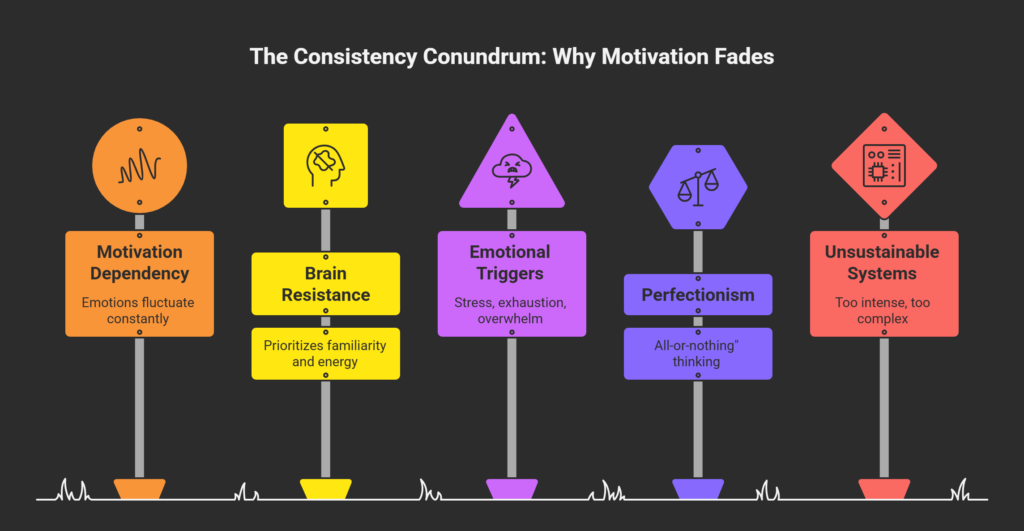 The foundational friction point where conscious willpower breaks down and automatic patterns take over.
Why Motivation Always Feels Strong at the Beginning
Motivation feels powerful initially because novelty creates emotional energy and dopamine driven excitement. But consistency becomes difficult when routines depend entirely on temporary emotional states instead of sustainable systems and identity based behavior.
The beginning of change feels exciting because the brain responds strongly to:
- novelty
- possibility
- anticipation
- emotional hope
You imagine a better future version of yourself. That imagination creates temporary momentum.
But motivation is emotional. And emotions fluctuate constantly.
This is why people often feel highly committed:
- on Mondays
- at the start of the month
- after emotional realizations
- after watching motivational content
But long term consistency requires behavior that survives:
- stress
- boredom
- fatigue
- emotional overwhelm
- ordinary days
And that is much harder psychologically.
According to Cleveland Clinic, sustainable routines rely more on repetition and environmental structure than short term bursts of motivation.
Motivation vs Discipline: What Actually Creates Consistency?
Motivation and discipline are often treated as opposites.
But they serve different purposes.
Motivation gives you the emotional energy to begin.
Discipline helps you continue when the excitement fades.
The problem is that neither works well without a repeatable system.
Motivation changes with:
- mood
- stress
- sleep
- energy
- emotional pressure
Discipline can also become difficult when every action requires conscious effort.
This is why long-term consistency depends on more than forcing yourself to act.
As behaviors are repeated, they gradually require less decision-making. The routine begins feeling more familiar, and the brain meets it with less resistance.
So motivation may start the action.
Discipline may help you return.
But consistent habits are what make the behavior easier to maintain over time.
The Brain Naturally Resists Long Term Change
This surprises many people.
They assume the mind should automatically support self improvement.
But the brain prioritizes:
familiarity and energy conservation.
Not transformation.
That means even frustrating routines can begin to feel emotionally safe simply because they are predictable.
So when you try to introduce major change, the brain often responds with:
- resistance
- procrastination
- avoidance
- mental fatigue
- inconsistency
Not because you are weak.
But because behavioral change creates uncertainty.
And uncertainty feels uncomfortable to the nervous system.
When Consistency Conflicts With Your Identity
People often assume consistency is simply a matter of effort.
But effort is only part of the story.
Many people carry quiet beliefs such as:
- “I never stick with things.”
- “I always lose momentum.”
- “I am not disciplined.”
- “I have tried before and failed.”
Over time, these beliefs become part of identity.
And when a new routine starts challenging that identity, internal resistance often appears.
The subconscious mind prefers familiar self perceptions, even when they are limiting.
That is why consistency is not only about building better habits.
It is also about building a different relationship with yourself.
Why You Lose Consistency So Quickly
Consistency often collapses in predictable emotional situations.
For example:
- after stress
- after one missed day
- during emotional exhaustion
- when results feel slow
- when life becomes overwhelming
The brain quietly searches for relief. And familiar behaviors usually require less emotional effort than new ones.
That is why people return to:
- scrolling
- comfort eating
- procrastination
- avoidance
- staying up late
- abandoning routines
even when they genuinely want change.
Most Consistency Advice Ignores Emotional Reality
A lot of self improvement advice sounds simple:
“Just stay disciplined.”
But discipline is not purely mechanical. Human behavior is emotional.
Someone dealing with:
- burnout
- anxiety
- emotional overwhelm
- internal pressure
will experience consistency very differently from someone with emotional stability and strong routines.
That is why harsh self criticism rarely creates sustainable growth.
It often creates:
- shame
- emotional exhaustion
- perfectionism
- self doubt
which makes consistency even harder.
The All or Nothing Pattern
One of the biggest causes of habit inconsistency is perfectionist thinking.
The mind quietly creates rules like:
- “If I miss one day, I failed.”
- “If I cannot do it perfectly, there is no point.”
- “I already ruined the routine.”
So one interruption becomes a complete collapse.
This pattern appears constantly in:
- workouts
- journaling
- meditation
- dieting
- productivity routines
And over time, restarting becomes emotionally exhausting.
If you struggle with this cycle repeatedly, How to Build Habits That Actually Stick explains why smaller sustainable systems usually work better than extreme behavioral overhauls.
Consistency Is More About Identity Than Motivation
This is one of the most important psychological shifts.
People often focus only on outcomes:
- losing weight
- becoming productive
- waking up early
- building routines
But the brain responds more deeply to identity.
For example, Instead of:
“I need to exercise.”
The identity shift becomes:
“I am becoming someone who takes care of my body consistently.”
That subtle difference matters.
Because identity based behavior creates less internal conflict over time.
The Hidden Emotional Cost of Constant Restarting
Repeated inconsistency affects more than routines.
Eventually it affects:
self-trust.
You begin doubting your own promises. And that emotional disappointment quietly builds.
This often creates internal thoughts like:
- “I never stay consistent.”
- “I always quit.”
- “I cannot maintain anything.”
The brain slowly absorbs these patterns as identity.
And once inconsistency becomes identity based, change feels even harder.
Why Consistency Feels Easier for Some People
People often assume naturally consistent individuals simply have stronger discipline.
But consistency usually depends on:
- environment
- emotional regulation
- nervous system stability
- realistic expectations
- supportive routines
- reduced decision fatigue
For example, someone with:
- predictable routines
- lower emotional stress
- healthier sleep
- structured systems
will naturally experience less behavioral resistance.
Consistency is rarely just “mindset.” It is usually systemic.
A Simple Framework That Explains Consistency
Motivation → Action → Friction → Emotional Response → Pattern
Here is how the cycle usually works:
Motivation
You feel inspired to change.
↓
Action
You begin the routine.
↓
Friction
The routine becomes inconvenient or emotionally difficult.
↓
Emotional Response
Stress, boredom, fatigue, frustration, or pressure appears.
↓
Pattern
The brain returns to familiar comfortable behavior.
Most people only focus on:
motivation and action.
But real consistency depends on understanding:
friction and emotional response.
A Real Life Example: Workout Consistency
Someone starts exercising intensely:
- six days weekly
- strict meal plans
- aggressive routines
For two weeks they feel motivated.
Then:
- life becomes busy
- exhaustion increases
- routine feels overwhelming
Missing one workout triggers guilt. Eventually the entire routine collapses.
The problem was not lack of desire.
The problem was:
unsustainable intensity.
Another Way This Often Appears: Productivity Routines
Another person creates:
- complex schedules
- morning routines
- strict productivity systems
But emotionally, they are already overwhelmed. The routine adds pressure instead of stability.
So procrastination becomes emotional relief.
Again, not laziness. Just psychological overload.
One Misconception That Keeps People Stuck
Many people believe that consistency should feel natural once you are motivated enough.
But consistency often feels repetitive, ordinary, and emotionally neutral. That is normal.
Sustainable routines are usually less exciting than people expect.
And that is actually a good sign.
Because stable behavior depends more on rhythm than emotional intensity.
Reflection Pause
Ask yourself honestly:
- Which routines collapse most often in your life?
- What emotional state usually comes before inconsistency?
- Are your systems realistic or emotionally exhausting?
- Do you expect perfection from yourself?
- What would consistency look like if it felt calmer instead of extreme?
Pause there for a moment.
Because awareness changes behavior more than self judgment ever will.
How to Stay Consistent Without Depending on Motivation
Learning how to stay consistent is rarely about finding more motivation.
It is about making your habits simple enough to continue during both good days and difficult ones.
Small, repeatable actions create far more lasting change than ambitious plans that depend on constant willpower.
The goal is not to feel motivated every day. It is to build routines that keep working even when motivation naturally fades.
1. Reduce Behavioral Friction
Make routines easier to begin.
Examples:
- prepare clothes earlier
- reduce distractions
- simplify goals
- remove unnecessary steps
The brain repeats behaviors that require less resistance.
2. Stop Building Extreme Systems
Consistency grows through repeatability.
Not intensity.
Smaller routines survive stressful periods more easily.
3. Focus on Returning, Not Perfection
Missing one day is normal.
The important skill is:
returning without emotional collapse.
That changes everything psychologically.
4. Build Emotional Awareness
Notice:
- when motivation disappears
- what emotions trigger avoidance
- which situations create resistance
Patterns become easier to interrupt once they are visible.
5. Create Systems for Low Energy Days
A sustainable routine should still function during:
- stress
- fatigue
- emotional overwhelm
- busy schedules
That flexibility prevents all-or-nothing collapse.
Why Discipline Feels Emotionally Difficult
Sometimes discipline feels hard because the brain associates structure with:
- pressure
- criticism
- burnout
- unrealistic expectations
This creates subconscious resistance.
If that pattern feels familiar, Why You Can’t Stay Disciplined: How to Fix It explores the emotional side of discipline more deeply.
Consistency Is Built, Not Born
Many people believe consistency is a personality trait.
It isn’t.
Consistency is a habit built through repetition.
Every time you repeat a small behavior, you strengthen the brain’s expectation that this action is part of your normal routine.
Over time, showing up requires less mental effort and becomes more automatic.
That is why building consistent habits is far more effective than relying on occasional bursts of motivation.
The Goal Is Not Perfect Consistency
This matters deeply. Healthy consistency is not robotic perfection.
It is:
- adaptability
- returning after setbacks
- emotional awareness
- sustainable pacing
- self-trust
The people who appear “consistent” are usually just better at:
recovering without quitting.













2 Responses