
Sometimes a small moment affects you far more deeply than expected.
A comment. A tone of voice. Being ignored. Criticism. A delayed reply.
Logically, part of you knows:
“This should not affect me this much.”
But emotionally, the reaction feels immediate, powerful, and difficult to control.
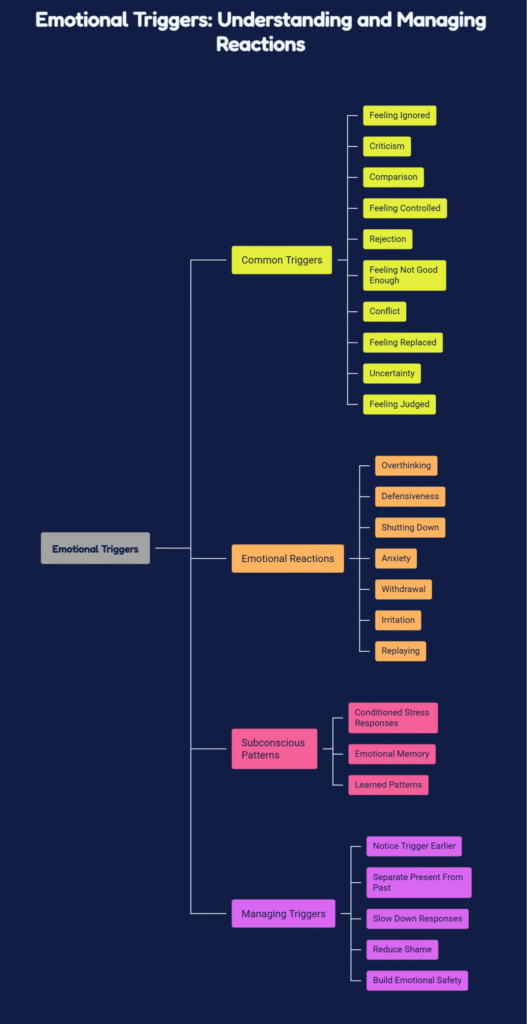
You may suddenly find yourself overthinking, becoming defensive, withdrawing emotionally, or replaying the situation long after it has passed.
These reactions are rarely random.
Most emotional triggers are connected to deeper subconscious patterns, emotional memories, and conditioned stress responses that operate beneath conscious awareness.
According to research from the American Psychological Association, automatic emotional reactions are closely connected to emotional memory and learned psychological patterns. This is why certain situations can affect you so intensely even when the logical part of your mind knows the situation may not be dangerous.
If you’ve already explored Emotional Triggers: Why You React So Deeply, you already know that emotional reactions often begin long before conscious thinking catches up.
What Are Emotional Triggers?
Emotional triggers are situations, words, memories, behaviors, or experiences that automatically activate a strong emotional response.
In simple terms, being “triggered” means that something in the present has activated an emotional reaction that feels much bigger than the situation itself. The reaction often happens so quickly that it feels automatic before you have time to think logically.
Sometimes the trigger is obvious. Sometimes it is surprisingly small.
A delayed message.
A critical comment.
A look on someone’s face.
Being excluded from a conversation.
The event itself may seem minor, but the brain often connects it to something emotionally significant from the past. When that happens, old emotional patterns become activated automatically.
This is why certain reactions can feel immediate, intense, and difficult to control.
10 Common Emotional Trigger Examples That Control Behavior
The following emotional trigger examples are some of the most common patterns people experience in everyday life. While everyone’s experiences are different, these situations often activate automatic emotional reactions connected to past experiences, subconscious beliefs, or learned emotional responses.
1. Feeling Ignored or Unimportant
Many people become emotionally triggered when:
- messages go unanswered
- someone seems distracted
- attention feels withdrawn
- they feel excluded socially
The emotional reaction often connects to deeper fears like:
- rejection
- abandonment
- invisibility
- emotional neglect
The trigger activates emotional memory faster than conscious logic.
Pause and Reflect
Sometimes the strongest reactions are not about:
the current moment itself.
They are about:
what the moment emotionally represents internally.
2. Criticism or Negative Feedback
Even small criticism can trigger:
- defensiveness
- shame
- anxiety
- emotional shutdown
especially for people who subconsciously associate mistakes with:
- rejection
- failure
- worthlessness
- pressure
The brain interprets criticism emotionally before reasoning fully engages.
3. Being Compared to Others
Comparison often triggers:
- insecurity
- self doubt
- frustration
- inadequacy
especially in environments focused heavily on:
- achievement
- appearance
- status
- validation
Social comparison activates subconscious identity fears very quickly.
4. Feeling Controlled or Micromanaged
Some people react intensely when:
- being told what to do
- feeling micromanaged
- losing autonomy
- feeling emotionally pressured
because control related situations can subconsciously trigger:
- powerlessness
- restriction
- emotional suffocation
The emotional reaction may appear stronger than the visible situation itself.
5. Rejection or Disapproval
This is one of the strongest emotional trigger examples in daily life.
Humans are psychologically wired for:
- belonging
- acceptance
- social safety
So rejection often activates:
- fear
- shame
- emotional pain
- overthinking
- self-criticism
According to Cleveland Clinic, social rejection can strongly affect emotional regulation and stress response systems.
A Real Life Example
Someone receives a short text message that simply says:
“Okay.”
Logically, it could mean almost anything.
The sender may be busy. Distracted. Tired.
But emotionally, the receiver begins analyzing the tone, replaying previous conversations, and wondering if something is wrong.
The emotional reaction is not actually responding to the message itself.
It is responding to the fear, meaning, or memory the message unconsciously activates.
This is how emotional triggers often work in daily life.
6. Feeling Not Good Enough
Situations involving:
- achievement
- appearance
- intelligence
- productivity
can trigger strong insecurity patterns.
The subconscious mind may automatically activate:
“I am falling behind.”
“I am not enough.”
“Others are doing better.”
These emotional patterns often become deeply conditioned over time.
7. Conflict and Raised Voices
For some people:
- arguments
- tension
- confrontation
- loud voices
immediately trigger:
- anxiety
- shutdown
- emotional overwhelm
- avoidance
especially if conflict previously felt emotionally unsafe.
The nervous system begins anticipating emotional danger automatically.
8. Feeling Replaced or Unvalued
This trigger often appears in:
- friendships
- relationships
- workplaces
The emotional reaction may include:
- jealousy
- sadness
- insecurity
- withdrawal
because the subconscious brain interprets social displacement as:
emotional threat.
9. Uncertainty and Lack of Control
Many people become emotionally triggered by:
- unclear situations
- unpredictability
- waiting
- unanswered questions
The brain naturally seeks:
- certainty
- predictability
- emotional safety
So uncertainty often increases:
- overthinking
- anxiety
- stress responses
This is closely connected to the subconscious patterns discussed in Why Work Triggers You More Than You Think.
10.Feeling Judged or Embarrassed
Embarrassment triggers often create:
- emotional replaying
- rumination
- shame
- social anxiety
The subconscious mind treats social judgment as emotionally important because belonging historically mattered for survival psychologically.
This is why embarrassing moments can replay repeatedly in the mind.
Why Emotional Triggers Feel Automatic
Emotional triggers rarely appear out of nowhere.
Most reactions follow a conditioned psychological loop that becomes stronger through repetition.
A simplified version looks like this:
Trigger → Emotional Reaction → Protective Response → Reinforcement
Example:
Criticism → Shame → Defensiveness → Brain remembers the pattern
Over time, these loops become increasingly automatic because the brain learns to anticipate emotional danger before conscious reasoning fully engages. This is why people often describe themselves as feeling triggered. The emotional response happens so quickly that the brain reacts before you have time to evaluate what is actually happening in the present moment.
One Important Misconception About Triggers
Many people assume:
“If I get triggered easily, I must be emotionally weak.”
But emotional triggers are not signs of weakness.
More often, they reflect emotional conditioning, nervous system sensitivity, unresolved experiences, or deeply learned psychological patterns.
The goal is not to eliminate emotional reactions completely.
The goal is to understand them well enough that they no longer control your behavior automatically.
Why Emotional Triggers Affect Relationships
Many relationship struggles are not caused by the current situation itself.
They are caused by the emotional meaning attached to it.
One partner sees a delayed reply.
The other partner sees a harmless inconvenience.
The trigger is not the delay.
The trigger is what the delay subconsciously represents.
This is why unresolved triggers often create repeated cycles of misunderstanding, reassurance seeking, defensiveness, conflict, or emotional withdrawal.
Without awareness, people often react to old emotional wounds while believing they are reacting only to the present moment.
Reflection Pause
Ask yourself honestly:
- Which situations affect you most emotionally?
- What emotion usually appears first?
- What fear sits underneath that reaction?
- Which patterns keep repeating in your life?
- Are you reacting to the situation itself, or what it represents?
Awareness does not solve every emotional pattern immediately.
But it often weakens the automatic nature of the loop.
How to Control Emotional Triggers Before They Control You
If you’ve ever wondered what to do when you feel triggered, the goal isn’t to eliminate emotional reactions completely. The goal is to recognize them earlier, slow down automatic responses, and choose a healthier way to respond. Learning how to deal with triggers is a gradual process that becomes easier with practice and self-awareness.
1. Notice the Trigger Earlier
Awareness creates interruption.
Pay attention to:
- body tension
- emotional shifts
- racing thoughts
- defensiveness
- withdrawal urges
These signals often appear before reactions intensify.
2. Separate the Present From the Past
Sometimes current situations activate:
older emotional conditioning.
Ask:
“Am I reacting only to this moment, or to what it emotionally reminds me of?”
That question creates psychological distance.
3. Slow Down Automatic Responses
Even small pauses matter.
Examples:
- breathing before replying
- delaying reactive messages
- stepping away temporarily
- journaling emotions
Small interruptions reduce emotional impulsivity.
4. Replace Self Criticism With Curiosity
Instead of:
“Why am I reacting like this?”
Try:
“What is this reaction trying to show me?”
Understanding creates more emotional regulation than self judgment ever will.
5. Build Emotional Safety Gradually
Triggers weaken when the nervous system repeatedly experiences:
- calmness
- emotional regulation
- healthier responses
- supportive environments
If you want deeper practical strategies, continue with How to Control Emotional Triggers Before They Control You.