
You know what you want to change.
Maybe it is:
- overthinking
- anxiety
- self-sabotage
- people pleasing
- procrastination
- negative thinking
- unhealthy habits
You have read the advice.
You have made the plans.
You have promised yourself that this time will be different.
Yet somehow the same patterns keep returning.
Not because you want them to.
Not because you are lazy.
Not because you secretly enjoy struggling.
But because much of human behavior operates from subconscious programming that developed long before conscious awareness became involved.
This is why many people feel trapped between what they know and what they repeatedly do.
If you have already read 10 Subconscious Behaviors You Didn’t Realize Control You, you have already seen how automatic many daily actions and reactions can become.
The next question is:
Can those patterns actually change?
The answer is yes.
But probably not in the way most people think.
What Is Subconscious Reprogramming?
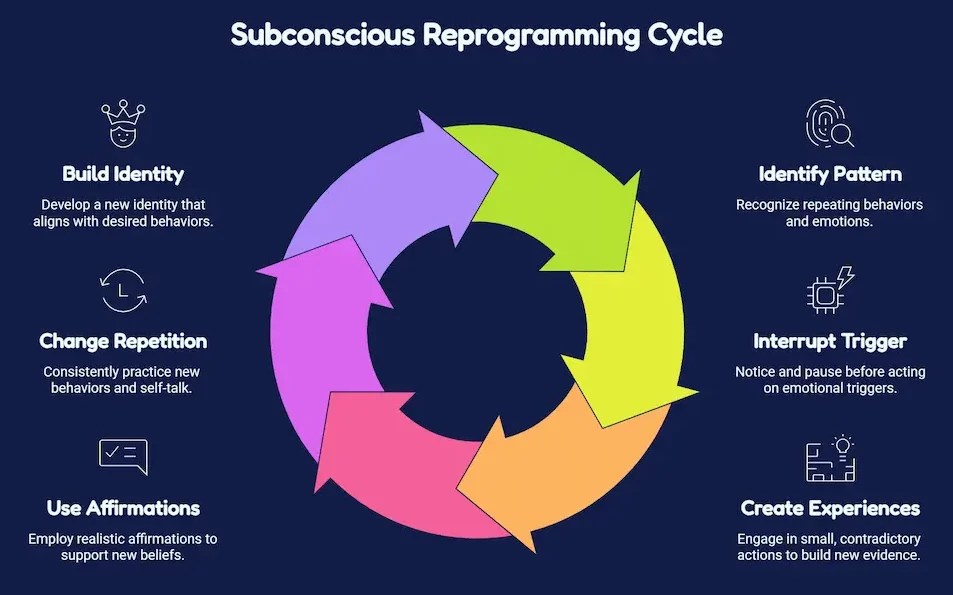
Subconscious reprogramming is the process of gradually changing automatic beliefs, emotional reactions, thought patterns, and behaviors stored beneath conscious awareness. It works through repetition, emotional reinforcement, new experiences, and consistent behavioral conditioning rather than sudden breakthroughs or positive thinking alone.
The goal is not to force yourself into becoming someone new overnight.
The goal is to change the patterns your brain automatically returns to.
That distinction matters.
Because lasting change is usually less dramatic than people expect.
And much more psychological.
Why Your Subconscious Mind Keeps Repeating the Same Patterns
Most people assume that if they consciously want something, their mind should automatically support it.
But the subconscious mind works differently.
Its primary job is not transformation.
Its primary job is:
- predictability
- efficiency
- familiarity
- emotional safety
This means the subconscious mind tends to repeat what it already knows.
Even when those patterns create frustration.
Even when those patterns no longer serve you.
According to research discussed by the Cleveland Clinic, repeated thoughts, emotional responses, and behaviors become increasingly automatic through reinforcement and repetition.
The subconscious mind learns through repeated experiences, gradually associating certain situations with safety, danger, success, or failure.
Over time, these repeated experiences do more than influence behavior. They gradually shape identity. People stop saying, “I keep procrastinating,” and begin saying, “I’m a procrastinator.” They stop saying, “I struggle with confidence,” and begin believing, “I’m just an insecure person.” That shift matters because repeated patterns can slowly become part of how we define ourselves, even though they originally developed through learned experiences rather than permanent personality traits.
This is why someone may consciously want confidence while subconsciously expecting rejection.
From a psychological perspective, the brain is constantly engaged in predictive processing. Rather than waiting to see what happens, it continually generates automatic predictions based on past experiences, allowing familiar patterns to repeat before conscious awareness fully catches up.
Or consciously desire consistency while subconsciously expecting failure.
The two systems can operate in conflict.
And that conflict often feels confusing.
A Quiet Realization
Many people are not fighting their circumstances.
They are fighting subconscious expectations created years ago.
The subconscious mind constantly makes automatic predictions about what is likely to happen next based on previous experiences.
The Hidden Pattern Most People Miss
When people search for how to reprogram subconscious mind patterns, they usually focus on the visible behavior.
For example:
- procrastination
- anxiety
- self-doubt
- emotional reactions
- negative thinking
But the behavior is rarely the actual problem.
The behavior is often protecting something deeper.
Underneath many conditioned responses are cognitive schemas, mental frameworks the brain develops through repeated experiences. These schemas quietly influence how situations are interpreted long before conscious reasoning begins.
For example:
A person who procrastinates may not have a productivity problem.
They may have a fear of failure problem.
Someone who constantly seeks reassurance may not have a confidence problem.
They may have an emotional safety problem.
Someone who repeatedly avoids opportunities may not have a motivation problem.
They may have an uncertainty problem.
This is where many self-help approaches fail.
They focus on changing behavior without understanding what the behavior protects.
The subconscious mind always has a reason.
Even when the reason is outdated.
One Misconception About Subconscious Reprogramming
One of the biggest misconceptions online is that subconscious reprogramming is simply repeating positive affirmations until your life changes.
That idea sounds appealing.
But it oversimplifies how the brain actually works.
The subconscious mind does not automatically accept every statement you repeat.
Instead, it pays attention to:
- repetition
- emotional intensity
- lived experience
- environmental evidence
- behavioral proof
According to research discussed by American Psychological Association, belief systems are strongly influenced by repeated experiences and reinforcement, not merely verbal repetition.
This does not mean affirmations are useless.
It means affirmations work best when supported by behavior.
Because the brain trusts evidence more than wishes.
Real-Life Examples of Subconscious Programming
Anxiety and Threat Prediction
Someone receives a message that simply says:
“We need to talk.”
Immediately their mind begins imagining:
- conflict
- criticism
- rejection
- bad news
Nothing has happened yet.
But anxiety appears automatically.
Why?
Because the subconscious mind has learned to associate uncertainty with danger.
If this pattern feels familiar, Why Your Subconscious Mind Keeps You Anxious explores how subconscious threat prediction develops.
The reaction feels automatic because it is.
The brain is responding to old conditioning.
Not current reality.
Self-Sabotage and Familiarity
Someone starts improving their life.
They begin:
- exercising
- setting boundaries
- building confidence
- creating routines
For a few weeks everything feels positive.
Then suddenly:
- procrastination returns
- consistency disappears
- avoidance increases
The person becomes frustrated.
But often the subconscious mind is responding to something deeper.
Growth feels unfamiliar.
And unfamiliarity can feel threatening.
The subconscious mind sometimes chooses familiarity over improvement.
Much of this learning is stored as implicit memory, allowing old patterns to influence behavior even when you cannot consciously remember where they began.
Not because it hates success.
Because it trusts what it already knows.
Why Old Patterns Keep Returning
Many people assume that awareness alone should eliminate unwanted patterns.
Unfortunately, awareness is only the beginning.
Patterns repeat because they are reinforced.
The brain also tends to look for evidence that confirms existing beliefs, a tendency psychologists refer to as confirmation bias. This makes old subconscious expectations feel increasingly true over time.
The Old Pattern Cycle
Trigger
↓
Automatic Behavior
↓
Temporary Relief
↓
Reinforcement
↓
Pattern Strengthens
This cycle explains why unwanted behaviors can feel so difficult to break. The subconscious mind pays attention to what brings immediate relief, even if the long term outcome is unhelpful. Every repetition strengthens the expectation that this is the normal way to respond.
Because repetition alone is not enough.
The brain also needs evidence.
A Pattern Most People Never Notice
The subconscious mind does not learn from what you want.
It learns from what you repeatedly do.
That difference explains many failed attempts at change.
Reflection Pause
Ask yourself honestly:
• Which patterns keep repeating despite your efforts to change?
• What emotional state usually appears before those patterns?
• What behaviors feel automatic rather than intentional?
• What are those behaviors protecting you from?
• If nothing changed, where would these patterns lead over the next five years?
Pause there for a moment.
Because awareness is often the first sign that subconscious reprogramming has already begun.
Many people spend years fighting patterns they have never fully observed.
You cannot meaningfully change what remains invisible.
How to Reprogram Your Subconscious Mind
Subconscious reprogramming is rarely about forcing change.
It is about creating new experiences that teach the brain a different pattern is possible.
1. Identify the Pattern Before Trying to Change It
Many people immediately focus on solutions.
But understanding comes first.
Ask yourself:
- What keeps repeating?
- When does it happen?
- What emotion appears first?
- What situation triggers it?
For example:
Instead of saying:
“I procrastinate.”
Go deeper:
“I procrastinate whenever I fear being judged.”
That changes everything.
Because now you are working with the real problem.
Not just the visible behavior.
The subconscious mind cannot be reprogrammed effectively if the pattern itself remains unclear.
2. Interrupt the Emotional Trigger
Most automatic behaviors begin with an emotional trigger.
Examples:
- stress
- anxiety
- rejection
- boredom
- uncertainty
- overwhelm
The behavior is usually the second step.
The emotion is the first.
Many people try changing the behavior while ignoring the trigger.
That rarely lasts.
Instead, begin noticing:
“What emotion appeared immediately before the pattern?”
That question creates psychological distance.
And psychological distance creates choice.
This is one reason emotional awareness is a foundational part of emotional intelligence and long term behavior change.
A Quiet Truth
You are not reacting to situations as much as you are reacting to what those situations mean to your subconscious mind.
That distinction explains many automatic reactions.
3. Create Small Contradictory Experiences
The subconscious mind changes through evidence.
Not arguments.
If your subconscious belief says:
“I always fail.”
You do not reprogram it by endlessly repeating:
“I am successful.”
You reprogram it by creating repeated experiences that challenge the belief.
For example:
- keeping small promises to yourself
- following through on tiny commitments
- handling discomfort without avoiding it
- maintaining simple routines
Every successful repetition becomes evidence.
And evidence gradually reshapes subconscious expectations.
This process is often called brain rewiring because repeated experiences gradually strengthen new neural pathways.
4. Use Affirmations More Realistically
Many people use affirmations incorrectly.
They repeat statements that feel completely disconnected from their reality.
For example:
“I am completely confident.”
Meanwhile their internal experience says:
“No you’re not.”
The subconscious mind notices that conflict.
A more effective approach is:
“I am learning to trust myself more.”
Or:
“I am becoming more comfortable handling uncertainty.”
These statements feel believable.
And believable thoughts create less internal resistance.
The goal is not blind positivity.
The goal is psychological acceptance.
5. Change Repetition, Not Just Thoughts
Subconscious programming develops through repetition.
Which means reprogramming requires repetition too.
Not perfection. Not intensity.
Repetition.
This includes:
- daily behaviors
- emotional responses
- self-talk patterns
- environmental cues
- personal expectations
Many people underestimate how much their environment reinforces subconscious patterns.
For example:
If someone constantly consumes content that reinforces fear, comparison, or negativity, those emotional states become easier for the brain to access automatically.
The subconscious mind learns from exposure, whether intentional or not.
Why the Brain Eventually Accepts New Patterns
The brain does not erase old subconscious programming overnight.
Instead, it gradually updates its predictions based on the evidence you provide most consistently.
Every time you respond differently to a familiar situation, you give your brain new information about what is safe, possible, and true. At first, those new responses may feel uncomfortable because they compete with patterns that have been reinforced for months or even years.
But repetition changes that.
As the new response is practiced again and again, the brain begins recognizing it as increasingly reliable. The old pattern receives less reinforcement, while the new one grows stronger through repeated experience.
This is one reason lasting subconscious reprogramming rarely happens through a single breakthrough or moment of motivation.
It happens when small, consistent actions repeatedly show your brain that a different way of thinking, feeling, or behaving is now possible.
The subconscious mind learns from accumulated evidence, not isolated moments of intention.
That is why meaningful change often feels gradual.
Not because it isn’t working.
But because your brain is quietly updating the story it believes about you.
The Subconscious Reprogramming Cycle
Old Belief
↓
New Behavior
↓
New Evidence
↓
Repeated Reinforcement
↓
Updated Identity
↓
New Default Pattern
This cycle illustrates how lasting change usually happens. The goal is not to fight old programming directly, but to repeatedly provide your subconscious mind with new evidence until a different pattern becomes the brain’s default response.
6. Build Evidence for a New Identity
This is where many people experience lasting change.
Instead of asking:
“How do I change this behavior?”
Ask:
“What identity would naturally create a different behavior?”
For example:
Instead of:
“I need to stop procrastinating.”
The identity shift becomes:
“I am becoming someone who acts before feeling ready.”
Instead of:
“I need more confidence.”
The identity shift becomes:
“I am becoming someone who can tolerate uncertainty.”
The subconscious mind responds strongly to identity because identity influences expectations. Over time, those repeated experiences gradually reshape your self-image, making healthier behaviors feel increasingly consistent with the person you believe yourself to be. As your self-image changes, your expectations begin to change as well. And those expectations quietly begin influencing your behavior.
Why Reprogramming Often Feels Slow
This frustrates many people.
They expect a breakthrough.
A moment.
A dramatic transformation.
But subconscious change often feels surprisingly ordinary.
Because most subconscious patterns developed over years.
Sometimes decades.
According to information discussed by the National Institute of Mental Health, behavioral and emotional patterns become deeply reinforced through repeated experiences over time.
Which means meaningful change often requires repeated experiences in the opposite direction.
That process is gradual.
But gradual does not mean ineffective.
In fact, gradual change tends to be more sustainable.
One Uncomfortable Truth About Subconscious Reprogramming
Many people say they want change.
But what they actually want is change without discomfort.
Unfortunately, those are not the same thing.
Every new pattern creates some degree of uncertainty.
And uncertainty often feels uncomfortable.
This is where many people accidentally quit.
Not because the process is failing.
Because the process is working.
The discomfort often signals that the subconscious mind is encountering something unfamiliar.
And unfamiliar experiences are exactly what create new conditioning.
The goal is not eliminating discomfort.
The goal is learning that discomfort is not always danger.
That realization changes everything.
Final Thoughts
Learning how to reprogram subconscious mind patterns is not about becoming a completely different person overnight.
It is about understanding:
- what patterns exist
- why they formed
- what emotional purpose they serve
- how they continue reinforcing themselves
The subconscious mind is not your enemy.
Most of its patterns were originally attempts to protect you.
The challenge is that some protective patterns eventually become limiting patterns.
And awareness is what begins separating the two.
Once a subconscious pattern becomes visible, it becomes easier to question.
Once it can be questioned, it can begin changing.
As those patterns change, your self-perception gradually changes as well, allowing new behaviors to feel more natural instead of forced.
And once your self-perception changes, a different future becomes possible.
If you want to continue this cluster, read How to Change Your Identity When You Feel Stuck next.
Questions You May Quietly Be Asking Yourself
Can I really reprogram my subconscious mind at any age?
Yes. The brain remains capable of learning throughout life. While deeply reinforced patterns may take longer to change, new experiences, behaviors, and emotional responses can gradually reshape subconscious expectations regardless of age.
Why do old patterns return even when I am making progress?
Progress does not automatically erase previous conditioning. During stress, uncertainty, or emotional overwhelm, the brain often defaults to familiar responses. This does not mean you failed. It simply means the newer pattern still needs reinforcement.
How long does subconscious reprogramming take?
There is no universal timeline. Some shifts happen quickly once awareness develops. Others require months of repeated experiences. Sustainable change usually depends less on speed and more on consistency.