

Better You Within

Why Work Triggers You More Than You Think

Your biggest work stress often isn’t the workload. It’s what your brain thinks the workload means.

An overwhelmed office worker looking down at a laptop screen in a dimly lit office while stylized, dark shadow figures are projected on the wall behind him, symbolizing internal stress triggers.
When a minor workplace moment triggers an outsized emotional reaction, your brain is usually responding to an invisible threat.

Table of Contents

An email arrives with a slightly clipped tone. Or a meeting invite appears on your calendar with no agenda and your manager’s name on it. Or a colleague is looped into something you weren’t told about.

None of these events are, on their own, dangerous. Yet the body often reacts as though they are, a tightening chest, a spike of dread, a mind that keeps circling back to the moment for the rest of the day.

Most people interpret this as overreacting. As being “too sensitive” for the workplace, or not having thick enough skin. But the size of a stress reaction rarely has much to do with the size of the event that caused it. It has far more to do with what that event seems to threaten, and the brain is remarkably consistent about which threats it takes seriously.

The Pattern Worth Noticing

Look closely at the moments that actually spike stress at work, and a pattern tends to emerge. It’s rarely the biggest, most objectively difficult tasks that cause the sharpest reactions. It’s smaller moments, an ambiguous message, a decision made without you, a piece of feedback delivered slightly too fast.

A demanding project with a clear plan often feels manageable, even when it requires real effort. But a two-line message from a manager that could be read multiple ways can occupy far more mental space than the project itself. That’s not a coincidence, and it’s not a flaw in how someone is handling their job. It’s a sign of exactly what the nervous system is built to notice.

Why the Brain Treats Work Like a Threat

The body’s stress response wasn’t designed for open-plan offices or Slack messages. It was built for physical survival, noticing danger fast enough to act before consciously thinking it through. According to Harvard Health Publishing, when the brain perceives a threat, the amygdala triggers a cascade of stress hormones so quickly that the reaction begins before a person is even consciously aware of what happened. The same mechanism that lets someone jump out of the way of an oncoming car without deciding to.

That system doesn’t distinguish especially well between a physical threat and a social one. A blunt email doesn’t put anyone in danger, but the part of the brain evaluating it doesn’t fully know that. It reacts to the shape of the situation, not the actual stakes.

This is where workplace psychology adds something genuinely useful. The NeuroLeadership Institute developed a framework known as the SCARF model identifying five specific social conditions the brain treats with roughly the same intensity as physical threats: Status, Certainty, Autonomy, Relatedness, and Fairness. When any of these feel threatened, the same stress circuitry that responds to physical danger activates, even though nothing physically dangerous has happened.

Domain What It Tracks A Work Moment That Can Trigger It
Status Standing relative to others Being corrected in front of colleagues
Certainty Ability to predict what’s coming A vague meeting invite with no agenda
Autonomy Sense of control over your own work Being told exactly how to do a task you already know
Relatedness Feeling safe with the people around you Being left out of a decision or thread
Fairness Whether exchanges feel equitable Watching someone else get credit for shared work

One reason uncertainty can feel so stressful is that the brain naturally tries to fill information gaps. When it cannot predict what comes next, it often generates possibilities of its own and those possibilities tend to lean toward potential threats rather than neutral outcomes.

This helps explain a single ambiguous message can outweigh an entire demanding project in terms of stress. The project may be effortful, but it doesn’t necessarily threaten status, certainty, autonomy, relatedness, or fairness. The message might touch two or three of those domains at once, even in four words.

💡 Signature Insight

A workplace trigger is rarely only about what happened. It is often about what the moment seems to say about your status, safety, control, belonging, or value.

Together, these five domains contribute to what workplace psychologists often call psychological safety the feeling that you can speak up, contribute, ask questions, or make mistakes without constantly anticipating negative consequences. When one or more of these domains feels threatened, that sense of safety often weakens, even if nothing objectively dangerous has happened.

Why the Reaction Feels Bigger Than the Moment

Once a threat response begins, it doesn’t stay contained to the triggering event. Stress hormones prepare the body to act, not to sit quietly at a desk which is part of why an ambiguous message can leave someone distracted, irritable, or replaying the moment for hours afterward, long after the message itself has been read and understood.

There’s also a second layer worth understanding. The brain doesn’t evaluate each new situation in isolation. It uses memory and prior experience to judge how much of a threat something represents, which means a moment that resembles a past experience a certain tone, a certain kind of exclusion can generate a reaction shaped as much by that pattern as by what’s actually happening right now. This doesn’t mean every strong reaction points to something specific from someone’s past. It simply means the brain is comparing the present to whatever it has learned before, often faster than conscious thought can keep up with.

If you’ve noticed that certain workplace situations seem to trigger the same emotional response again and again, Why You Keep Thinking the Same Thoughts: Break the Loop explores how repeated mental patterns become easier for the brain to revisit over time.

What This Doesn’t Mean

This pattern doesn’t mean someone is fragile, unprofessional, or unsuited to their role. A strong reaction to an ambiguous message isn’t a character flaw, it’s a nervous system doing exactly what it evolved to do, applied to a modern environment it was never built for.

It also doesn’t mean every workplace frustration is “just biology” and therefore not worth examining. Real problems, unclear communication, exclusion, unfair treatment deserve real attention. Understanding the mechanism behind the reaction doesn’t erase the legitimacy of what triggered it. It simply explains why the reaction arrives with more force than the moment, on its own, seems to justify.

In many ways, workplace stress is simply one form of an emotional trigger. The setting changes, but the underlying psychological process is remarkably similar.

If you’d like to understand why emotional triggers affect us so powerfully in every area of life—not just at work—Emotional Triggers: Why You React So Deeply explores the psychology behind these reactions in more depth.

A Reflection Pause

Before moving into practical application, it can help to notice your own pattern rather than judge it:

  • Which of the five domains, status, certainty, autonomy, relatedness, fairness tends to get triggered most often for you at work?
  • Is there a specific type of message or moment that consistently produces a bigger reaction than the moment seems to warrant?
  • What does your reaction usually look like in the first few minutes before you’ve had time to think it through?

There’s no right answer. The goal is simply to notice which domain your reactions tend to cluster around, because that noticing is what makes the pattern easier to work with later.
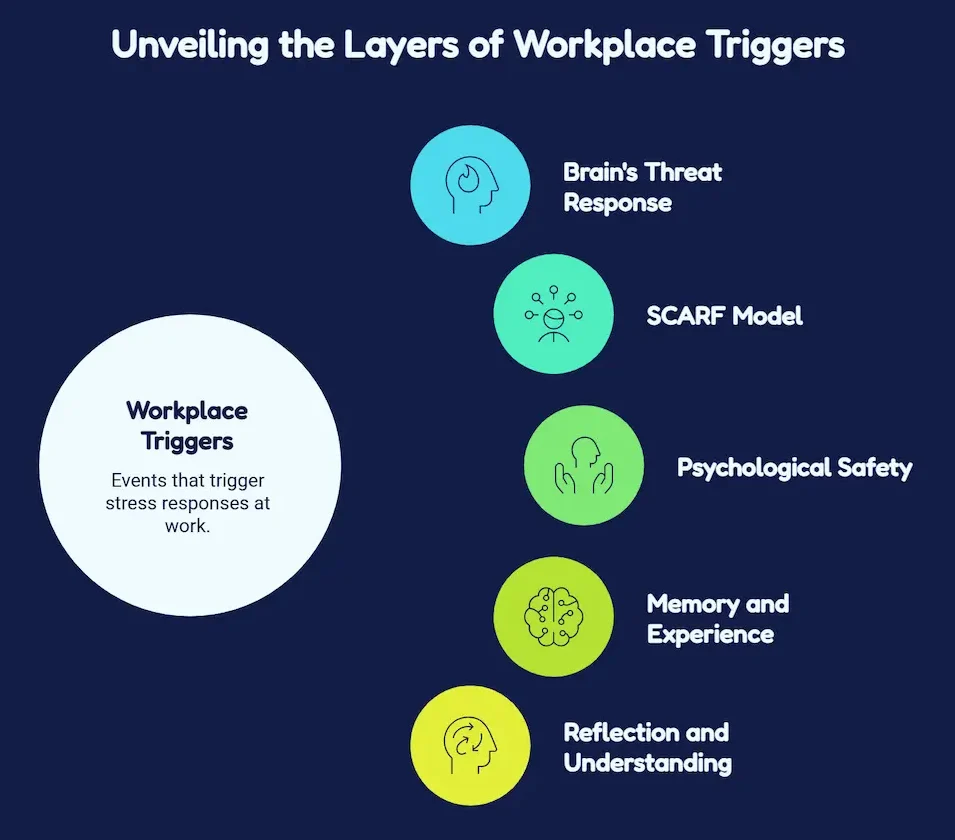
Infographic titled "Unveiling the Layers of Workplace Triggers" on a dark blue background. On the left, a large white circle reads "Workplace Triggers: Events that trigger stress responses at work." To the right, a vertical, color-gradient chain of five smaller circles outlines the layers: Brain's Threat Response, SCARF Model, Psychological Safety, Memory and Experience, and Reflection and Understanding.

The Bigger Picture

Understanding this pattern changes what a strong reaction at work actually means. It’s rarely a sign that something is wrong with a person’s resilience. More often, it’s a sign that a specific, identifiable domain status, certainty, autonomy, relatedness, or fairness just got touched, and the brain responded the way it responds to any perceived threat: fast, and without asking permission first.

That distinction matters, because it turns a vague, uncomfortable experience , “I overreact at work and I don’t know why” into something far more specific and workable: “This message touched my sense of certainty, and that’s a domain I react strongly to.” One of those statements invites shame. The other invites understanding.

Understanding the trigger is the first step. How to Control Emotional Triggers Before They Control You explores practical ways to pause, regulate your response, and choose a more helpful reaction before emotions take over.

Questions You May Quietly Be Asking Yourself

Why do small things at work trigger such a big emotional reaction?

Small workplace moments often feel bigger than they are because the brain responds to what they seem to threaten rather than to the event itself. An ambiguous email, unexpected feedback, or being left out of a conversation can affect your sense of certainty, status, fairness, or belonging. When those psychological needs feel threatened, the stress response can activate even if there is no real danger.

Why do I keep replaying conversations with my manager or colleagues?

Replaying workplace conversations is often the brain’s attempt to reduce uncertainty or understand a situation more clearly. While reflecting occasionally can be useful, repeatedly revisiting the same interaction rarely produces new answers. Instead, it can reinforce stress and make the event feel more significant than it actually was.

How can I stop taking things so personally at work?

The goal isn’t to stop caring about your work or other people’s opinions. It’s to recognise which situations consistently trigger your stress response and understand why they affect you so strongly. Once you can identify the underlying trigger such as uncertainty, loss of control, or fear of rejection. You can respond more thoughtfully instead of reacting automatically.

Continue Your Journey

If this pattern feels familiar, the next step is learning how to work with these reactions before they take over:

How to Control Emotional Triggers Before They Control You — the practical next step, once you can name which domain is being triggered.

For a broader foundation in how emotional triggers work in general, beyond the workplace:

Emotional Triggers: Why You React So Deeply

To see how this pattern connects to other common triggers across different areas of life:

10 Emotional Triggers That Control Your Behavior


Share with someone who may need this

Continue Your Inner Growth Journey

Receive weekly reflections on emotional wellbeing, mindset, and self-growth.