
3 Simple Ways to Rewire Your Brain for Positive Thinking
Forcing a happy thought on top of a hard moment rarely works — and understanding why reveals a more reliable way to actually shift how your mind defaults to thinking.
Table of Contents
Telling yourself to “just think positive” rarely works, and it’s worth understanding why before trying anything else. The advice assumes positivity is a switch — flip it, and the negative thoughts quiet down. In practice, forcing a cheerful thought on top of a genuinely stressful moment usually does the opposite. It often feels hollow because your mind knows the difficult situation hasn’t changed.
That’s not a personal failure. It’s a sign that the strategy itself was aimed at the wrong target. Positive thinking isn’t really about producing more positive thoughts on demand. It’s about gradually shifting which thoughts your mind reaches for automatically — and that’s a slower, more specific process than most advice on the topic suggests.
Why the Mind Defaults to Negative
Before any technique will make sense, it helps to understand what you’re actually working against. Human minds are not neutral. They’re tuned, fairly strongly, toward noticing and remembering negative information more than positive information — a pattern psychologists call the negativity bias.
In one of the most widely cited reviews on the subject, psychologist Roy Baumeister and colleagues found that this asymmetry shows up consistently across everyday events, relationships, feedback, and first impressions — bad experiences tend to be noticed faster, felt more intensely, and remembered longer than good ones of equal size. The leading explanation is evolutionary: for most of human history, missing a threat was far more costly than missing a reward, so minds that paid closer attention to danger were more likely to survive and pass that tendency on.
This matters because it reframes the entire task. You’re not trying to fix something broken. You’re trying to work against a bias that’s doing exactly what it was built to do, just in a modern context where most of the “threats” your mind flags are emails, comments, or minor setbacks rather than genuine danger.
That’s why positive thinking is less about creating new thoughts and more about repeatedly redirecting your attention.
What “Rewiring” Actually Means
The word “rewiring” gets used loosely, so it’s worth being precise about what it actually refers to. According to Harvard Medical School’s Dr. Andrew Budson, writing for Harvard Health, neuroplasticity is the brain’s genuine, ongoing ability to change its structure and function in response to learning and repeated experience — not a metaphor, but an actual physical process that continues throughout life.
What this means practically is that repeated, focused attention on a specific pattern of thinking can gradually strengthen it, the same way repeated practice strengthens a physical skill. It also means the reverse is true: patterns that go unpracticed tend to weaken. This is genuinely useful information, but it comes with an important limit — meaningful shifts in automatic thinking patterns develop gradually, through consistent repetition, not through a single motivated afternoon of positive thinking.
With that foundation in place, here are three specific ways to work with this mechanism rather than against it.
The Positive Thinking Blueprint
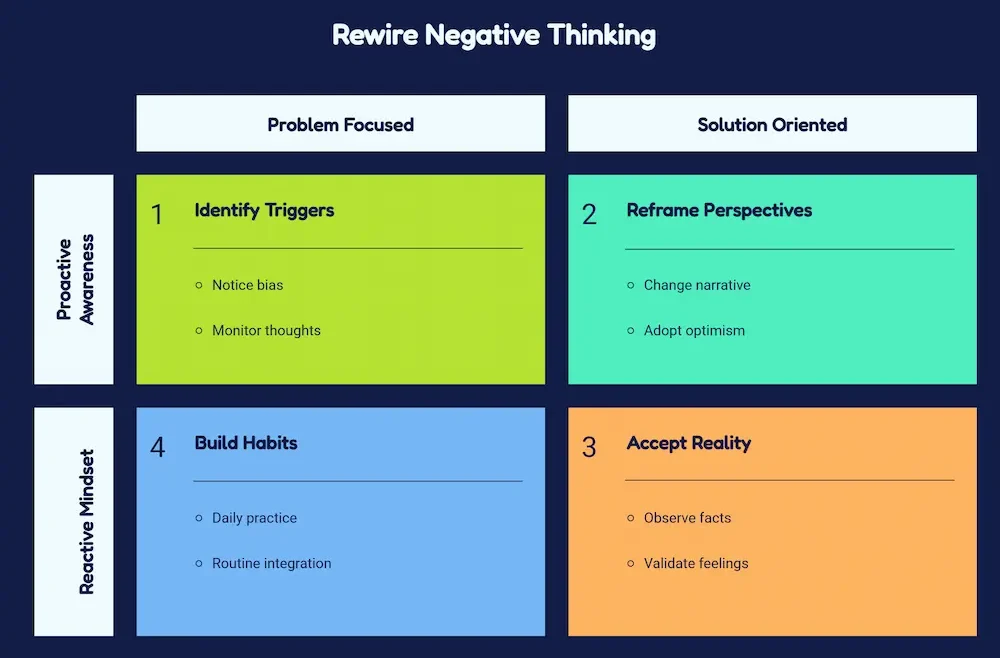
Positive thinking isn’t created by forcing happier thoughts. It develops through small, repeated changes in how you interpret experiences and where you direct your attention.
1. Reframe the Interpretation, Not the Fact
The first and most evidence-backed technique is called cognitive reappraisal — deliberately changing how you interpret a situation, rather than trying to change how you feel about it directly. Research on emotion regulation consistently identifies reappraisal as one of the more effective strategies for shifting emotional response, precisely because it intervenes early, at the level of interpretation, before the emotional reaction has fully formed.
In practice, this doesn’t mean insisting a difficult situation is actually good. It means noticing the automatic interpretation your mind reached for first, and asking whether a more accurate — not more cheerful — interpretation is available. “I made a mistake in that meeting, which means I’m bad at my job” is an interpretation, not a fact. “I made a mistake in a meeting, which happens to almost everyone occasionally” is also an interpretation — and a more accurate one, most of the time.
The distinction matters. This technique works by correcting a distorted or overly harsh reading of events, not by painting over a genuinely difficult one.
The goal isn’t optimism. It’s accuracy.
2. Deliberately Notice What the Negativity Bias Skips
Because the negativity bias filters attention toward threats and problems by default, positive and neutral details often go unregistered simply from lack of attention — not because they weren’t there. The second technique works by deliberately interrupting that filter.
This looks like pausing, once or twice a day, to notice something specific and ordinary that went reasonably well — not a dramatic win, just something concrete: a conversation that went smoothly, a task completed without incident, a moment of quiet. The specificity matters more than the size of the moment. Vague gratitude (“today was fine”) doesn’t give the mind much to actually register. A specific detail does.
This isn’t about ignoring real problems. It’s about correcting an attentional imbalance that, left unaddressed, quietly convinces the mind that difficult moments make up more of the day than they actually did.
💡 Signature Insight
Positive thinking isn’t something you force in difficult moments. It’s something your mind gradually learns through the thoughts and experiences you repeat most often.
3. Attach the Practice to Something You Already Do
The biggest obstacle to either of the first two techniques isn’t difficulty — it’s forgetting to do them. A reframe or a moment of noticing only works if it actually happens, consistently, and relying on remembering to do it “sometime during the day” tends to fail for the same reason most unscheduled intentions do.
The more reliable approach is attaching the practice to something that already happens automatically every day — after making coffee, right before opening your laptop, during a regular commute. The goal isn’t a long session. A single reframed thought or one specific noticed detail, repeated daily at a consistent moment, does more for long-term change than an occasional, longer effort. Consistency, not intensity, is what allows a new mental pattern to actually strengthen over time.
This follows the same principle explored in How Habits Are Formed: Why You Feel Stuck—small behaviours repeated in a consistent context become easier for the brain to repeat automatically.
What This Doesn’t Mean
None of this is about becoming relentlessly upbeat, dismissing real problems, or performing positivity you don’t feel. That approach — sometimes called toxic positivity — tends to backfire for a straightforward reason: it asks the mind to accept an interpretation so far removed from what’s actually happening that it creates internal friction instead of resolving it.
If negative thinking currently feels less like the occasional automatic thought and more like a persistent loop that’s hard to interrupt even with these techniques, that’s a different and more specific pattern. How to Break Toxic Thought Loops: Even If You Tried Before addresses that experience directly, and may be a more useful starting point than these general practices alone.
Realistic Expectations
These techniques don’t produce an immediate mood shift, and expecting one tends to create disappointment that undermines the practice before it’s had time to work. What they do, with consistency, is gradually change which interpretation your mind reaches for first — the reframe becoming a little more automatic, the noticing becoming a little less effortful, over weeks rather than days.
That slower timeline isn’t a flaw in the method. It reflects how the underlying mechanism — genuine neuroplastic change — actually works. Positive thinking, understood this way, isn’t a mood you force. It’s an attentional habit you build.
The Bigger Picture
Positive thinking isn’t the absence of negative thoughts. It’s the gradual shift from reacting automatically to responding more intentionally. Every time you question an automatic interpretation or notice something your negativity bias would normally ignore, you’re teaching your brain a slightly different way of paying attention. Those small moments rarely feel dramatic, but over time they’re what change your default way of thinking.
💭 A Quiet Realization
Maybe becoming a more positive person was never about pretending life is easier than it is. Maybe it’s simply teaching your mind to notice more than the problems it has spent years trying to protect you from.
Continue Your Journey
Learning to think more positively isn’t about forcing better thoughts. It’s about understanding why your mind thinks the way it does, learning to interrupt unhelpful patterns, and gradually building healthier ones over time.
If you want to understand why your mind focuses on the negative:
→Why Am I So Negative? Understanding the Cycle of Negative Thinking
Discover how the negativity bias influences your thoughts and why your brain notices problems more easily than positives.
If negative thoughts feel stuck on repeat:
→ How to Break Toxic Thought Loops: Even If You Tried Before
Learn how to interrupt repetitive thinking patterns that are harder to break than everyday negative thoughts.
If you’re ready to build healthier thinking patterns over time:
→ How to Rewire Your Thinking Patterns: Step-by-Step
Explore the psychology behind lasting cognitive change and how small, repeated shifts gradually become your new default.
Frequently Asked Questions
Can you actually rewire your brain for positive thinking?
Yes, in a specific and limited sense. Neuroplasticity — the brain’s documented ability to change its structure and function in response to repeated experience — means that consistently practicing certain thought patterns, like reappraisal or deliberate positive noticing, can strengthen those patterns over time. This is a gradual process measured in weeks of consistent practice, not an instant switch.
Why does forcing positive thoughts sometimes make me feel worse?
Forcing an interpretation that feels far removed from reality creates internal friction rather than resolving the original negative thought. This is common with toxic positivity, where a difficult situation gets papered over instead of genuinely reinterpreted. Effective techniques like cognitive reappraisal work by correcting an inaccurate or overly harsh interpretation, not by denying what actually happened.
How long does it take to build a more positive thinking pattern?
There’s no fixed timeline, since it depends on consistency and the specific pattern being practiced, but meaningful shifts in automatic thinking generally take weeks of regular repetition rather than days. Attaching a small practice to something you already do daily tends to produce more reliable results than occasional, longer efforts.