

Someone describes themselves as easygoing, confident that it’s true — they rarely raise their voice, they don’t hold grudges, they consider themselves low-maintenance to be around. Then, in an unguarded moment, a close friend mentions, gently, that they can actually be quite hard to read, or quick to go quiet when annoyed rather than easygoing about it at all.
The surprising part isn’t the feedback. It’s the confidence that came before it. Most people don’t walk around uncertain of who they are — quite the opposite. The uncertainty tends to arrive later, in a single moment where a long-held self-image runs into evidence that doesn’t quite fit.
This isn’t the same experience as feeling lost or disconnected from who you are altogether — a distinct and equally real experience covered in Identity Crisis: Why You Feel Lost in Life. This is something quieter and, in some ways, more common: being reasonably confident in your self-understanding, while carrying blind spots you don’t know exist yet.
Why Most People Overestimate Their Self-Awareness
Here’s a finding worth sitting with.In a large-scale research program involving nearly 5,000 participants, organizational psychologist Tasha Eurich and her team found that while roughly 95% of people believe they are self-aware, only 10 to 15% actually meet the criteria when measured directly. You can explore the original self-awareness study for more details.
That’s not a small gap. It means the overwhelming majority of people confidently believe something about their own self-knowledge that doesn’t hold up under closer examination — not because they’re dishonest, but because self-awareness turns out to be a genuinely different skill than simply having thoughts about yourself.
This matters because most advice about self-understanding assumes the second thing is the same as the first. It isn’t.
Psychologists often refer to this ongoing picture we hold of ourselves as self-perception. The challenge is that self-perception isn’t automatically accurate—it is shaped by our experiences, memories, assumptions, and the information we notice about ourselves.
Why Thinking About Yourself Isn’t the Same as Knowing Yourself
The instinct is to assume that self-awareness comes from introspection — sitting with your thoughts, reflecting on your motives, asking yourself what you really want. Eurich’s research complicates that assumption in an important way: it distinguishes between two separate kinds of self-awareness that don’t necessarily move together.
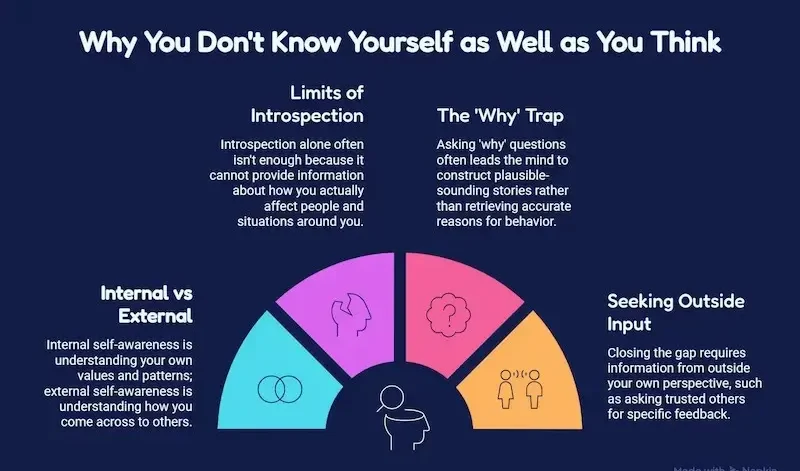
Internal self-awareness is how clearly you understand your own values, reactions, and patterns from the inside. External self-awareness is how accurately you understand how you actually come across to other people. According to the research, these two are largely independent — someone can have a rich, detailed inner sense of who they are while remaining genuinely unaware of the impression they leave on others, and vice versa. Being strong in one doesn’t predict being strong in the other.
This is why introspection alone often isn’t enough. A person can reflect for years on their own motivations and still misjudge how their tone lands, how their silence gets interpreted, or how a habit they consider minor is experienced by people close to them — because that information was never going to come from the inside. It requires a different kind of evidence entirely: how you actually affect the people and situations around you, not just how you intend to.
Why Introspection Alone Can Mislead
There’s a second layer worth understanding, because it explains why reflecting harder doesn’t always help. Eurich’s research found that people who spend more time asking themselves “why” — why do I feel this way, why did I react like that — often end up less accurate about themselves, not more. The “why” question tends to pull toward whatever explanation feels most comfortable or familiar, rather than what’s actually true, since the underlying reasons for a reaction aren’t always consciously accessible in the first place.
This connects to something explored in What Is the Subconscious Mind? Meaning, Examples, and How It Works a great deal of what shapes behavior operates below conscious awareness to begin with. Asking “why did I do that” often invites the mind to construct a plausible-sounding story after the fact, rather than genuinely retrieve the reason — which means confident introspection can produce a confident answer that simply isn’t accurate.
What This Looks Like in Ordinary Life
Someone who prides themselves on being a good listener might interrupt constantly without registering it, because in their own experience, they’re engaged and enthusiastic — the gap only becomes visible if someone else names it directly.
Someone who believes they handle stress well might notice, only in hindsight, that they’ve been short with people all week — invisible from the inside because it didn’t feel like “stress,” it just felt like a demanding week.
In both cases, nothing was being hidden on purpose. The self-image and the behavior simply developed along separate tracks, because one was built from the inside and the other was only ever visible from the outside.
A Reflection Pause
Rather than asking “am I self-aware,” which is difficult to answer accurately from the inside, it can help to get more specific:
- Has anyone close to you ever described you in a way that surprised you — not because it was unkind, but because it didn’t match how you saw yourself?
- When you reflect on a reaction you had, do you tend to ask “why did I do that,” or “what actually happened right before I reacted”?
- Is there an area of your life where you’d genuinely be curious what an honest observer would say about you?
- Can you think of a time when your intentions were good, but the impact on someone else was different from what you expected?
There’s no need to resolve these immediately. Noticing where the question feels uncertain is often the more useful outcome.
Closing the Gap, in Small Ways
Because internal reflection alone has real limits, the most reliable way to close this gap involves a different kind of input: information from outside your own perspective.
This doesn’t require an elaborate process. Eurich’s research points to something simple — shifting from “why” questions to “what” questions when reflecting on a reaction (what happened, what specifically triggered this, what would help right now) tends to produce more useful insight than open-ended “why” reflection. It also points to the value of occasionally asking someone you trust a direct, specific question about how you come across, rather than a vague one — a specific moment or pattern is easier for someone to answer honestly than “am I difficult to work with.”
Neither of these closes the gap permanently. Self-awareness, based on this research, isn’t a fixed trait you either have or don’t — it’s closer to an ongoing practice of staying curious about the parts of yourself you can’t see directly.













One Response