

Mental Conditioning: How Your Mind Becomes Stronger Over Time
Mental conditioning isn’t about becoming fearless—it’s about training your mind to respond differently, one small challenge at a time.
Table of Contents
There’s a quiet assumption behind most conversations about mental strength: that some people simply have it, and others don’t. One person stays composed under pressure, tries the hard thing without much visible struggle, recovers quickly from setbacks. Another feels shaky before anything difficult and reads that shakiness as proof they’re not built for it.
That assumption doesn’t hold up particularly well. What often separates those two people isn’t that one was born mentally stronger than the other. More often, it’s a history of small experiences that gradually built one person’s confidence in handling difficult situations. That confidence has a name in psychology—self-efficacy—and unlike a fixed trait, it can be developed over time.
What Mental Conditioning Actually Is
According to the American Psychological Association, self-efficacy — the psychological concept underlying mental conditioning — refers to a person’s belief in their own capacity to carry out the actions needed to produce a given outcome. It’s worth being precise about what this is not. It isn’t general self-esteem, and it isn’t the same as changing what you think about a situation (a different process, covered in How to Rewire Your Thinking Patterns) or updating a belief sitting below conscious awareness (How to Reprogram Your Subconscious Mind covers that territory directly). Mental conditioning is narrower and more concrete: it’s the trust that you can act effectively, built specifically through the experience of acting.
This distinction matters because it changes what actually helps. Thinking differently about a challenge can help you approach it with more clarity. Believing you’re capable of executing the actions required is a separate, additional layer — and it’s built differently than either of those.
The Four Sources of Mental Conditioning
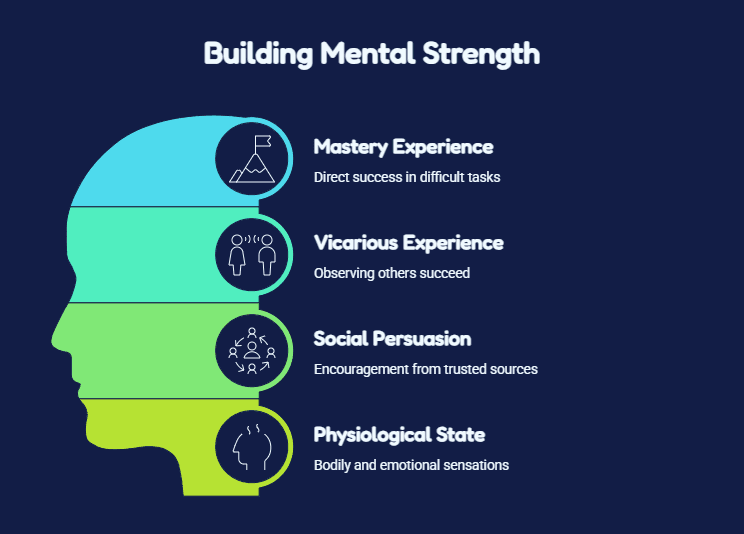
Psychologist Albert Bandura’s research identified four distinct sources that shape this kind of belief, and they aren’t equally powerful. Understanding the hierarchy matters as much as knowing the list.
| Source | What It Involves | Relative Strength |
| Mastery experience | Actually doing something difficult and succeeding, even in a small way | Strongest — direct evidence |
| Vicarious experience | Watching someone similar to you succeed at something comparable | Moderate — secondhand evidence |
| Social persuasion | Credible encouragement from someone whose opinion you trust | Moderate, but weak alone |
| Physiological state | The bodily and emotional sensations present during a difficult moment | Weakest as standalone evidence, most often misread |
Bandura’s own research consistently found mastery experience to be the most influential of the four, for a straightforward reason: it’s the only one built from direct, personal evidence rather than secondhand reassurance. The other three matter, but they tend to support conditioning that’s already underway rather than create it from nothing.
💡 BYW Insight
Mental conditioning isn’t built by feeling fearless. It’s built by collecting enough evidence that you can act even when fear is present.
Why “Feeling Weak” Is the Least Reliable Signal
This is where the original framing of “even if you feel weak” deserves a closer look, because it points at something genuinely important — physiological state is real, and it does factor into mental conditioning. The mistake isn’t feeling it. The mistake is treating it as decisive.
A racing heart before a difficult conversation, a wave of doubt before starting something unfamiliar, a shaky feeling before doing something that matters — these are physiological and emotional signals, not verdicts on capability. Bandura’s research places this source at the bottom of the hierarchy precisely because it’s the easiest to misread. The body produces similar sensations for genuine incapacity and for ordinary difficulty; the sensation alone doesn’t distinguish between them.
The Mental Conditioning Blueprint
Recognizing this gap — between what a feeling seems to indicate and what it actually indicates — is itself a form of accurate self-perception, the same skill explored in Why You Don’t Know Yourself as Well as You Think. Someone who reflexively reads “I feel shaky” as “I am not capable” is making an inference their body’s sensations don’t actually support.
Building Mastery Experience Deliberately
Because mastery experience carries the most weight, it’s the most useful place to focus deliberately. This doesn’t require dramatic challenges. It requires manageable difficulty, repeated consistently — something hard enough to require real effort, but not so far beyond current capacity that failure becomes the likely outcome.
In practical terms, this often means working just beyond your current comfort zone—not so far that the challenge feels overwhelming, but far enough that successfully handling it provides new evidence about what you’re capable of.
A person avoiding difficult conversations doesn’t build conditioning by attempting the hardest conversation available. They build it by having a moderately uncomfortable one, succeeding at getting through it, and letting that specific piece of evidence accumulate. Each instance becomes a small, direct data point the mind can actually reference later — closer to proof than to a hopeful assumption.
This is also where the other three sources become genuinely useful, rather than sufficient on their own. Watching someone comparable to you handle something similar (vicarious experience) can lower the perceived difficulty of a first attempt. Encouragement from someone credible (social persuasion) can help someone take that first attempt at all. Neither replaces the mastery experience itself — they simply make it more likely to happen.
A Common Mistake
A great deal of popular advice about building mental strength leans almost entirely on the weakest of the four sources: verbal persuasion, delivered as motivational language, without any accompanying mastery experience behind it. Repeating an encouraging statement to yourself can feel supportive in the moment, but Do Affirmations Really Work on Your Subconscious? explores why words unsupported by real evidence tend to feel hollow, particularly when they contradict a person’s current experience.
This is the gap between telling yourself you’re capable and actually collecting evidence that you are. The first can help at the margins. The second is what mental conditioning is actually built from. Encouragement can help you begin. Evidence is what convinces your mind you can continue.
A Reflection Pause
Before applying this framework to something specific, it can help to get concrete:
- Is there a particular kind of difficulty where you consistently talk yourself out of trying, before you’ve actually attempted it?
- When you feel physically uneasy before doing something hard, do you tend to treat that feeling as information about the task, or as a verdict on your ability to handle it?
- What would count as a manageable — not dramatic — version of that difficulty you could actually attempt this week?
The goal isn’t to eliminate the uncomfortable feeling. It’s to stop letting it cast the deciding vote.
The Bigger Picture
Mental conditioning is what makes everything else in this library usable rather than simply understood. Recognizing a subconscious pattern, reframing a thought, seeing a blind spot clearly — all of that intellectual work matters, but it doesn’t by itself produce the belief that you can act on what you’ve learned. That belief is built separately, through evidence, one manageable difficulty at a time.
This is also why it rarely happens quickly. Mastery experience, by definition, requires actually doing the thing — which means mental conditioning is less something you decide to have and more something you accumulate, deliberately, attempt by attempt.
Mental conditioning doesn’t replace healthy thinking or subconscious change. It gives you the confidence to put those changes into action.
Lasting change depends not only on understanding yourself but also on acting consistently enough to build new evidence. Why Most Behavior Change Fails (And What Psychology Says Actually Works) brings these ideas together into a broader framework for sustainable change.
💭 A Quiet Realization
Maybe mental strength was never something other people were born with. Maybe it’s simply the result of collecting enough evidence that you can keep going, one difficult experience at a time.
Key Takeaways
- Mental conditioning is the belief in your capacity to act effectively, distinct from changing what you think or reprogramming a subconscious belief.
- It’s built from four sources — mastery experience, vicarious experience, social persuasion, and physiological state — and they are not equally powerful.
- Mastery experience, built through manageable rather than overwhelming difficulty, is the strongest source by a wide margin.
- Physiological sensations like nervousness or shakiness are the least reliable signal of actual capability, despite often feeling the most convincing in the moment.
Continue Your Journey
Mental conditioning is one part of lasting psychological change. These related guides explore the thinking patterns, beliefs, and self-awareness that work alongside your growing capacity to act.
If you want to understand yourself more accurately:
→ Why You Don’t Know Yourself as Well as You Think
Discover why we often misread our own thoughts, feelings, and abilities—and how greater self-awareness leads to better decisions.
If you want to change your automatic thinking patterns:
→ How to Rewire Your Thinking Patterns: Step-by-Step
Learn how repeated mental habits shape your reactions and how healthier thinking patterns develop over time.
If you want to reshape deeper subconscious beliefs:
→ How to Reprogram Your Subconscious Mind
Explore how long-held beliefs are formed and the practical steps that help change them.
If you’re wondering why motivation and affirmations aren’t enough:
→ Do Affirmations Really Work on Your Subconscious?
Understand why encouragement alone rarely creates lasting confidence without real experiences to support it.
Frequently Asked Questions
What is mental conditioning in psychology?
Mental conditioning refers to the process of building self-efficacy — a person’s belief in their own capacity to carry out the actions needed to produce a specific outcome. It’s built primarily through direct experience of attempting and succeeding at manageable challenges, rather than through motivation or willpower alone.
Can mental conditioning actually be trained, or is it a fixed trait?
It’s generally understood as trainable rather than fixed. Research identifies specific, repeatable sources that build it, with direct mastery experience — succeeding at a manageable difficulty — being the strongest and most reliable of these.
Why do I feel mentally weak even when I know I’m capable?
This usually reflects a mismatch between physiological sensation (like nervousness or a racing heart) and actual capability. These bodily signals are considered the least reliable of the four recognized sources of mental conditioning, since the body often produces similar sensations for genuine incapacity and for ordinary difficulty.