

Better You Within

Why You Can’t Stop Narrating Your Own Life

Your inner voice isn’t the problem. Your relationship with it is.

Woman sitting by a window in quiet reflection, representing the inner voice and growing self-awareness.
Learning to notice your inner voice is often the first step toward changing the way you think.

Table of Contents

Pouring a cup of coffee and internally noting, okay, just need to grab the mug, careful, it’s full, as though narrating a task no one asked to have described. Or reading a slightly odd text message and immediately hearing a running commentary begin: that was strange, why would they phrase it that way, should I respond now or wait.

If this kind of inner dialogue feels almost constant, you’re far from alone.  

This isn’t the same as a single worry looping on repeat, which is its own distinct pattern covered in Why You Keep Thinking the Same Thoughts. This is something broader and more constant — an ongoing commentary track that seems to run underneath almost everything, narrating, evaluating, and interpreting experience as it happens, rather than fixating on any one thought in particular.

What This Pattern Actually Is

Most people don’t notice this narration as a distinct thing. It blends into the background of ordinary thinking, so consistently present that its absence — a rare quiet moment — can feel more unusual than its presence. But once named, the pattern becomes hard to unsee: a nearly continuous internal voice, commenting on what’s happening, what it means, and what should happen next.

This is different from mental chatter about one specific problem. It’s closer to a running narrator attached to your own life, describing and interpreting experience almost as it unfolds — sometimes helpfully, sometimes exhaustingly, and almost always automatically.

Why the Mind Narrates in the First Place

Here’s what makes this pattern worth understanding rather than simply fighting: it isn’t random noise. According to research popularized by developmental psychologist Lev Vygotsky and explored in Scientific American’s coverage of inner speech research, the silent self-talk adults engage in as a matter of course is understood to be an internalized version of the out-loud speech children use to guide their own actions — narrating what they’re doing, reasoning through a problem out loud, talking themselves through a task.

As Vygotsky’s developmental framework describes it, this self-directed speech doesn’t disappear as children grow older — it goes quiet, folding inward into the silent internal dialogue adults use for thinking, planning, and self-regulation. The constant narration many adults notice isn’t a malfunction. It’s the same self-guiding tool a five-year-old uses out loud, still running, just without the sound.

There’s a second layer worth understanding as well. Some neuroscience research on the brain’s default mode network — the system most active during self-reflective, internally directed thought — has proposed that part of its role involves constructing an ongoing internal narrative that helps situate each moment within a broader, continuous sense of self. This remains an active area of research rather than settled fact, but it offers a plausible reason the narration rarely stays quiet for long: part of its job may be stitching each new moment into an ongoing story about who you are and what’s happening to you.

💡 BYW Insight

The voice in your head isn’t there because your mind is broken. It developed as a way to guide, plan, and make sense of experience. The real question isn’t whether it speaks. It’s how it speaks to you.

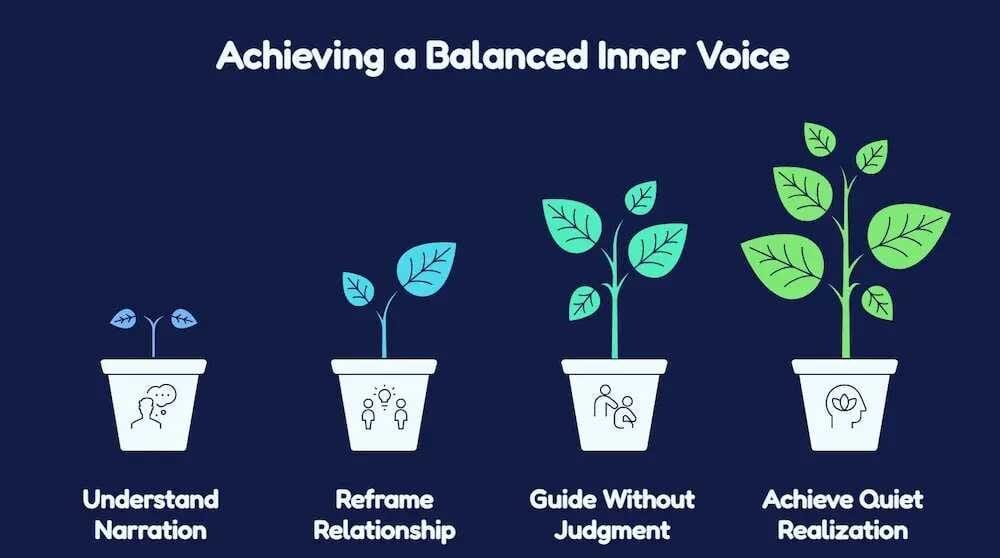
Diagram illustrating four stages of developing a balanced inner voice: understanding your narration, reframing your relationship with thoughts, guiding yourself without judgment, and achieving quiet realization.The Misconception Worth Correcting

Because this internal narration can feel exhausting, the instinct is usually to try to eliminate it entirely — to find some way to finally think in silence. This goal, understandable as it is, tends to backfire, and it’s worth understanding why.

If ongoing narration is, at its root, an internalized self-regulation tool — the same one a child once used out loud to guide their own behavior — then trying to eliminate it completely isn’t really quieting noise. It’s attempting to shut off a system still doing a job, even if that job has become less helpful in its current form. This is often why aggressive attempts to “empty the mind” tend to fail or feel like a fight: The narrator isn’t malfunctioning. It’s simply continuing to perform a job that now benefits from a healthier way of speaking. 

The more useful goal isn’t silence. It’s a shift in what the narration is actually doing — from constant evaluation and judgment toward something closer to simple observation. A narrator quietly describing what’s happening (“this is a stressful moment”) functions very differently from one constantly judging it (“I’m handling this badly, like always”). The volume of narration matters less than its tone.

When Narration Becomes a Problem

Not all narration is created equal, and this is where the pattern can quietly shift from useful to draining. Ongoing, evaluative commentary — running judgments about performance, worth, or likely outcomes — tends to be far more exhausting than purely descriptive narration, because it isn’t just observing the moment. It’s grading it.

This is also where narration can shade into more specific, more damaging patterns. When the commentary stops moving and fixates on one particular judgment, repeating it rather than continuing to narrate forward, that’s a shift into the territory covered in Why You Keep Thinking the Same Thoughts. When that fixation becomes actively self-critical and self-reinforcing, How to Break Toxic Thought Loops addresses that more corrosive version directly. Ongoing narration is the wider pattern underneath both — but it isn’t automatically identical to either one.

A Reflection Pause

Rather than trying to stop the narration outright, it can help to simply notice its quality:

  • In an ordinary moment today, was your internal commentary mostly describing what was happening, or mostly judging it?
  • Is there a specific situation where the narration tends to turn sharply critical, rather than staying observational?
  • What would it feel like if the narrator’s job were simply to notice, rather than to evaluate?

There’s no need to change anything immediately. Simply noticing the difference between description and judgment is often the more useful first step.

What Actually Helps

Because the goal isn’t eliminating the narrator, the more workable approach is gradually shifting its habitual tone — from evaluation toward description. This is less about a single technique and more about a repeated redirection: noticing when the commentary has turned judgmental, and consciously reframing it in more neutral, observational language.

The change usually happens gradually rather than all at once. A narrator that has spent years criticizing, predicting, or correcting won’t suddenly become neutral overnight. Each time you gently rephrase a judgment into a description, you’re giving your mind another example of a different way to relate to your experience. Over time, those small shifts become easier and more automatic. 

For the deeper mechanics of how this kind of shift in thought content actually takes hold over time, How to Rewire Your Thinking Patterns: Step-by-Step covers that process directly. What’s worth carrying forward from this article specifically is the starting reframe: the narrator was never really the problem. Its tone was.

The Bigger Picture

Constant inner narration can feel like something to escape, especially on days when it turns sharply critical. But understood accurately, it’s closer to an old, deeply practiced habit of self-guidance — one that developed for good reason and never fully switched off, because it was never designed to.

That reframe changes the relationship considerably. The goal isn’t a silent mind. It’s an inner voice that can guide you without constantly judging, correcting, or wearing you down. 

💭 A Quiet Realization

Maybe the goal was never to stop talking to yourself. Maybe it was to create an inner voice that no longer needs to warn, correct, or criticize you through every ordinary moment.

Key Takeaways

  • Continuous inner narration is a distinct pattern from a single repeating thought or a toxic thought loop — it’s an ongoing commentary track, not a fixation.
  • This narration is understood to be an internalized form of the self-directed speech children use out loud to guide their own actions, now happening silently.
  • Trying to eliminate the narration completely tends to backfire, because it’s a functioning self-regulation tool, not background noise.
  • The more workable shift is from evaluative narration (judging) toward descriptive narration (observing) — tone matters more than volume.

Continue Your Journey

If this pattern feels familiar, these articles explore where your inner narrator can lead next—and how to gradually change its tone.

How to Rewire Your Thinking Patterns: Step-by-Step
Learn how repeated thought patterns become automatic and how healthier patterns develop over time.

Why You Keep Thinking the Same Thoughts: Break the Loop
Explore what happens when your inner narration becomes stuck on a single recurring thought.

How to Break Toxic Thought Loops: Even If You Tried Before
Discover how repetitive thoughts can become self-critical loops—and how to begin interrupting them.

Frequently Asked Questions

Why do I narrate everything in my head?

This is generally understood as an internalized form of self-directed speech — the same self-guiding talk children use out loud while learning to plan and regulate their own behavior, which becomes silent inner speech in adulthood. It isn’t a malfunction; it’s a long-running self-regulation habit.

Is it normal to have a constant internal monologue?

Yes, though the intensity and constancy of inner speech varies considerably between individuals. What matters more than whether narration is present is its tone — largely observational narration tends to feel neutral, while constantly evaluative or critical narration tends to feel exhausting.

How do I quiet my inner narrator?

Rather than aiming for complete silence, which tends to be difficult and often counterproductive, a more workable goal is shifting the narration’s tone from judgment toward observation — noticing when commentary turns critical and consciously reframing it in more neutral, descriptive language.

Share with someone who may need this

Continue Your Inner Growth Journey

Receive weekly reflections on emotional wellbeing, mindset, and self-growth.