

The week your aunt was in the hospital, you handled everything — the calls, the logistics, the version of yourself that stayed steady while everyone else fell apart a little. Afterward, someone said it: you’re so mentally tough. It didn’t feel like toughness from the inside. It felt more like autopilot, like you weren’t summoning strength so much as just doing the next necessary thing, over and over, until it was over.
That gap between how it looked and how it felt is worth paying attention to, because it points at something most advice about mental toughness gets backwards.
What People Get Wrong About Mental Toughness
“Be mentally tough” is one of the most common pieces of advice people receive under pressure, and one of the least useful, because it treats toughness as something available on demand — a switch to flip through sheer will. When it doesn’t flip, the natural conclusion is that something is missing: not enough grit, not enough resolve, not enough of whatever mental toughness is supposed to be made of.
This can get the sequence wrong. Mental toughness doesn’t have to be understood as something you either possess before difficulty arrives or somehow summon when pressure begins. Research suggests that characteristics associated with mental toughness can develop through experience and training. That makes mental conditioning a useful way to think about the processes that may help strengthen those capacities over time.
What Mental Conditioning Really Means
Mental conditioning has already been covered in depth elsewhere in this library. Here, we use the term for the deliberate process of strengthening how you respond to challenge through repeated practice and experience. Self-efficacy — your belief in your capacity to act effectively — is one important part of that process, especially as successful experiences give you evidence that you can handle difficulty. We won’t restate the full process here, but it’s worth keeping in view because it provides a useful foundation for understanding how capacities associated with mental toughness can develop.
How Mental Conditioning Builds Psychological Strength
Mental conditioning works by giving the mind accumulated, direct evidence of competence — proof gathered through repeated experience rather than through self-talk or motivational effort. Each time a person faces a manageable difficulty and gets through it, that evidence updates something quieter than confidence: an underlying expectation about how future difficulty is likely to go.
This is closely related to, but not identical with, resilience. The American Psychological Association describes resilience as the process and outcome of successfully adapting to difficult or challenging life experiences. Mental toughness is usually discussed somewhat differently, particularly in performance psychology, where qualities such as control, commitment, challenge, and confidence are emphasized. The two concepts overlap, but they aren’t interchangeable: resilience focuses broadly on adaptation in the face of adversity, while mental toughness describes a particular set of characteristics associated with functioning effectively under pressure.
Why Mental Toughness Is an Outcome, Not a Starting Point
Mental toughness has its own established research base in performance psychology, most notably the 4Cs model developed by researchers Clough, Earle, and Sewell, which characterizes it through four components: control (a sense of influence over circumstances and emotional responses), commitment (sustained dedication to a task despite difficulty), challenge (perceiving obstacles as something to engage with rather than avoid), and confidence (belief in one’s own ability, developed rather than assumed).
What’s genuinely useful about this research is that mental toughness doesn’t have to be treated as something completely fixed at birth. Research and applied work in this area suggest that qualities associated with mental toughness can be influenced by experience, training, and environment. That makes the 4Cs useful for understanding what mental toughness can look like in practice, while mental conditioning gives us a way to think about some of the experiences and repeated practice that may help strengthen those qualities over time.
This gives us a more useful distinction to work with: mental conditioning describes a process of practice and adaptation, while mental toughness describes qualities that become especially visible under pressure. The two can be closely related without being the same thing — one helps us think about how psychological capacities may be strengthened over time, while the other describes how some of those capacities can appear when difficulty arrives.
How Daily Conditioning Shapes Responses Under Pressure
That week at the hospital may not have created the steadiness it revealed. Some of that capacity could have been developing through much smaller, less dramatic experiences — difficult phone calls made instead of avoided, demanding weeks navigated, problems faced and worked through. None of those moments had to feel like training at the time. But experiences like these can give you opportunities to practice coping, regulation, and effective action long before a bigger test arrives.
The reverse helps explain why simply telling someone to “be tougher” in a high-pressure moment is rarely useful. An instruction alone doesn’t provide the coping skills, experience, confidence, or regulation strategies that may help someone respond effectively. What shows up under pressure can draw partly on capacities developed beforehand — often through much smaller experiences that nobody would have thought to call brave.
This is also where emotional regulation quietly does more work than it gets credit for. How to Control Emotional Triggers Before They Control You covers a related mechanism directly — the capacity to notice a reaction forming and respond deliberately rather than automatically, which is often what separates someone who looks composed under pressure from someone who’s actually regulating well underneath it.
The BYW Mental Strength Framework
Put together, we can use a simple BYW framework to understand how these ideas may connect — not as a fixed psychological sequence, but as a practical way of seeing the relationship between preparation and performance:
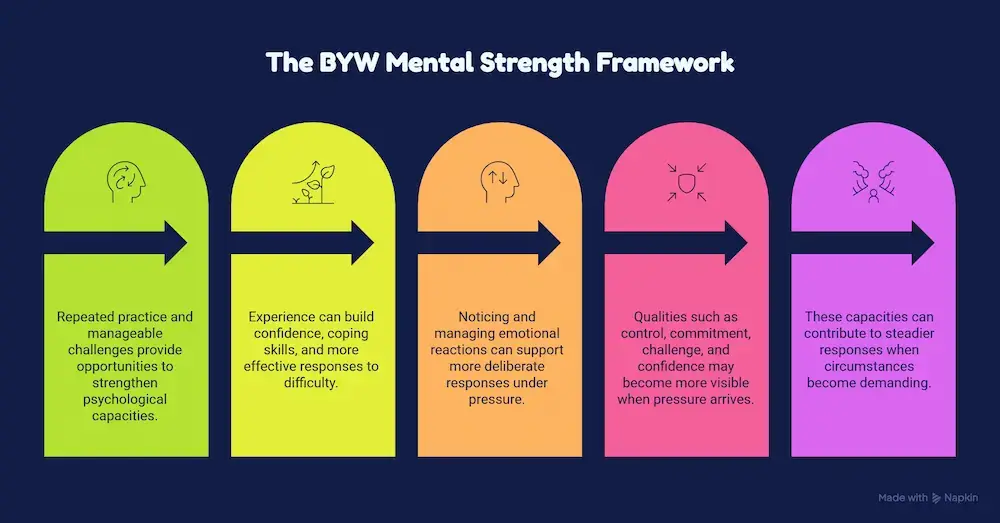
Mental Conditioning → repeated practice and manageable challenges provide opportunities to strengthen psychological capacities.
Growing Capacity → experience can build confidence, coping skills, and more effective responses to difficulty.
Emotional Regulation → noticing and managing emotional reactions can support more deliberate responses under pressure.
Mental Toughness → qualities such as control, commitment, challenge, and confidence may become more visible when pressure arrives.
Performance Under Pressure → these capacities can contribute to steadier responses when circumstances become demanding.