

Lying awake after the party, the night replays itself uninvited.
Sometimes this replay lands somewhere useful — noticing you went quiet whenever the conversation turned toward you, wondering why.
Other nights, the exact same activity spirals somewhere else entirely: did that comment land wrong, did you laugh too loud, did everyone notice you standing alone by the drinks table for those few seconds before someone came over?
Same late-night replay. Same person doing it.
But the attention is going somewhere very different.
Why Self-Awareness and Self-Consciousness Are Often Confused
Self-awareness and self-consciousness can both involve directing attention toward yourself, which is exactly why they’re so easy to confuse.
Someone spending more time thinking about themselves might reasonably assume that means they’re becoming more self-aware — more insightful, more in touch with their own patterns.
But more self-focused attention doesn’t automatically produce greater self-understanding.
An important early distinction came from psychologists Allan Fenigstein, Michael Scheier, and Arnold Buss. Their 1975 Self-Consciousness Scale identified separate dimensions of self-focused attention.
Private self-consciousness described attention to internal aspects of yourself, including thoughts and feelings.
Public self-consciousness described awareness of yourself as a social object — the aspects of yourself other people can perceive and respond to.
The researchers also identified social anxiety as a separate factor. Public self-consciousness was moderately associated with social anxiety, while private self-consciousness was not consistently related to it.
That distinction matters.
Thinking about what’s happening inside you and thinking about how you’re coming across to other people are both forms of self-focused attention. But they aren’t psychologically identical.
What Healthy Self-Awareness Looks Like
Healthy self-awareness goes beyond simply directing attention inward.
It involves trying to understand your own internal experience — your reactions, motives, emotions, patterns, and the effects those patterns may have on your behavior.
That distinction became clearer in later research on self-reflection and insight.
Researchers Anthony Grant, John Franklin, and Peter Langford found that self-reflection and insight are separable. Someone can spend considerable time examining themselves without necessarily understanding themselves more accurately.
That is an important difference for everyday life.
Noticing that you went quiet whenever the conversation turned toward you is self-focused attention.
Asking what was happening inside you at those moments — whether you felt exposed, uncertain, uncomfortable, or something else entirely — creates the possibility of insight.
But even then, reflection isn’t automatically insight. Sometimes the answer isn’t immediately obvious.
That’s part of what Why You Don’t Know Yourself as Well as You Think explores: looking inward can be useful, but looking inward and understanding accurately are not necessarily the same thing.
What Self-Consciousness Really Is
In everyday language, saying “I felt self-conscious” usually means something more specific than simply being aware of yourself.
It often describes heightened concern about how you appear to other people.
Did that look awkward?
Did I say something stupid?
Are people noticing me?
What do they think of me?
Psychological research on public self-consciousness helps illuminate this experience because it concerns attention to aspects of the self that can be observed and evaluated by others.
But public self-consciousness and social anxiety aren’t the same thing.
The original Self-Consciousness Scale treated them as separate dimensions, although public self-consciousness showed a moderate relationship with social anxiety.
So becoming aware of how you appear to other people isn’t inherently unhealthy.
The problem begins when that awareness becomes dominated by worry, repeated evaluation, or attempts to predict judgments you cannot actually know.
That’s where the late-night replay of the party can shift.
Wondering why you went quiet may open the door to understanding.
Replaying whether your laugh sounded strange or whether standing alone looked awkward keeps your attention focused on how you may have appeared to an imagined audience.
Both involve thinking about yourself.
But they’re asking very different questions.
Why Self-Consciousness Can Turn Into Overthinking
Self-conscious attention can become fertile ground for overthinking when it revolves around questions that cannot easily be resolved.
Did that look bad?
Did they notice?
What did they think?
Sometimes there is simply no reliable answer available.
And when the mind keeps trying to solve an uncertain social judgment anyway, the same moment can be replayed again and again without producing much new information.
This connects to something explored in Why You Can’t Stop Narrating Your Own Life: having an internal commentary isn’t automatically a problem.
What matters is what that commentary is doing.
Is it helping you notice something useful?
Is it exploring what you actually felt or did?
Or is it repeatedly trying to reconstruct what everyone else might have thought?
The first may create an opportunity for insight.
The last can leave you with more thinking but no greater certainty.
How Self-Awareness Can Support Growth Instead of Judgment
Useful self-awareness isn’t simply thinking about yourself more.
It is self-focused attention that helps you notice and understand something relevant about your own experience.
That might be:
a recurring pattern,
a trigger worth recognizing,
a reaction you don’t fully understand yet,
or a blind spot worth examining more closely — the kind of discovery explored in Why You Can’t See Your Own Blind Spots.
And even here, curiosity matters.
Later research distinguishing self-reflection from insight gives us an important warning: reflection alone doesn’t guarantee understanding.
You can think about yourself endlessly and still remain confused.
The useful shift, then, isn’t necessarily from self-conscious to self-aware as though they were opposite ends of one psychological scale.
It is from evaluation toward inquiry.
Instead of:
How did I look?
try:
What happened for me there?
Instead of:
What must they think of me?
try:
Why am I so worried about what they might think?
That second question doesn’t guarantee an immediate answer.
But at least it points your attention toward something you can actually investigate.
Periods of heightened self-consciousness can also happen during genuinely vulnerable moments — unfamiliar social situations, major transitions, or periods of uncertainty about identity, something explored more fully in Identity Crisis: Why You Feel Lost in Life.
Feeling self-conscious in those moments isn’t evidence that something is wrong with you.
Sometimes it simply tells you where your attention has gone.
And noticing that may be the beginning of something more useful.
The BYW Self-Awareness Framework
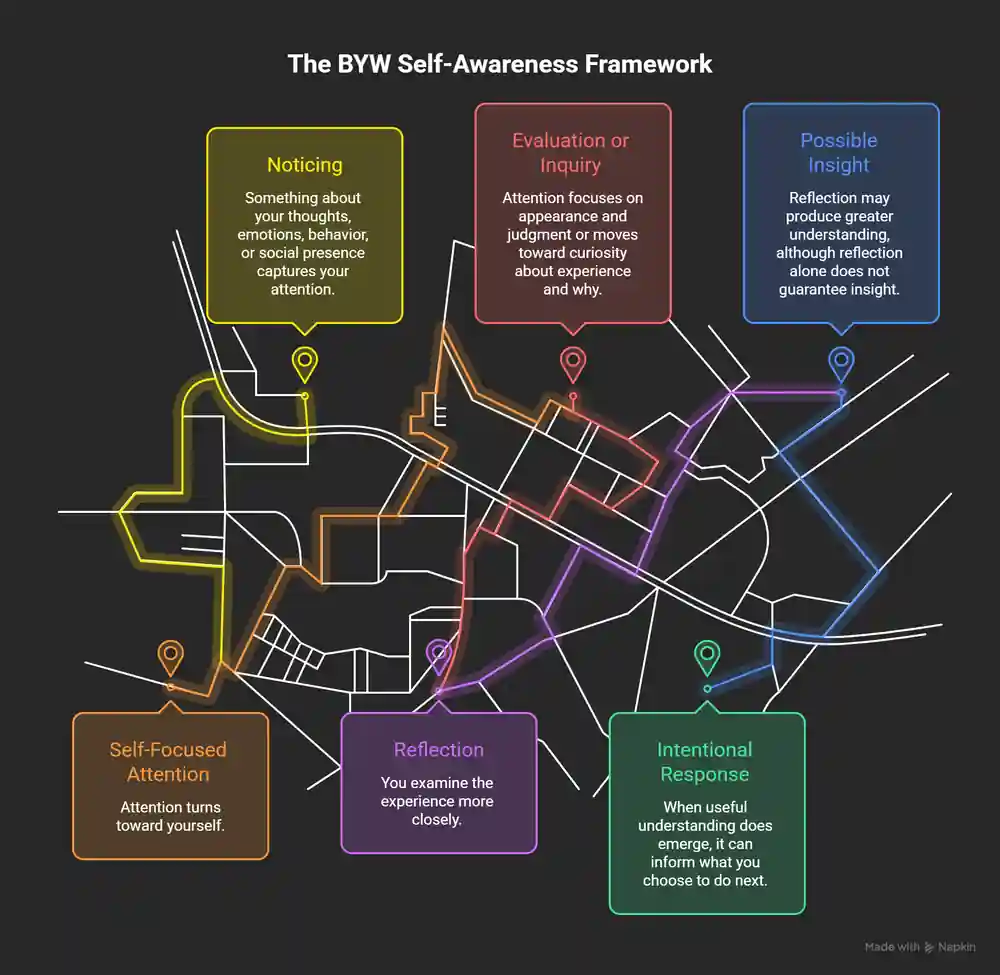 The research doesn’t support treating self-consciousness and self-awareness as fixed stages that everyone moves through in sequence.
A more useful BYW synthesis is to ask where self-focused attention is going and what it is producing:
Noticing → something about your thoughts, emotions, behavior, or social presence captures your attention.
Self-Focused Attention → attention turns toward yourself.
Evaluation or Inquiry → that attention may become focused on how you appear and might be judged, or it may move toward curiosity about what you’re experiencing and why.
Reflection → you examine the experience more closely.
Possible Insight → reflection may produce greater understanding, although reflection alone does not guarantee insight.
Intentional Response → when useful understanding does emerge, it can inform what you choose to do next.