

The ingredients are already in the fridge.
The recipe is saved on your phone.
You had every intention of cooking something nutritious tonight.
But after a day of answering messages, sorting out responsibilities, making plans, and handling unexpected problems, even deciding what to cook feels like too much.
So you order the same takeaway you ordered last week.
Not necessarily because you wanted it more.
Perhaps because it required almost no deciding.
Earlier in the day, you handled much more complicated choices without thinking twice.
Now, something as ordinary as dinner feels surprisingly difficult.
Why can a small decision feel so demanding after a long day?
One possible explanation is something commonly called decision fatigue.
But the psychology behind it is more complicated than the familiar idea that we’ve simply used up our willpower.
Why Good Decisions Can Feel Harder Later
We often assume that making a good decision is mostly about knowing what we want.
If you want to eat well, you’ll choose the nutritious meal.
If you want to exercise, you’ll decide to exercise.
If you want to manage your time, you’ll choose what matters most.
But real life rarely works so neatly.
Decisions happen within circumstances.
Some arrive when we’re rested and attentive.
Others arrive when we’re tired, distracted, stressed, or already managing several competing demands.
And sometimes, the act of choosing feels more difficult than the options themselves.
That experience is commonly described as decision fatigue.
The important question is whether repeated decisions themselves cause that difficulty — and what research can actually tell us.
What Is Decision Fatigue?
Decision fatigue is a term used to describe difficulties with decision-making that may arise after repeated or demanding choices.
Researchers Gina Pignatiello, Ronald Martin, and Ronald Hickman examined the concept in their paper, Decision Fatigue: A Conceptual Analysis.
Their analysis describes decision fatigue in terms of impaired decision-making and behavioral control following repeated acts of choosing.
Potential characteristics include difficulty evaluating trade-offs, greater passivity in decisions, and changes in self-regulation.
The analysis helps clarify how researchers have described the phenomenon.
However, a conceptual analysis does not, by itself, establish that repeated decisions reliably cause these effects in everyday life.
Cleveland Clinic also describes decision fatigue as a phenomenon rather than a medical diagnosis.
In everyday language, it can involve feeling mentally worn down by choices, avoiding decisions, procrastinating, or becoming less deliberate about what to do next.
These experiences are recognizable.
But recognizing an experience and establishing its scientific explanation are two different things.
What Decision Fatigue Can Look Like in Everyday Life
Imagine a typical day.
You begin by deciding which tasks need your attention.
You respond to messages.
You handle a family matter.
You compare two options for an upcoming purchase.
You rearrange an appointment.
You make several small decisions that barely register as decisions.
By evening, someone asks:
What should we have for dinner?
And your immediate response is:
Anything. I don’t want to decide.
Other familiar examples might include:
- Putting off a straightforward email because you don’t want to think through another response.
- Choosing a familiar product instead of comparing alternatives.
- Agreeing with someone else’s plan because discussing options feels exhausting.
- Postponing a small task that requires several choices before you can begin.
These examples illustrate what people often mean by decision fatigue.
They don’t establish that earlier decisions caused the later behavior.
Ordinary tiredness, stress, time pressure, hunger, emotional demands, and habits could also contribute.
That distinction becomes especially important when we look at the research.
Why the Willpower Battery Explanation Is Controversial
One popular explanation for decision fatigue comes from ego depletion theory.
The classic idea is that self-control depends on a limited resource.
Use that resource repeatedly, and less remains available for the next demanding task.
It sounds intuitive.
You make decisions all day.
Your mental battery gradually empties.
By evening, even simple choices feel difficult.
But this explanation has faced substantial scientific challenges.
In 2016, Martin Hagger and colleagues published a large, preregistered replication study involving 23 laboratories and more than 2,100 participants.
The study tested a version of the ego-depletion effect and did not find a statistically significant effect under the conditions examined.
That result raised serious questions about the reliability of the classic limited-resource explanation.
Importantly, it does not prove that effortful decisions never affect later behavior.
Nor does it prove that decision fatigue is imaginary.
It means we should not present a draining supply of willpower as an established psychological fact.
More recent research has also complicated the picture.
A 2024 study examining large-scale healthcare field data reported no clear evidence for the decision-fatigue pattern it investigated.
That finding is relevant because decision fatigue has often been discussed in settings involving repeated professional judgments.
Still, one field study cannot settle every question about decision-making across different situations.
The responsible conclusion is narrower:
The popular explanation that repeated decisions steadily deplete a finite mental resource is not securely established by current evidence.
Why Continued Decision-Making May Feel Demanding
If the mental-battery explanation is uncertain, what else might help explain the experience?
One possibility involves how people evaluate effort.
Deliberate decision-making can require attention, comparison, uncertainty management, and consideration of consequences.
Research on effort-based decision-making suggests that cognitive effort can carry a subjective cost.
This connects with Behavioral Friction: Why Small Obstacles Stop Big Goals.
That article explores how the effort involved in an action can influence whether it feels worth undertaking.
Decision-making introduces a related question:
How much effort does choosing itself require?
Imagine you’re deciding between cooking dinner and ordering something familiar.
Cooking may involve several smaller choices.
What should you make?
Do you have everything?
How long will it take?
Will everyone eat it?
Ordering your usual meal may involve almost none of those questions.
The familiar option can feel easier because it requires less deliberation.
But we should be careful here.
Research showing that people sometimes avoid cognitive effort does not prove that every additional decision makes the next decision harder.
The idea that accumulated decision demands change how costly further deliberation feels is a possible explanation, not a settled universal mechanism.
Decision Fatigue vs. Ordinary Tiredness
Decision fatigue and ordinary tiredness can overlap.
But they aren’t interchangeable terms.
You might feel physically exhausted because you haven’t slept well.
You might feel mentally overwhelmed because you’re worried about something.
Or you might find yourself avoiding choices after a day involving unusually demanding decisions.
Those experiences can look similar from the outside.
Why You Always Feel Tired: Even After Sleeping explores broader contributors to persistent tiredness.
Decision fatigue, by contrast, is specifically a concept about difficulties associated with repeated decision-making.
The distinction matters because feeling unable to decide doesn’t necessarily tell you what caused the difficulty.
And if exhaustion is persistent, severe, or affecting daily functioning, it shouldn’t automatically be attributed to decision fatigue.
Why Decision Fatigue Matters for Behavior Change
Many personal goals require more decisions than we initially expect.
Consider a new exercise routine.
You need to decide when to exercise.
What kind of workout to do.
Whether you have enough time.
What to wear.
Whether to begin now or postpone it.
And whether today’s circumstances require changing the plan.
Sometimes the workout isn’t the only demanding part.
It’s everything you need to decide before the workout begins.
This connects with Why Most Behavior Change Fails.
Behavior change involves more than motivation.
It also depends on circumstances, routines, opportunities, and the practical demands involved in acting.
Reducing repeated decisions may help make some routines simpler to manage.
For example, deciding in advance that you’ll walk after breakfast removes the need to reconsider the timing every morning.
That doesn’t guarantee you’ll walk.
But it creates a clearer plan.
Another related pattern appears in Why You Can’t Stop Narrating Your Own Life.
Sometimes a decision isn’t simply made or postponed.
It’s repeatedly reconsidered.
Should I do it now?
Maybe later.
What if I choose the wrong thing?
Perhaps I should wait.
That kind of repetitive mental activity can make a decision feel harder to resolve.
However, repetitive internal narration and decision fatigue are not established as the same process, and we shouldn’t assume that repeated thoughts necessarily deplete a shared mental resource.
Why Motivation Doesn’t Completely Solve Decision Fatigue
It’s possible to want an outcome while finding the process of choosing difficult.
You may genuinely want to eat well.
You may still find meal planning demanding.
You may want to exercise.
You may still struggle to decide when and how to fit it into your day.
This distinction connects with Why Do I Lose Motivation?
Motivation concerns the reasons and willingness that support action.
Decision-making involves evaluating and selecting between possible actions.
These processes interact, but they aren’t identical.
Someone can remain motivated toward a goal while finding the decisions surrounding that goal inconvenient, complicated, or tiring.
Likewise, simplifying a decision doesn’t automatically create motivation.
Both the desire to act and the conditions surrounding action deserve attention.
How to Reduce Unnecessary Decision Load
We don’t need to prove that willpower is a finite battery to recognize that some decisions are unnecessarily complicated.
Simplifying recurring choices can be useful for practical reasons.
It can save time.
Reduce repeated planning.
Make expectations clearer.
And help you act without reconsidering every detail.
Here are some ways to approach it.
1. Create helpful defaults
Not every decision needs to be made from scratch.
You might rotate a few familiar weekday meals.
Choose a regular time for exercise.
Or establish a simple morning routine.
A default isn’t a rigid rule.
It’s a starting point you can adjust when circumstances change.
2. Decide in advance when practical
Some decisions are easier to manage before the moment of action arrives.
You could decide what to cook before a busy evening.
Prepare your workout plan for the week.
Or identify tomorrow’s most important task before ending the workday.
This doesn’t guarantee better decisions later.
But it can reduce the amount of planning required in the moment.
3. Simplify the options
Sometimes the difficulty isn’t choosing between two reasonable alternatives.
It’s managing too many possibilities.
You don’t always need to compare every available option.
For routine, low-stakes decisions, a small set of acceptable choices may be sufficient.
Important decisions, however, may deserve more careful comparison.
The goal isn’t to avoid thinking.
It’s to match the amount of deliberation to the importance of the decision.
4. Reduce unnecessary steps
This overlaps with Behavioral Friction: Why Small Obstacles Stop Big Goals.
A behavior can involve both deciding what to do and preparing to do it.
Making the necessary information, equipment, or materials accessible may simplify the process.
For example, keeping a short list of meals you already know how to prepare can reduce both planning and preparation difficulties.
5. Notice when another problem needs attention
If choices suddenly feel difficult, ask what else may be happening.
Are you tired?
Hungry?
Stressed?
Overwhelmed by competing responsibilities?
Concerned about making a mistake?
Not every difficult decision is evidence of accumulated decision load.
Sometimes the most useful response is rest, support, more information, or a change in circumstances.
The BYW Decision Load Framework
The following is a BYW practical synthesis, not an established clinical model or scientifically demonstrated causal sequence.
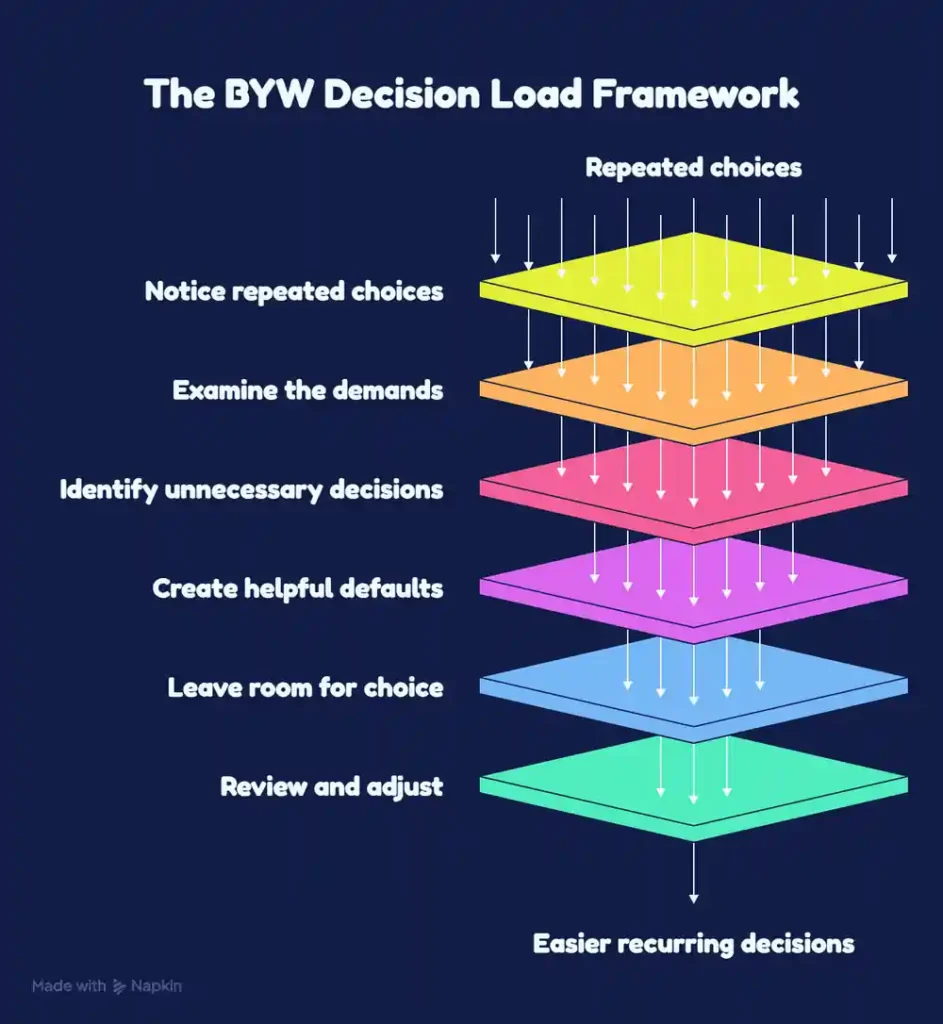 It illustrates how to recognize and simplify recurring decisions without assuming that every choice drains a finite mental resource.
1. Notice Repeated Choices
Identify decisions you keep making throughout the day.
What should I cook? When should I exercise? What should I do first?
2. Examine the Demands
Consider what makes each decision difficult.
Too many options? Unclear priorities? Missing information? Lack of time?
3. Identify Unnecessary Decisions
Look for recurring low-stakes choices that don’t require fresh deliberation every time.
Do I really need to plan dinner from scratch each evening?
4. Create Helpful Defaults
Choose a practical starting point.
Keep several familiar meal options available.
5. Leave Room for Deliberate Choice
Reserve careful consideration for situations that genuinely require it.
Important financial, health, family, and professional decisions deserve appropriate attention.
6. Review and Adjust
Notice whether your new approach makes everyday decisions more manageable.
Is the routine helping, or has it become too restrictive?
This framework doesn’t assume that reducing the number of choices replenishes willpower.
It offers a practical way to make recurring decisions easier to manage.