

Why Most Behavior Change Fails: What Psychology Says Actually Works
Lasting behavior change rarely comes down to willpower—it depends on whether your capacity, inner drive, and environment are working together.
Table of Contents
Somewhere in most people’s history is a small graveyard of attempts: a gym membership used twice, a journal with entries only through January, a productivity system abandoned within a month of being set up with real enthusiasm. Each one felt different going in. Each one ended the same way.
The usual conclusion is that something was missing — more discipline, a better plan, a stronger reason. That conclusion isn’t entirely wrong, but it’s incomplete in a way that quietly sets people up to repeat the same failed pattern with a new behavior next time. Behavior change doesn’t fail from one missing ingredient. It fails because it depends on three separate forces working together, and almost every popular approach to change only addresses one of them.
The Research Behind This
This isn’t a new observation. In a widely used framework published in Implementation Science, researchers Susan Michie, Maartje van Stralen, and Robert West proposed that any behavior is the product of three interacting conditions: capability (the psychological and physical ability to do something), opportunity (the external conditions that make a behavior possible), and motivation (the conscious and unconscious processes that drive it). Their central finding, now widely applied across health and behavioral research, is straightforward but easy to overlook: remove any one of these three, and the behavior collapses—regardless of how strong the other two are.
This matters because almost all popular advice about behavior change focuses on exactly one of these three: motivation. Try harder. Want it more. Find your “why.” When change fails despite genuine desire, the research suggests the problem was rarely motivation alone — it was one of the other two forces, quietly unaddressed the entire time.
The Better You Within Behavior Change Framework
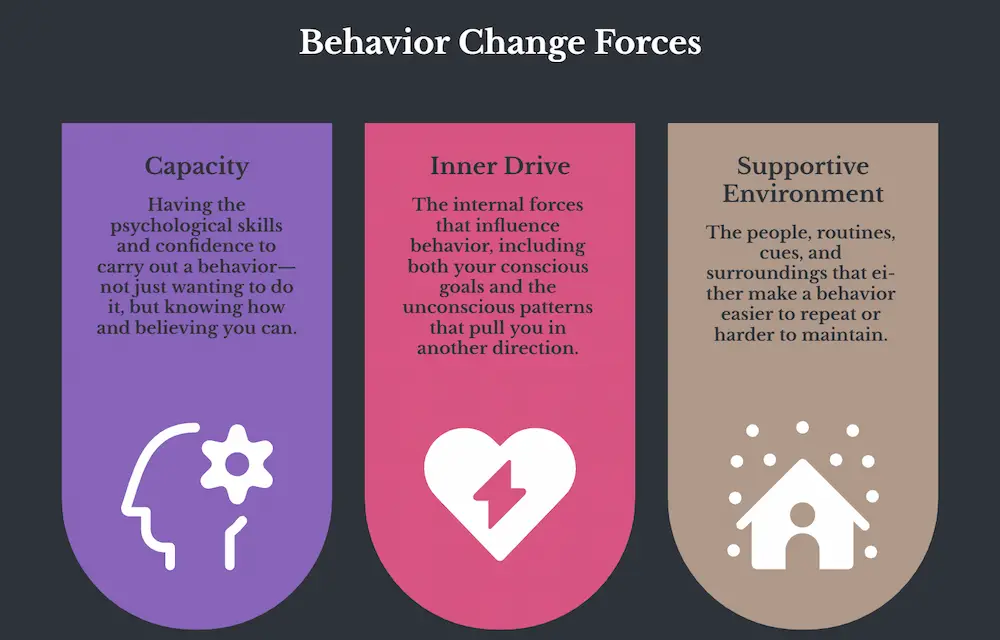
Our practical way of bringing together well-established psychological principles into one easy-to-understand model. It isn’t a new scientific theory. It’s a simple framework that helps explain why lasting behavior change depends on more than willpower alone.
| Force | What It Involves | Where It Breaks Down | Related BYW Coverage |
| Capacity | Having the psychological skills and confidence to carry out a behavior—not just wanting to do it, but knowing how and believing you can. | Trying to change before you’ve built the mindset, skills, or confidence needed to sustain the behavior. | Rewiring thought patterns, mental conditioning |
| Inner Drive | The internal forces that influence behavior, including both your conscious goals and the unconscious patterns that pull you in another direction. | Focusing only on motivation while emotional triggers, identity conflicts, or self-sabotage quietly work against the change. | Identity, emotional triggers, self-sabotage |
| Supportive Environment | The people, routines, cues, and surroundings that either make a behavior easier to repeat or harder to maintain. | Depending on willpower to overcome an environment filled with friction, distractions, or unhelpful habits. | Habit formation, distraction, and discipline |
The Inner Drive row deserves a closer look, because it’s where most behavior change advice quietly goes wrong.
💡 BYW Insight
Most people don’t fail because they’re trying to change the wrong behavior. They fail because they’re trying to change one part of a system that has quietly been working against them all along.
Drive Has Two Layers, and Most Advice Only Addresses One
Drive isn’t a single force. It splits into reflective motivation — the conscious reasons and values behind wanting to change — and automatic motivation — the unconscious emotional reactions, associations, and protective patterns that respond to a situation before conscious thought even catches up.
Reflective motivation is where identity comes in. How to Change Your Identity When You Feel Stuck covers this directly: when a new behavior conflicts with someone’s existing self-concept, the conscious desire to change is real, but it’s competing against an equally real internal story about who that person believes they are. This is conscious, and it’s usually the layer people focus on entirely — setting goals, writing affirmations, deciding to become someone new.
Automatic motivation is the layer almost every popular approach to change ignores completely. This is where emotional triggers live — the fast, largely unconscious reactions explored in What Is an Emotional Trigger? Why You Get Triggered So Easily and How to Control Emotional Triggers Before They Control You — and where self-sabotage operates, the pattern in which discomfort, fear, or unfamiliarity quietly pulls behavior backward even while the conscious mind insists it wants to move forward, covered in Why You Keep Sabotaging Yourself Without Knowing.
This is the crucial insight this framework adds: a person can have strong, genuine reflective motivation and still fail consistently, because automatic motivation is working in the opposite direction the entire time, unnoticed. Addressing conscious desire without addressing this deeper layer is like paddling forward while something below the surface keeps pulling back.
Capacity and Environment Complete the System
Even with drive fully aligned, behavior still requires capacity — the actual psychological ability to execute it — and environment — external conditions that make repetition realistic rather than an uphill fight every single time.
Capacity failures often look like motivation failures from the outside, but they’re not the same thing. Someone who hasn’t yet built the underlying skill or belief in their own ability to follow through will struggle regardless of how motivated they feel in the moment — which is why building genuine capability matters as much as wanting the outcome.
Environment failures are more visible but just as commonly ignored. How Habits Are Formed: Why You Feel Stuck and How to Build Habits That Actually Stick both address this directly: a behavior surrounded by friction, poor cues, or constant competing distractions requires far more willpower to sustain than one supported by a well-designed environment. How to Eliminate Distractions and Stay Disciplined extends this further — protecting a behavior that’s already working from the environmental forces that quietly erode it over time.
Why Most Behavior Change Fails
Put together, this explains the pattern behind most failed change attempts: they address one force, occasionally two, and almost never all three at once. A motivational push without environmental support burns out. A well-designed environment without addressing automatic, emotional resistance gets quietly sabotaged. Strong reflective motivation without built capacity collapses the first time real difficulty appears.
None of this reflects weakness. It reflects an approach that was only ever targeting a third of the actual system.
A Reflection Pause
Rather than asking “why can’t I stick to this,” it can help to get specific about which force has typically gone unaddressed:
- When a change attempt has failed before, was it because you didn’t know how (capacity), because something kept pulling you back emotionally (automatic drive), or because your surroundings made it genuinely difficult (environment)?
- Is there a behavior you consciously want but consistently avoid — and if so, what might the automatic, unconscious layer be protecting you from?
- Which of the three forces have you never actually addressed directly?
The Bigger Picture
This is really the underlying architecture behind everything this library covers. Identity, emotional triggers, self-sabotage, habits, and discipline were never separate topics competing for attention. They’re different parts of the same system — capacity, drive, and environment — and lasting change requires all three moving together, not one of them working harder to compensate for the other two.
That reframe changes what “trying harder” actually means. It was never really about more effort in one direction. It’s about noticing which part of the system has been quietly left out.
💭 A Quiet Realization
Looking back, most of your failed attempts probably weren’t proof that you couldn’t change. They were proof that you were carrying the whole responsibility yourself while other parts of the system quietly worked against you.
Key Takeaways
- Behavior change depends on three interacting forces: capacity, drive, and environment — removing any one causes the behavior to collapse regardless of the other two.
- Drive itself splits into two layers: conscious, reflective motivation (identity) and unconscious, automatic motivation (emotional triggers and self-sabotage) — most advice only addresses the first.
- Capacity and environment are just as often the missing piece as motivation, even though motivation gets almost all the attention in popular advice.
- Lasting change rarely begins with trying harder. It begins with understanding which part of the system you’ve been asking to do all the work.
Continue Your Journey
This framework connects across the entire Better You Within library. Depending on which force feels most unaddressed in your own experience:
For Capacity: Mental Conditioning: How Your Mind Becomes Stronger Over Time — for building the psychological capability behind lasting change.
For Drive (Reflective): How to Change Your Identity When You Feel Stuck — for resolving the conflict between a new behavior and an existing self-concept.
For Drive (Automatic):What Is an Emotional Trigger? Why You Get Triggered So Easily, How to Control Emotional Triggers Before They Control You, and Why Do I Self-Sabotage? The Hidden Reasons You Keep Holding Yourself Back — for the unconscious layer most change attempts miss entirely.
For Environment: How Habits Are Formed: Why You Feel Stuck, How to Build Habits That Actually Stick, and How to Eliminate Distractions and Stay Disciplined — for building and protecting the external conditions that make change sustainable.
Frequently Asked Questions
Why does behavior change usually fail, even with strong motivation?
Motivation itself has two layers — conscious (reflective) and unconscious (automatic) — and most change efforts only address the conscious layer. Emotional triggers and self-sabotage often operate at the unconscious layer, working against the change even when the conscious desire is genuine.
What actually makes behavior change last?
Research on behavior change, including the widely used COM-B model, suggests lasting change requires three conditions together: the psychological capacity to perform the behavior, an environment that supports it, and motivation at both the conscious and unconscious level. Addressing only one of these tends to produce short-lived results.
Is willpower enough to change a behavior permanently?
Generally, no. Willpower can temporarily override a difficult environment or unaddressed emotional resistance, but it’s a limited resource. Behavior that depends entirely on willpower, without supporting capacity or environment, tends to be the first thing to break down under stress or fatigue.