

You’ve worked hard for two years to earn that promotion. When you finally get it, you feel proud, relieved, and perhaps even a little more confident. You’ve achieved something that once seemed so far away.
But a few days later, something changes. You start thinking about the next promotion, a better salary, or the people who are already further ahead. Suddenly, the achievement you worked so hard for doesn’t seem quite enough anymore.
And it isn’t just about careers. You might feel the same way about your appearance, your relationships, or even how well you’re doing as a parent. No matter how much you do, there’s always that quiet thought: I could be doing better.
What “I’m Not Good Enough” Actually Means
When you think, I’m not good enough, it can feel like you’re simply being honest with yourself. You look at what you haven’t achieved, the mistakes you’ve made, or the ways you fall short of your expectations, and the conclusion seems obvious.
But here’s something worth considering: What if that feeling isn’t telling you the truth about who you are, but revealing how you’ve learned to judge yourself?
Think about it. You might accomplish something today that would have made you incredibly proud a few years ago. Yet now, instead of celebrating, you barely acknowledge it. The achievement hasn’t become less meaningful. Your expectations have changed.
Sometimes, the feeling of not being good enough has less to do with what you’re actually capable of and more to do with the standards you’ve come to believe you must meet.
And when those standards keep changing, even genuine success can begin to feel insufficient.
Why Someone Can Feel Not Good Enough Even When Doing Well
Have you noticed how much your confidence can depend on what’s happening in one particular area of your life? You might feel wonderful when someone praises your work, but a single criticism can leave you questioning your abilities. Or perhaps you feel confident when you look a certain way, only to feel inadequate when you compare yourself with someone else.
Psychologists Jennifer Crocker and Connie Wolfe explored something similar in their research on contingencies of self-worth. Their work suggests that we sometimes tie our sense of worth to particular things — our achievements, appearance, other people’s approval, or how well we perform compared with others.
When something matters this much to how we see ourselves, success in that area can make us feel better about ourselves, while setbacks can affect us more deeply than we might expect.
Now think about that promotion. You worked hard, achieved your goal, and felt successful. But if your sense of worth depends on how far you’ve progressed in your career, one promotion might not be enough to settle that feeling for long. Soon, you may find yourself looking toward the next achievement, hoping it will finally make you feel successful enough.
The achievement was real. The problem may be that you’ve started expecting your achievements to prove something about your worth as a person.
Where the Not-Enough Belief Can Come From
It’s worth being careful here, because there’s no single, universal origin story that applies to everyone who recognizes this pattern.
Psychologist Melanie Fennell’s cognitive model of low self-esteem, published in 1997, proposes that some people develop a broad negative belief about themselves, sometimes called a “bottom line.” Alongside this belief, they may develop conditional assumptions or “rules for living,” such as if I don’t perform exceptionally, I’m not enough. Meeting these rules may help keep the underlying negative belief from becoming prominent, while perceived failures can bring it back into focus.
A refined cognitive-behavioural model, proposed by Katharine Rimes, Patrick Smith, and Livia Bridge in 2023, builds on Fennell’s work. It gives greater attention to interpersonal experiences, social and cultural influences, and beliefs about personal adequacy and acceptance by others.
These models suggest that criticism, comparison, rejection, or conditional approval may contribute to negative self-beliefs in some people. But they don’t provide a definitive explanation for every individual, and not everyone who feels inadequate can identify a particular early experience.
The pattern can still be worth examining in the present, even when its origins are unclear.
How Conditional Worth Keeps the Pattern Going
Whatever its origin, conditional self-worth can sometimes produce a recognizable pattern:
Standard → a condition gets attached to feeling adequate — a level of achievement, approval, or performance.
Striving → effort goes toward meeting that specific condition.
Achievement or Reassurance → the condition gets met, or external validation arrives.
Temporary Relief → for a period, the feeling of not being enough becomes less prominent.
New or Higher Standard → attention shifts toward another condition that now seems necessary.
Not Enough Again → the earlier relief fades, and the familiar feeling returns.
Sometimes, reaching a goal brings genuine satisfaction. But when your sense of worth depends on constantly proving yourself, that satisfaction may not last. You achieve what you wanted, only to find yourself wondering what you need to accomplish next.
The problem isn’t necessarily the goals you’re setting. It’s what those goals have come to mean about you.
So here’s a question worth asking yourself: When I finally achieve something I’ve worked hard for, do I allow myself to feel proud of it, or do I immediately start looking for the next thing I need to prove?
Why Achievement Doesn’t Always Fix the Feeling
You can be good at what you do, appreciated by others, and genuinely successful — yet still feel that something is missing. You reach a goal, enjoy the achievement for a while, and then find yourself wondering what you need to accomplish next.
Sometimes, the problem isn’t that your achievements aren’t meaningful. It’s that you’ve started using them to measure your worth. And when feeling good enough depends on what you accomplish, even a major success may not bring the lasting satisfaction you expected.
This connects with How Your Self-Image Predicts Your Behavior, which explores how the way you see yourself influences your choices. But there’s another question worth asking here: Have you started believing that you must keep achieving more to deserve feeling good about yourself?
How the Belief Can Change Behavior
The feeling of never being good enough doesn’t always stay in your thoughts. Sometimes, it quietly influences the choices you make every day.
You might work longer hours because you feel you haven’t done enough, even when you’ve already given your best. You might avoid trying something new because the possibility of failing feels too uncomfortable. Or perhaps you find yourself constantly comparing your progress with others, noticing what they have achieved while overlooking how far you’ve come.
Even compliments can become difficult to accept. Someone praises your work, and instead of enjoying the moment, you immediately think of what you could have done better.
For some people, the fear of not being good enough leads to constant striving. For others, it does the opposite — they stop trying because they’re afraid they won’t measure up anyway.
Different behaviors, but sometimes the same question underneath: What if I try my best and it still isn’t enough?
How to Begin Changing the Pattern
What if, instead of trying harder to prove you’re good enough, you started questioning why you feel the need to prove it in the first place?
Think about the last time you achieved something you were proud of. Did you allow yourself to enjoy it? Or did your mind immediately move to what you hadn’t accomplished yet?
Start by noticing these moments. When you catch yourself thinking, I should be doing more or I’m still not good enough, ask yourself where that expectation is coming from. Is it something you genuinely want, or something you’ve come to believe you must achieve to feel worthy?
This is where Self-Awareness vs Self-Consciousness becomes especially relevant. There’s a difference between understanding your thoughts and constantly judging yourself for having them. The goal isn’t to become even more critical of yourself, but to notice the expectations you’ve been carrying, perhaps without ever questioning them.
You might also try looking at your mistakes differently. If you make a poor decision or fall short of a goal, does it mean you’ve failed at something, or does it mean you are a failure? Those are two very different conclusions.
Changing a belief you’ve carried for years takes time. But you can begin by separating what you accomplish from what you’re worth. Your achievements can be meaningful without becoming the measure of your value as a person.
The BYW Moving “Enough” Line
Have you ever noticed how reaching one goal sometimes makes you feel good for a while, only for another goal to take its place?
You tell yourself you’ll finally feel successful when you get that promotion, reach a certain income, or earn someone’s approval. And when it happens, you feel proud and relieved. But before long, another expectation appears. Now there’s something else you need to achieve before you can truly feel good about yourself.
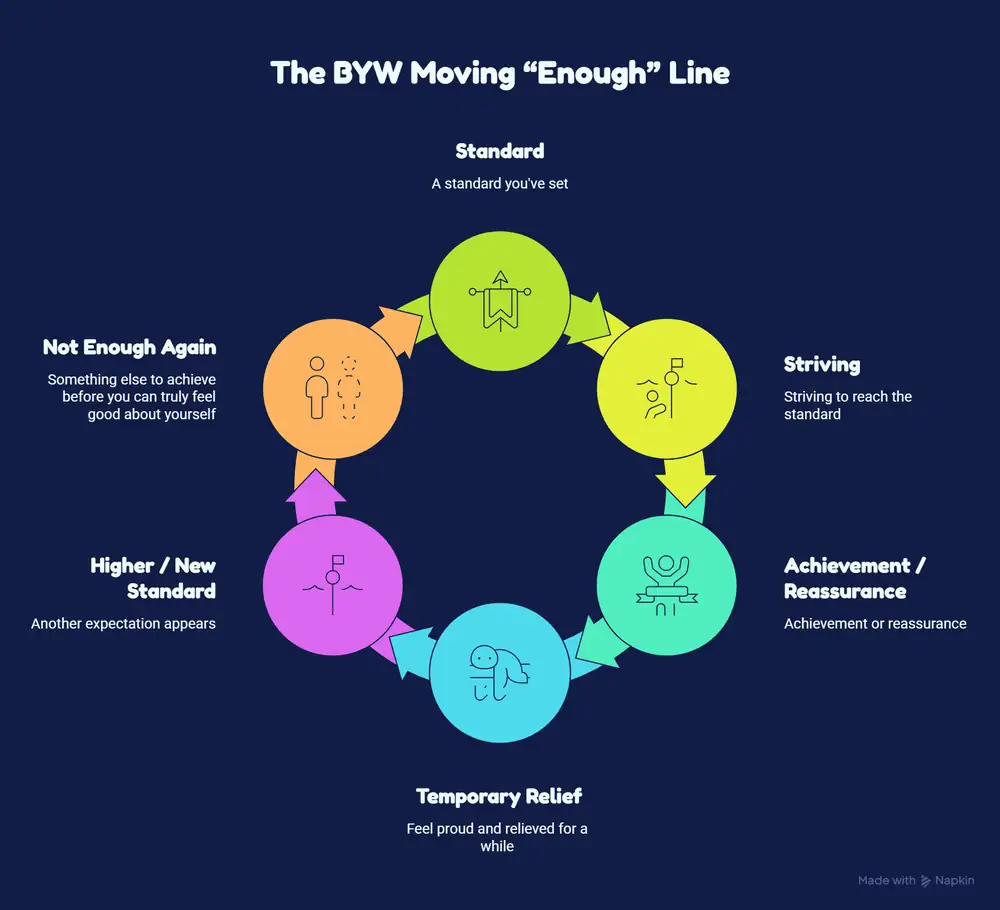 This is what we call the BYW Moving “Enough” Line:
Standard → Striving → Achievement / Reassurance → Temporary Relief → Higher / New Standard → Not Enough Again
It’s a pattern that can develop when your sense of worth becomes closely tied to what you accomplish or how others see you. Not everyone experiences it, but if you recognize yourself in it, consider what happens each time you reach the standard you’ve set.
The problem isn’t having goals or wanting to improve. Ambition can be healthy and fulfilling. The difficulty begins when every achievement becomes another test of whether you’re good enough.
And perhaps that’s the most important thing to recognize: You can keep growing without having to keep proving your worth.