
Have you ever reacted in a way you did not understand?
Or said something you did not mean?
Or repeated the same habit even though you knew better?
That does not automatically mean you lack discipline.
It may mean that an old habit, emotional association, or automatic mental pattern responded before you had time to think deliberately.
Many of your daily reactions are influenced by processes that happen outside conscious awareness. Past experiences, repeated behaviors, learned associations, and familiar triggers can all shape what you feel and do in the moment.
You can see some of these patterns in 10 Subconscious Behaviors You Didn’t Realize Control You.
But first, it helps to understand what people actually mean when they use the term “subconscious mind.”
 What Is the Subconscious Mind?
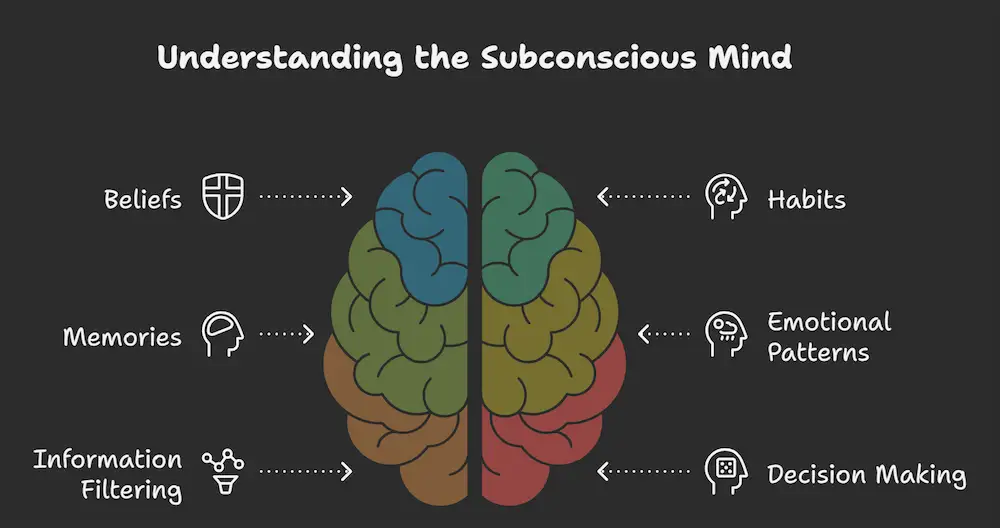
The subconscious mind is a popular term for mental activity that happens outside your immediate awareness but can still influence how you think, feel, and behave.
It is not a separate physical part of the brain or a hidden control centre. In modern psychology, researchers are more likely to use terms such as nonconscious processes, automatic thinking, implicit memory, conditioning, and habitual behavior.
In everyday language, however, “subconscious mind” is a useful way to describe the learned associations, memories, expectations, and automatic patterns that can affect you before conscious thought catches up.
In simple terms:
Your conscious mind notices and thinks deliberately. Your subconscious patterns influence many of the responses that happen automatically.
Is the Subconscious Mind Real?
The automatic mental processes people call the subconscious are real, but the subconscious is not one clearly defined “place” inside the brain.
Psychology recognizes that memories, learned associations, habits, emotions, and perceptions can influence behavior without entering conscious awareness. For example, you may complete a familiar task automatically, feel uneasy around a particular cue, or repeat a response before consciously deciding to do it.
The word subconscious groups these different processes into one familiar idea. It is useful in everyday conversation, as long as we do not treat it as a mysterious force that controls everything you do.
The Real Problem: Why You Feel Out of Control
You want to think positively…
But negative thoughts keep coming back.
You struggle to change your habits…
But you keep falling into the patterns.
You try to stay calm…
But emotions take over.
In other words, you may know what you want to do but still find yourself repeating a familiar response.
This gap often appears when a learned pattern is activated more quickly than deliberate thought. It does not mean you are powerless. It means the automatic response has been practiced more often than the alternative.
How the Subconscious Mind Works
Your mind cannot consciously analyze every sensation, decision, and movement at the same time. With experience, some familiar processes become faster and require less deliberate attention.
Habits are one example. When you repeatedly perform the same behavior in a similar situation, the situation itself can begin to trigger the response. This is why you may reach for your phone when you feel bored or follow a familiar route without planning every turn.
These responses are not stored in one hidden mental compartment. They develop through learning, memory, repetition, attention, emotion, and the association between cues and actions.
This automaticity can be helpful because it reduces effort. It can also keep an unwanted response going when the original pattern no longer serves you.
The Automatic Pattern Loop
Experience → Association → Cue → Response
You experience something.
Your mind forms an association.
A similar internal or external cue appears.
A familiar response is activated.
Repetition can make the connection feel increasingly automatic.
Conscious vs Subconscious Mind
|
Conscious Processing |
Automatic or Nonconscious Processing |
|
Involves current awareness |
Happens without full awareness |
|
Deliberate and effortful |
Often fast and low effort |
|
Supports planning and reflection |
Supports familiar responses and habits |
|
Can evaluate alternatives |
Can be activated by learned cues |
|
Flexible but limited in attention |
Efficient but sometimes inflexible |
This is a simplified comparison. Conscious and nonconscious processes continually interact rather than operating as two completely separate minds.
To understand this in more depth: Conscious vs Subconscious Mind
What Happens Outside Conscious Awareness?
Processes outside your immediate awareness can:
- activate learned habits;
- influence where your attention goes;
- bring emotional associations to mind;
- help you perform practiced skills;
- shape quick impressions and expectations;
- influence how you respond to familiar cues.
This does not mean every decision is controlled by the subconscious. It means conscious awareness is only one part of how the mind processes information.
Real Life Examples of the Subconscious Mind Being in Control
1. Driving
When you first learn to drive, almost every action requires focused attention. With practice, many parts of driving become more automatic, although safe driving still requires awareness and judgment.
2. Social Reactions
You enter a room and immediately feel uncomfortable. A familiar tone, expression, setting, or social cue may have activated an emotional association before you consciously understood it.
3. Repeating Mistakes
This may reflect a learned cue-response pattern, an emotional coping strategy, or a habit that has become easier to repeat than to interrupt.
4. Self-Sabotage
You set an important goal, but when progress begins to feel unfamiliar, demanding, or emotionally risky, you procrastinate or retreat into an older behavior.
This does not always mean your subconscious is trying to sabotage you. Avoidance can be reinforced because it reduces discomfort in the short term, even when it creates problems later.
To explore why this pattern happens, read: Why Do I Self-Sabotage?
Want to recognize more automatic patterns? Read:10 Subconscious Behaviors You Didn’t Realize Control You
How Automatic Patterns Can Shape Your Life
Automatic patterns can influence:
- the habits you repeat;
- the situations you avoid;
- the expectations you carry into relationships;
- the way you interpret familiar experiences;
- and how quickly you react to emotional cues.
Their influence is not permanent or absolute. A pattern can feel automatic while still being open to awareness, new learning, environmental change, and repeated practice.
Can You Change Subconscious Patterns?
You cannot directly command every automatic thought or emotional response. You can, however, influence learned patterns by changing what happens around the trigger and repeatedly practicing a different response.
A simple starting process is:
- Notice
Identify the thought, feeling, cue, or situation that appears before the automatic response. - Pause
Create a small gap before acting. Even a brief pause helps move the response into conscious awareness. - Choose
Select one realistic alternative rather than demanding a complete transformation. - Repeat
Practice the alternative in a similar context until it becomes easier and more familiar.
This process does not erase every old pattern. It gradually strengthens your ability to respond differently.
For a deeper step-by-step process, read How to Reprogram Your Subconscious Mind.
Practical Ways to Work With Automatic Patterns
Journal the Pattern
Write down what happened immediately before a repeated thought, feeling, or behavior. This can help you identify cues that are difficult to notice in the moment.
Practice Mindful Awareness
Mindfulness can help you observe a reaction without responding immediately. The goal is not to remove thoughts but to notice them early enough to choose what happens next.
Change Your Environment
Reduce cues that repeatedly activate an unwanted habit and make helpful behaviors easier to begin. Environment often matters more than willpower alone.
Repeat a Specific Alternative
Choose one small response you can practice in the same situation. A clear alternative is more useful than simply telling yourself to “stop” the old behavior.
Track What Happens
Record when the pattern appears, what triggered it, and what helped you respond differently. Tracking can reveal progress that is easy to miss from day to day.
A Common Mistake to Avoid
Many people try to fight every unwanted thought or reaction as though their own mind were the enemy.
That approach often creates more frustration.
Automatic patterns usually developed through learning, repetition, emotional protection, or adaptation. Understanding their function does not mean accepting harmful behavior. It gives you a clearer place to begin changing it.
Your mind is not working against you. It may simply be repeating what it has learned to do.
Self-Check: A Quick Reflection
Ask yourself:
- What thought do I repeat daily?
- What reaction do I want to change?
- What pattern keeps repeating in my life?
Is 95% of the Mind Subconscious?
You may have seen claims that 90% or 95% of the mind is subconscious. There is no accepted scientific calculation showing that a precise percentage of the mind works subconsciously.
A large amount of mental processing does happen outside conscious awareness, but researchers cannot divide the mind into an exact conscious and subconscious percentage.
The useful point is not the number. It is that awareness is limited, while many perceptions, memories, habits, and automatic responses operate without continuous conscious attention.
FAQ SECTION
What is subconscious mind in simple words?
How does the subconscious mind affect behavior?
What does the subconscious mind do daily?
Can you control your subconscious mind?
How do I know if my subconscious mind is controlling me?
Continue Your Journey
Understanding automatic mental patterns is the first step. The next article depends on what you are experiencing:
If negative thoughts keep returning:
Read Why Your Mind Is Always Negative to understand what may be reinforcing the pattern.
If you want to change an automatic response:
Read How to Reprogram Your Subconscious Mind for a practical step-by-step process.
If you want to understand conscious and automatic thinking more clearly:
Read Conscious vs Subconscious Mind.
If you want to recognize these patterns in everyday behavior:
Read 10 Subconscious Behaviors You Didn’t Realize Control You.