
You sit down to work.
You know exactly what needs to be done.
You open the document.
Read the task.
Prepare to start.
And then somehow:
- you check your phone
- open another tab
- scroll for a few minutes
- respond to a message
- watch a video
- reorganize something unimportant
An hour passes.
The work remains untouched.
What makes this frustrating is that the distraction was never the goal.
You wanted to focus.
You wanted to make progress.
Yet your attention drifted somewhere else almost automatically.
If this happens often, it is easy to conclude:
“I have no discipline.”
But distraction is usually more complicated than that.
Many people assume focus is simply a matter of willpower.
In reality, distraction control is heavily influenced by subconscious habits, emotional regulation, environmental cues, and how the brain responds to discomfort.
If you have already read Why You Can’t Stay Disciplined: How to Fix It, you already understand that discipline is rarely about forcing yourself harder. It is usually about understanding the patterns that quietly pull you away from what matters.
In short: Distraction control is not simply about having stronger willpower. It is the ability to manage the habits, emotions, and environmental cues that repeatedly pull your attention away from meaningful work. Lasting focus develops when you understand these patterns and make it easier for your brain to stay engaged instead of constantly resisting distractions.
What Is Distraction Control?
Distraction control is the ability to recognize, manage, and reduce attention shifts that pull you away from important tasks. It involves regulating impulses, designing supportive environments, and building habits that make focus easier to maintain over time.
Distraction control is not about eliminating every interruption.
It is about reducing unnecessary attention leaks before they become automatic behaviors.
Focus vs. Distraction Control
| Focus | Distraction Control |
| Keeping your attention on a meaningful task. | Reducing the interruptions and habits that pull attention away. |
| Happens during the task itself. | Begins before the task by shaping your environment and routines. |
| Relies on sustained attention. | Relies on awareness, habit design, and emotional regulation. |
| Can fluctuate throughout the day. | Can be strengthened by improving systems rather than relying only on willpower. |
Why Distractions Feel So Powerful
Most people think distractions are attractive because they are enjoyable.
That is only part of the story.
The brain naturally seeks:
- novelty
- stimulation
- relief
- immediate rewards
Meanwhile, focused work often involves:
- effort
- uncertainty
- delayed rewards
- mental strain
Given those options, the brain frequently chooses the easier path.
According to the American Psychological Association, attention and self-regulation are strongly influenced by cognitive load, emotional state, and environmental demands.
This aligns with what researchers understand about the brain’s attention systems: focus becomes more difficult when mental resources are already stretched by stress, fatigue, or emotional pressure.
This means distractions are not always competing against motivation.
They are often competing against discomfort.
That distinction matters.
Because it changes the question from:
“Why am I so distracted?”
to:
“What discomfort am I trying to escape?”
The Brain Behind Distraction
Part of the reason distractions feel so compelling lies in how the brain manages attention.
The prefrontal cortex—the area involved in planning, decision-making, and self-control—helps you stay focused on long-term goals. But when you’re mentally tired, emotionally overwhelmed, or juggling too many demands, this part of the brain has to work harder.
At the same time, the brain naturally notices things that promise quick rewards or immediate relief, such as a notification, a new message, or a brief break from an uncomfortable task.
This doesn’t mean your brain is working against you. It means your attention is constantly balancing immediate comfort with long-term priorities. Understanding this balance can make it easier to design habits and environments that support focus instead of relying on willpower alone.
One Misconception About Distraction Control
Many people believe focus improves when they become more disciplined.
But sustainable focus often improves before discipline does.
Why?
Because discipline becomes easier when there are fewer distractions competing for attention.
People often imagine highly focused individuals constantly resisting temptation.
In reality, many simply create environments that reduce temptation in the first place.
Strong systems reduce friction.
Weak systems require constant self-control.
That is why someone can feel disciplined in one environment and completely distracted in another.
The problem is often not character.
The problem is exposure.
The Hidden Pattern Most People Miss
Most distractions are not random.
They serve a purpose.
A distraction often appears at the exact moment something becomes emotionally uncomfortable.
For example:
A person begins an important project.
Suddenly they:
- check notifications
- clean their desk
- browse the internet
- start unrelated tasks
The timing is rarely accidental.
The work may trigger:
- uncertainty
- fear of failure
- boredom
- self-doubt
- pressure
The distraction creates temporary relief.
For a moment, the discomfort disappears.
This is where many people get stuck.
The problem is not the distraction.
The problem is what the distraction protects them from feeling.
Real-Life Example: When Distraction Becomes Emotional Escape
Someone sits down to write an important presentation.
The task could improve their career.
They know it matters.
Yet instead of beginning, they spend thirty minutes checking emails.
Then another twenty minutes organizing files.
Then they scroll social media.
From the outside, it appears to be poor focus.
But internally, something different may be happening.
The presentation activates:
- performance pressure
- fear of judgment
- uncertainty about results
The distractions provide emotional relief.
The behavior looks unproductive.
The emotional purpose underneath often goes unnoticed.
Why The Pattern Keeps Repeating
Distractions become habits through reinforcement.
The cycle often looks like this:
The Dopamine Relief Loop
Trigger
↓
Discomfort
↓
Distraction
↓
Temporary Relief
↓
Reinforcement
↓
Repeat
The brain learns:
“When discomfort appears, distraction helps.”
Over time this becomes automatic.
According to Cleveland Clinic, behaviors that provide immediate rewards are more likely to be repeated because the brain naturally reinforces rewarding experiences.
The distraction may only provide relief for a few minutes.
But the brain remembers the reward.
And that is enough to strengthen the pattern.
How Your Environment Trains Your Attention
Many people underestimate how much their environment shapes focus.
Consider how often attention is interrupted by:
- notifications
- emails
- social media
- background noise
- multiple open tabs
- constant accessibility
Each interruption teaches the brain to switch attention more frequently.
Eventually sustained focus begins feeling unfamiliar.
Your environment is not merely surrounding your habits.
It is training them.
This is why systems often matter more than motivation.
If you are trying to build consistency alongside focus, How to Build Habits That Actually Stick explores why repetition becomes easier when behavior is supported by structure.
External vs. Internal Distractions
Not all distractions come from the outside.
Some are visible, while others happen entirely inside your mind.
Recognizing the difference can make it much easier to understand why staying focused sometimes feels so difficult.
| External Distractions | Internal Distractions |
| Phone notifications | Worry or anxiety |
| Emails and messages | Self-doubt |
| Social media | Fear of failure |
| Background noise | Boredom |
| Interruptions from others | Perfectionism |
| Multiple browser tabs | Racing thoughts |
| Cluttered workspace | Emotional discomfort |
External distractions compete for your attention from the environment around you.
Internal distractions arise from your own thoughts and emotions, often making it difficult to stay present even in a quiet room.
For many people, removing external distractions improves focus. But lasting change usually comes from understanding the internal patterns that make those distractions feel so appealing in the first place.
Throughout BetterYouWithin, you’ll notice a recurring idea: lasting change rarely comes from controlling every external situation. It comes from understanding the internal patterns that quietly shape your behavior.
Reflection Pause
Ask yourself honestly:
- What usually distracts you first?
- What task do you avoid most often?
- What emotion appears before the distraction?
- Does the distraction create temporary relief?
- Are you struggling with focus, or escaping discomfort?
- If there were no phone, no notifications, and no internet, what would your mind distract itself with instead?
Awareness does not solve the pattern immediately.
But it makes the pattern visible.
And visible patterns become easier to change.
How to Improve Distraction Control Step by Step
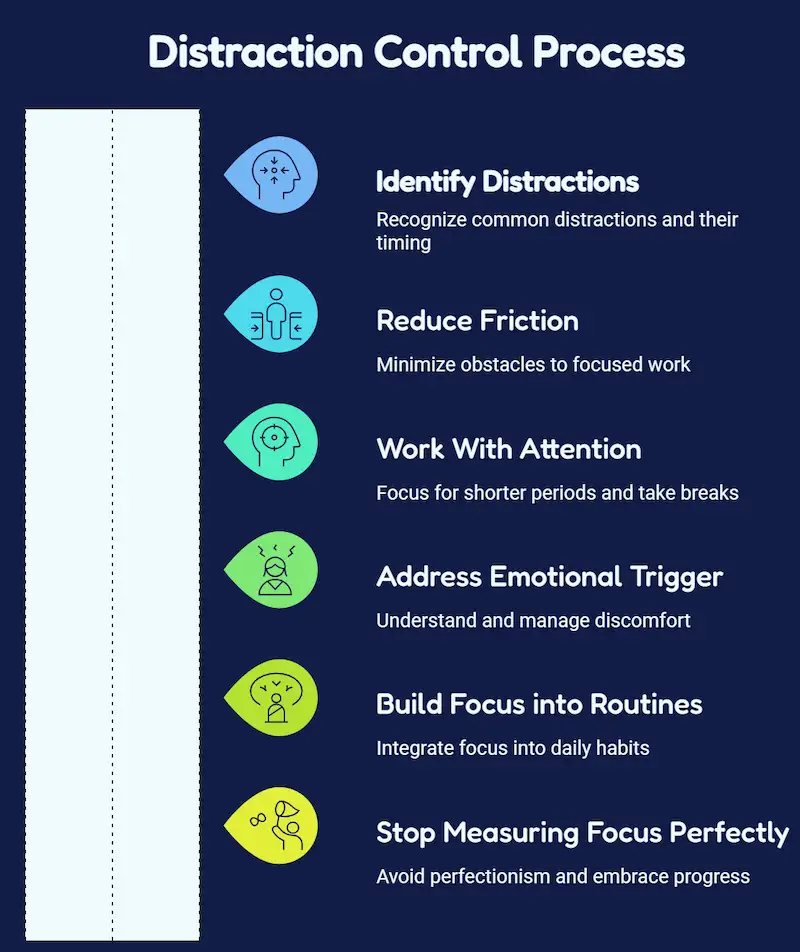
1. Identify Your Most Common Distractions
Many people try removing distractions before understanding them.
Start by noticing:
- where attention goes
- when it happens
- what emotion came first
Why it works:
Awareness interrupts automatic behavior.
Psychologically, the brain cannot change a pattern it does not recognize.
2. Reduce Friction Around Focus
Make focused work easier to begin.
Examples:
- silence notifications
- close unnecessary tabs
- prepare work materials beforehand
- create a dedicated workspace
Why it works:
The brain naturally chooses lower-resistance behaviors.
Reducing friction increases the likelihood of focused action.
3. Work With Attention, Not Against It
Many people expect perfect concentration for hours.
That expectation often creates frustration.
Instead:
- focus for shorter periods
- take intentional breaks
- return consistently
Why it works:
Attention naturally fluctuates.
Working with realistic attention cycles reduces mental fatigue.
4. Address The Emotional Trigger
Sometimes the distraction is not the real problem.
Ask:
- What feels uncomfortable about this task?
- What am I avoiding feeling right now?
Why it works:
The emotional trigger often drives the behavior more than the distraction itself.
Understanding the trigger weakens its influence.
5. Build Focus Into Existing Routines
New behaviors are easier when attached to existing habits.
For example:
After morning coffee,
→ begin ten minutes of focused work.
After lunch,
→ review priorities for the afternoon.
Why it works:
The brain responds well to predictable behavioral cues.
This is one reason Habit Stacking: The Easiest Way to Build Routines can make focus habits easier to maintain.
6. Stop Measuring Focus Perfectly
Many people abandon progress after one distracted day.
They assume:
“I failed again.”
But attention is never perfect.
Why it works:
Reducing perfectionism prevents the all-or-nothing cycle that destroys consistency.
Progress survives imperfect days.
One Uncomfortable Truth About Focus
Many people believe they need better concentration.
Sometimes they actually need a better relationship with discomfort.
This can feel uncomfortable to admit.
Because it means the phone is not always the problem.
The notifications are not always the problem.
The distraction itself is not always the problem.
Often the deeper issue is that modern life has trained us to escape discomfort immediately.
Boredom.
Uncertainty.
Waiting.
Mental effort.
Silence.
All of these experiences have become increasingly unfamiliar.
According to Harvard Health, constant stimulation can make sustained attention more difficult because the brain becomes accustomed to frequent novelty and interruption.
The uncomfortable truth is this:
Focus often improves when you become more willing to remain present with discomfort rather than escaping it instantly.
That is a very different skill than productivity.
It is a form of awareness.
Key Takeaways
If you remember only a few ideas from this article, let them be these:
· Distractions are often learned responses to discomfort rather than a simple lack of discipline.
· Lasting focus improves when you reduce unnecessary friction instead of relying only on willpower.
· Your environment matters more than most people realize.
· Emotional awareness weakens automatic habits by making hidden patterns visible.
· Small systems outperform motivation over the long term.
Final Thoughts
Distraction control is not about becoming perfectly focused.
It is about understanding why attention keeps drifting in the first place.
Many distractions are not random interruptions.
They are learned responses.
Automatic attempts to avoid discomfort, uncertainty, pressure, or emotional strain.
Once you begin seeing the pattern, the struggle often makes more sense.
The goal isn’t to become someone who never gets distracted. It’s to become someone who notices distractions sooner and returns to what matters more gently and more consistently. The goal is:
- noticing attention shifts earlier
- understanding the emotional trigger underneath them
- reducing unnecessary friction
- creating environments that support focus
- returning to what matters more consistently
Because lasting discipline rarely comes from forcing yourself harder.
It usually comes from making focus easier to repeat.
If discipline still feels like an ongoing struggle, Why You Can’t Stay Disciplined: How to Fix It explores the deeper patterns that make consistency difficult even when motivation is strong.
Questions You May Quietly Be Asking Yourself
Why do I get distracted even when I genuinely want to focus?
Because wanting to focus and feeling comfortable focusing are not always the same thing. Many distractions appear when a task triggers boredom, uncertainty, pressure, or emotional discomfort. The distraction often provides temporary relief rather than genuine enjoyment.
Is distraction a discipline problem or a habit problem?
Usually both are connected. Repeated distractions eventually become habits, and habits influence discipline. The good news is that changing the environment and understanding the underlying pattern often improves both at the same time.
Can focus improve if I have struggled with distractions for years?
Yes. Attention patterns are highly trainable. Most people do not improve focus by becoming more motivated. They improve it by becoming more aware of what triggers distraction and gradually building systems that support sustained attention.