

By now, you’ve seen that self-sabotage is rarely about laziness, a lack of willpower, or not wanting success badly enough.
More often, it’s a learned response shaped by emotional experiences, subconscious beliefs, and the brain’s natural preference for what feels familiar.
That understanding matters.
Because the way you approach change depends on how you explain the problem.
If you believe you’re simply undisciplined, you’ll probably respond with more pressure and self-criticism.
If you recognize that your behavior is trying to protect you from emotional discomfort, you’ll approach change with greater awareness and curiosity.
That doesn’t mean lowering your expectations.
It means changing your strategy.
The goal is not to fight yourself into becoming someone different.
The goal is to create enough emotional safety that your mind no longer feels the need to rely on old protective patterns.
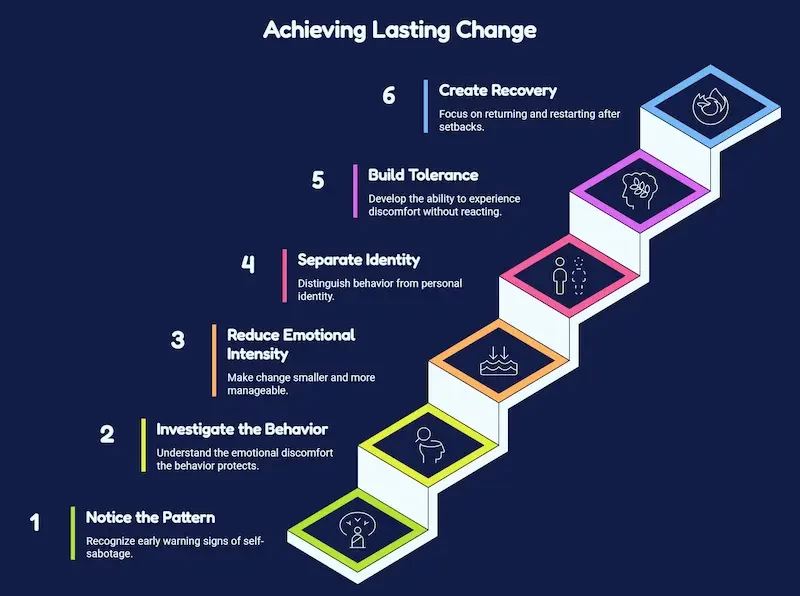
The following steps are designed to help you interrupt the cycle gradually, build self-trust through consistent action, and create changes your mind can realistically sustain.
The goal isn’t to become a different person overnight. It’s to respond differently to the same emotional triggers, one small choice at a time. Lasting change usually begins with repeated moments of awareness, not dramatic transformations.
What Is Self-Sabotage?
Self-sabotage is a pattern in which a person unconsciously acts against their own goals, wellbeing, relationships, or success. These behaviors are usually driven by subconscious fears, emotional conditioning, protective beliefs, or learned coping mechanisms rather than a conscious desire to fail.
Self-sabotage can look like:
- procrastination
- perfectionism
- quitting too early
- avoiding opportunities
- emotional withdrawal
- inconsistency
- chronic overthinking
- abandoning progress
The behavior often appears irrational. But underneath it usually sits a hidden emotional reason.
And that distinction matters.
Because people rarely sabotage themselves for no reason.
Why Self-Sabotage Happens
Most people assume self-sabotage is caused by laziness.
But psychologically, that explanation is often inaccurate.
The brain is designed to prioritize:
- safety
- familiarity
- predictability
Not transformation. Not growth. Not success.
Safety comes first.
This means that when change begins creating emotional discomfort, the subconscious mind may interpret progress itself as a threat.
According to the Cleveland Clinic, self-sabotaging behaviors are frequently connected to stress responses, low self-worth, fear, and learned emotional patterns. When someone questions their own worth or believes they are undeserving of success, they may unconsciously engage in behaviors that reinforce those beliefs.
The subconscious mind often asks:
“Is this familiar?”
before it asks:
“Is this good for me?”
That is why unhealthy patterns can feel strangely comfortable.
A Simple Example
Someone finally begins improving their health.
They:
- exercise regularly
- eat better
- feel more confident
Then unexpectedly:
- routines collapse
- motivation disappears
- old habits return
From the outside it looks like a discipline problem.
Internally, the brain may be reacting to unfamiliarity.
Growth creates uncertainty.
And uncertainty creates discomfort.
Why Understanding the Pattern Isn’t Always Enough
One of the most frustrating parts of self-sabotage is this:
Many people already understand what they’re doing.
They know they procrastinate.
They recognize their avoidance.
They’ve read books, watched videos, and reflected on their habits.
Yet the pattern continues.
This often leads to another painful question:
“If I know what’s happening, why can’t I stop?”
Because awareness and automatic behavior are not controlled by the same systems.
Understanding happens consciously.
Patterns operate through repeated emotional learning.
When your brain has associated certain situations with emotional discomfort, it doesn’t wait for you to think logically. It reacts automatically based on what has felt safest in the past.
This is why insight alone rarely creates lasting change.
Real change happens when new emotional experiences are repeated often enough that the brain begins to see them as safe, familiar, and predictable.
Understanding opens the door.
Repeated action is what rewires the path.
The Hidden Pattern Most People Miss
When people try to overcome self-sabotage, they often focus on changing the visible behavior.
They tell themselves they need to stop procrastinating, become more disciplined, stay motivated, or simply try harder.
But these behaviors are often symptoms rather than the real problem.
A more helpful question is:
What emotional discomfort is this behavior helping me avoid?
Many self-sabotaging behaviors begin as protective responses and become forms of avoidance coping. Rather than solving the underlying problem, they temporarily reduce emotional discomfort while allowing the deeper pattern to continue. They may reduce emotional discomfort in the short term, even though they create frustration in the long term.
For example:
Procrastination may help you avoid:
- fear of failure
- fear of judgment
- disappointment
- self-doubt
Perfectionism may help you avoid:
- criticism
- embarrassment
- vulnerability
- making mistakes
Emotional withdrawal may help you avoid:
- rejection
- conflict
- intimacy
- feeling misunderstood
When viewed this way, self-sabotage stops looking irrational.
Instead, it begins to look like an outdated coping strategy that your mind learned to repeat because it once felt emotionally safer than facing uncertainty.
That doesn’t mean the behavior is helping you today.
It simply means your brain may still be relying on a strategy that made sense at another point in your life.
Recognizing this shift—from asking “What’s wrong with me?” to asking “What is this pattern trying to protect me from?”—often becomes the first step toward lasting change.
The Identity Behind Self-Sabotage
By now, it may seem clear that self-sabotage often protects us from uncomfortable emotions.
But emotional discomfort isn’t always the only thing being protected.
Sometimes, the pattern is protecting the way we see ourselves.
Each of us carries an internal story about who we are.
Over time, those stories become part of our identity.
Perhaps you’ve caught yourself thinking:
- “I’m just not a disciplined person.”
- “I’ve never been good at following through.”
- “I always lose motivation.”
- “Success isn’t really for someone like me.”
These beliefs may feel like facts.
But in many cases, they’re simply stories built from repeated experiences.
The challenge is that the brain naturally prefers consistency.
When your actions begin moving beyond the identity you’ve carried for years, your subconscious mind may experience that change as unfamiliar—even if it’s positive.
Imagine someone who has always believed they’re “bad with money.”
As they begin saving consistently and making healthier financial decisions, they may unexpectedly overspend or abandon their budget.
Not because they want to fail.
But because their new behavior conflicts with the identity they’ve spent years reinforcing.
The same pattern can appear in relationships, careers, health, and personal growth.
This doesn’t mean your identity is fixed.
In fact, the opposite is true.
Identity is shaped by repeated evidence.
Each small promise you keep to yourself becomes evidence that the old story may no longer be accurate.
Over time, those small pieces of evidence begin reshaping the way you see yourself.
Real change often begins long before your circumstances look different.
It begins the moment your identity starts catching up with your actions.
Self-sabotage rarely happens because you’re working against yourself. More often, you’re protecting an older version of yourself that your mind still believes it needs to preserve. Understanding that difference doesn’t excuse the behavior—it changes how you begin changing it.
Real-Life Examples of Self-Sabotage
Career Growth
A person receives an opportunity they’ve wanted for years.
Suddenly they begin:
- procrastinating
- delaying decisions
- avoiding responsibility
Consciously they want success.
Subconsciously they fear:
- higher expectations
- visibility
- failure
The opportunity creates emotional pressure.
For a subconscious mind that associates success with uncertainty, that pressure can quietly trigger avoidance instead of action.
Although the situations may look different on the surface, the underlying psychological process is often remarkably similar. The behavior changes, but the subconscious goal remains the same: reduce emotional discomfort and return to what feels emotionally familiar. Once you begin recognizing this pattern across different areas of your life, self-sabotage starts feeling less like a personal flaw and more like a learned response that can be understood and eventually changed.
Relationships
Someone wants a healthy relationship.
But when emotional closeness begins growing, they:
- become defensive
- withdraw emotionally
- create unnecessary conflict
- overanalyze everything
The problem is not that they want distance.
The problem is that vulnerability feels unsafe.
Personal Growth
Many people notice that just as they begin building momentum:
- confidence drops
- old habits return
- consistency disappears
This is often the exact moment subconscious resistance appears.
Because growth is moving them away from what feels familiar.
Why the Pattern Keeps Repeating
Self-sabotage becomes stronger through reinforcement.
The cycle usually looks like this:
Trigger → Emotional Discomfort → Avoidance → Temporary Relief → Reinforcement
For example:
Trigger
A new opportunity appears.
↓
Emotional Discomfort
Fear and uncertainty emerge.
↓
Avoidance
Procrastination begins.
↓
Temporary Relief
Stress decreases temporarily.
↓
Reinforcement
The brain learns avoidance creates relief.
And the cycle repeats.
This same mechanism is explored more deeply in The Real Reason You Sabotage Your Own Success.
The brain remembers relief.
Even when the relief creates long-term problems.
One Misconception That Keeps People Stuck
Many people quietly believe:
“If I really wanted success, I wouldn’t keep getting in my own way.”
But self-sabotage isn’t usually a conflict between desire and effort.
It’s a conflict between conscious goals and subconscious protection.
One part of you is focused on where you want to go.
Another part is focused on keeping you emotionally safe based on past experiences.
When those two systems disagree, the protective system often wins not because it’s stronger, but because it operates automatically.
Understanding this changes the conversation.
Instead of asking,
“What’s wrong with me?”
you can begin asking,
“What is my mind trying to protect me from?”
That shift replaces self-judgment with curiosity.
And curiosity creates space for change.
Before exploring how to interrupt these patterns, take a moment to notice how they show up in your own life. Lasting change begins with honest observation, not self-criticism.
Reflection Pause
Before moving on, take a moment to reflect.
- What area of your life do you keep undermining?
- What emotion usually appears before the behavior?
- What are you trying to avoid feeling?
- What does the behavior temporarily protect you from?
- If the pattern disappeared tomorrow, what responsibility would remain?
Pause there for a moment.
Because self-sabotage often hides behind a deeper emotional need.
And once that need becomes visible, the pattern starts losing power.
Turning Awareness Into Lasting Change
By now, you’ve seen that self-sabotage is rarely about laziness, a lack of willpower, or not wanting success badly enough.
More often, it’s a learned response shaped by emotional experiences, subconscious beliefs, and the brain’s natural preference for what feels familiar.
That understanding matters.
Because the way you explain the problem influences how you approach the solution.
If you believe you’re simply undisciplined, you’ll probably respond with more pressure, more self-criticism, and more unrealistic expectations.
If you recognize that your behavior is trying to protect you from emotional discomfort, you’ll approach change with greater awareness, curiosity, and patience.
That doesn’t mean lowering your standards or making excuses for yourself.
It means changing your strategy.
Lasting change rarely comes from fighting yourself.
It comes from understanding the patterns driving your behavior and responding to them differently.
The goal is not to force yourself into becoming someone else overnight.
The goal is to create enough emotional safety that your mind no longer feels the need to rely on old protective patterns.
That process doesn’t happen through one breakthrough moment.
It happens through small, repeated choices that gradually build self-trust and reshape the way you respond to challenges.
The following steps are designed to help you interrupt the cycle before it repeats automatically, strengthen your ability to tolerate discomfort, and create changes that feel both realistic and sustainable.
The goal isn’t to become a different person overnight. It’s to respond differently to the same emotional triggers, one small choice at a time. Lasting change usually begins with repeated moments of awareness, not dramatic transformations.
1. Notice the Pattern Before the Behavior
Most people recognize self-sabotage only after it’s already happened.
They realize they’ve procrastinated.
Skipped the workout.
Avoided the difficult conversation.
Abandoned the habit they were trying to build.
By then, the pattern has already run its course.
Lasting change begins much earlier.
Instead of focusing only on the behavior, learn to notice what happens in the moments leading up to it.
Ask yourself:
- What situation triggered this reaction?
- What emotion appeared first?
- What thoughts immediately followed?
- What urge did I feel before I acted?
For example, someone might notice that every time they begin making progress, thoughts like these quietly appear:
“This won’t last.”
“You’ll probably mess this up anyway.”
“What’s the point of trying?”
“Everyone else can do this better than I can.”
These thoughts often feel convincing in the moment.
But they are not always objective facts.
They are often examples of cognitive distortions habitual thinking patterns that exaggerate risk, predict failure, or underestimate your ability to cope. Left unnoticed, these automatic thoughts can trigger emotions that make avoidance feel like the safest option.
The behavior hasn’t happened yet.
But the pattern has already started.
Recognizing these early warning signs creates something incredibly valuable:
A moment of choice.
That pause may only last a few seconds, but it gives you the opportunity to respond differently instead of reacting automatically.
You may still feel anxious.
You may still feel uncertain.
The difference is that you begin choosing your response rather than allowing the pattern to choose it for you.
With practice, those small moments of awareness become easier to recognize. Over time, they strengthen your ability to interrupt automatic habits before they turn into self-sabotaging behaviors.
2. Stop Fighting the Behavior and Investigate It
This may feel counterintuitive.
Most people immediately try to eliminate the behavior itself.
They tell themselves:
- “I need more discipline.”
- “I need to stop being lazy.”
- “I need to try harder.”
But self-sabotage often survives criticism.
Because criticism treats the symptom.
Not the cause.
Instead, ask yourself:
What is this behavior trying to protect me from?
For example:
Procrastination may protect you from:
- fear of failure
- fear of judgment
- disappointment
Perfectionism may protect you from:
- criticism
- vulnerability
- rejection
Avoidance may protect you from:
- uncertainty
- emotional discomfort
- responsibility
That distinction matters.
Because once you understand the protection, the behavior begins making sense.
When you begin asking what a behavior is protecting you from instead of judging yourself for having it, something important happens.
Curiosity starts replacing criticism.
And curiosity creates the psychological space needed for lasting change.
Research on self-compassion, particularly the work of psychologist Dr. Kristin Neff, suggests that treating yourself with understanding after setbacks doesn’t reduce accountability. Instead, it helps reduce shame, strengthens emotional resilience, and makes it easier to return to healthy behaviors after setbacks.
Self-understanding doesn’t remove responsibility.
It often makes meaningful change feel far more possible.
One Misconception About Self-Sabotage
Many people believe:
“If I understood the pattern, I would stop doing it.”
Not necessarily.
Awareness is the beginning.
Not the finish line.
A person can fully understand:
- their anxiety
- their procrastination
- their avoidance
and still repeat it.
Why?
Because understanding happens consciously.
Patterns operate subconsciously.
Change requires repetition, not insight alone.
This is why many people know exactly what they should do but still struggle to do it consistently.
3. Reduce the Emotional Intensity of Change
One reason self-sabotage appears is because change feels emotionally overwhelming.
People often attempt:
- complete life transformations
- extreme routines
- impossible expectations
The nervous system interprets that as pressure. Learning simple nervous system regulation skills such as slowing your breathing, taking a short walk, or pausing before reacting can reduce that sense of overwhelm and make consistent action feel more manageable.
Pressure creates resistance. Resistance creates avoidance.
Avoidance creates self-sabotage.
A better approach:
Make change smaller.
Instead of:
- 60 minutes of exercise
start with:
- 10 minutes
Instead of:
- completely changing your routine
start with:
- one repeatable behavior
The brain adapts more easily to gradual change than dramatic transformation.
A Real-Life Example
Someone decides to become healthier.
They create:
- strict meal plans
- intense workout schedules
- rigid rules
For a week everything feels exciting. Then reality appears.
Work becomes stressful. Energy drops.
The routine feels impossible. Soon they quit entirely.
The problem was not motivation. The problem was overload.
The system created resistance faster than confidence.
4. Separate Identity From the Pattern
This may be the most important step in the entire article.
Many people stop seeing self-sabotage as behavior. They start seeing it as identity.
The internal story becomes:
- “I always quit.”
- “I’m self-destructive.”
- “I can’t stay consistent.”
- “This is just who I am.”
That is dangerous.
Because identity feels permanent.
Behavior does not.
You are not:
- procrastination
- avoidance
- inconsistency
- self-sabotage
You are experiencing patterns.
Patterns can change. They change gradually as repeated experiences reshape both your habits and the way you see yourself.
Identity is larger than the behavior.
5. Build Tolerance for Discomfort
Many people focus on eliminating discomfort rather than learning emotional regulation. But lasting growth often comes from developing the ability to experience difficult emotions without immediately reacting to them.
But growth often requires learning how to stay present with it.
Because every meaningful change creates some level of:
- uncertainty
- frustration
- vulnerability
- imperfection
The goal is not feeling comfortable all the time.
Psychologists often describe this ability as psychological flexibility—the capacity to stay connected to your values even when uncomfortable thoughts or emotions are present. This idea is also reflected in Acceptance and Commitment Therapy (ACT), which encourages developing psychological flexibility rather than trying to eliminate uncomfortable thoughts or emotions altogether.
The goal is learning:
“I can feel uncomfortable and still move forward.”
That skill weakens self-sabotage dramatically.
6. Create Recovery Instead of Perfection
Perfection creates collapse.
Recovery creates consistency.
Most people think:
- success = never failing
But sustainable growth looks more like:
- returning
- restarting
- adjusting
- continuing
The people who change long term are not perfect.
They simply recover faster.
This is one reason How to Break the Self-Sabotage Cycle for Good becomes such an important next step after awareness.
Because breaking the cycle is often less about preventing mistakes and more about preventing abandonment.
One Uncomfortable Truth
Sometimes self-sabotage survives because it protects a familiar version of you.
That can be difficult to accept. But the brain often prefers:
familiar pain
over
unfamiliar growth.
Growth creates uncertainty.
And uncertainty feels risky.
So part of the mind quietly chooses what it already knows. Even when it hurts.
The real challenge is not convincing yourself that change is possible.
The real challenge is teaching your nervous system that change is safe.
That is a completely different process.
Final Thoughts
If you want to know how to stop self-sabotaging, start by changing the question.
Instead of asking:
“Why am I doing this to myself?”
Ask:
“What is this pattern trying to protect me from?”
That question creates awareness.
Awareness creates understanding.
And understanding creates the possibility of change.
Self-sabotage is rarely proof that you are broken.
More often, it reflects:
- subconscious protection patterns
- emotional conditioning
- fear-based reinforcement
- familiar coping strategies
The goal is not becoming perfect.
The goal is becoming conscious. Over time, every small decision to respond differently strengthens emotional resilience. You become better equipped to face discomfort without automatically falling back into old protective patterns.
Because once a pattern becomes visible, it becomes far harder for it to control you automatically.
Lasting change rarely comes from winning a battle against yourself. More often, it comes from understanding yourself well enough to choose a different response, one small decision at a time.
If you want to continue this cluster, read How to Break the Self-Sabotage Cycle for Good next.
Questions You May Quietly Be Asking Yourself
Can self-sabotage ever disappear completely?
The behavior may become much weaker, but most people occasionally encounter old patterns during stress or major life transitions. The goal is not perfection. The goal is recognizing the pattern before it takes control.
Why do I sabotage things I genuinely want?
Because conscious desire and subconscious conditioning are not always aligned. You may want success consciously while another part of your mind still associates success with pressure, judgment, or emotional risk.
How long does it take to overcome self-sabotage?
There is no fixed timeline. Change usually happens gradually as awareness increases, emotional triggers become visible, and new responses are repeated often enough to feel familiar.