

You try to move on mentally.
But your mind keeps returning to the same thought.
Sometimes it happens:
- late at night
- during quiet moments
- while driving
- after conversations
- during stress
- first thing in the morning
The same memory. The same fear. The same imagined scenario.
Again and again.
If you constantly wonder why do I think the same thoughts, the experience can become emotionally exhausting very quickly.
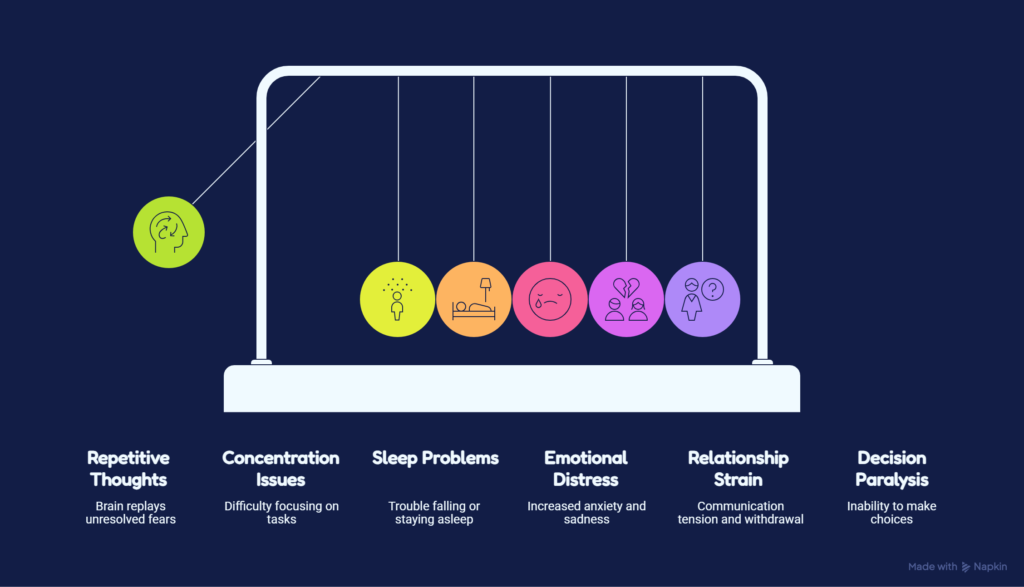
And over time, repetitive thinking starts affecting:
- concentration
- sleep
- emotional wellbeing
- relationships
- decision-making
- self-trust
Many people quietly fear, “What if I can never stop thinking this way?”
But repetitive thoughts are usually not random.
They often follow emotional and psychological patterns the brain has learned to repeat automatically.
If you have already read Why Your Mind Is Always Negative: How to Stop the Cycle, you already understand how the brain tends to repeat familiar emotional patterns even when they create stress.
Why Do You Keep Thinking the Same Thoughts?
“Same Thought” or “Same Thoughts”—Is There a Difference?
Whether you find yourself trapped in a singular, looping same thought or a rotating wheel of negative same thoughts, the underlying psychological mechanism is identical. In behavioral psychology, this repetition usually means your brain has fallen into an automated neural pathway—a mental habit loop designed to look for problems.
Repetitive thoughts usually happen because the brain becomes emotionally attached to unresolved fears, stress, uncertainty, emotional discomfort, or subconscious mental patterns. The mind repeats thoughts in an attempt to predict, solve, avoid, or emotionally process situations that still feel psychologically unfinished.
The brain dislikes uncertainty.
When something feels emotionally unresolved, the mind often continues returning to it repeatedly. Psychologists often call this pattern rumination. Rumination is the habit of repeatedly thinking about the same worries, experiences, or emotions without reaching a satisfying resolution.
This can happen with:
- worries
- regrets
- fears
- imagined conversations
- future scenarios
- relationship concerns
- mistakes
- self-criticism
The repetition creates the illusion that:
“If I think about this enough, I will finally feel control or certainty.”
But usually the opposite happens.
The thought becomes stronger through repetition.
The Brain Repeats What Feels Emotionally Important
This is one of the most important things to understand. Your mind does not repeat every thought equally.
It repeats thoughts connected to:
- fear
- emotional pain
- uncertainty
- shame
- unresolved tension
- emotional significance
That emotional intensity signals:
“Pay attention to this.”
So the brain continues replaying it automatically.
According to research from National Institute of Mental Health, repetitive negative thinking patterns are closely connected to stress, anxiety, and emotional processing systems in the brain.
Why Your Mind Mistakes Thinking for Solving
One reason thought loops become so persistent is that the brain often confuses thinking with progress.
When something feels uncertain, painful, or emotionally important, the mind assumes that more analysis will eventually produce relief.
It quietly believes:
- “If I think about this long enough, I will find the answer.”
- “If I replay the situation again, I will finally understand it.”
- “If I stay mentally prepared, I can prevent future pain.”
The problem is that many emotional situations cannot be solved through endless thinking.
They require acceptance, emotional processing, or uncertainty tolerance instead.
This is why thought loops often continue long after useful reflection has ended.
The mind is still searching for certainty that thinking alone cannot provide.
Why Thought Loops Become Stronger Over Time
Over time, repetitive thinking can develop into what psychologists often call a thought loop.
A thought loop is a repeating mental pattern that keeps bringing the same thought back because the brain has learned to treat it as emotionally important.
This develops through:
- repetition
- emotional association
- mental rehearsal
The cycle often looks like this:
Trigger → Thought → Emotional Reaction → More Thinking → Reinforcement
Example:
Trigger
An awkward conversation
↓
Thought
“Maybe they are upset with me.”
↓
Emotional Reaction
Anxiety and uncertainty
↓
More Thinking
Replaying conversation repeatedly
↓
Reinforcement
Brain learns the thought is emotionally important
The loop strengthens itself automatically.
This cycle becomes even stronger when repetitive thinking combines with underlying anxiety. The mind starts scanning for problems, replaying scenarios, and anticipating negative outcomes as a way of trying to feel prepared. If this pattern feels familiar, Why Your Subconscious Mind Keeps You Anxious explores how subconscious fear and nervous system conditioning can quietly keep these thought loops active.
Why Repetitive Thoughts Feel So Difficult to Stop
Why Overthinking Feels Impossible to Stop
Most people try stopping repetitive thoughts by:
- forcing themselves not to think
- suppressing thoughts
- distracting themselves aggressively
But the brain often reacts strangely to suppression.
The more emotionally threatened you feel by a thought:
the more attention the brain gives it.
This is why people sometimes feel trapped in:
- overthinking patterns
- intrusive thoughts
- repetitive mental replaying
The brain interprets emotional urgency as importance.
A Common Myth About Repetitive Thoughts
Many people assume:
“If I keep thinking something repeatedly, it must be true.”
Not necessarily. Repetition does not automatically equal truth.
Sometimes repetitive thoughts simply reflect:
- emotional fear
- uncertainty
- nervous system activation
- subconscious conditioning
- unresolved emotional tension
This distinction matters deeply.
Because people often begin trusting repetitive thoughts simply because they appear constantly.
Common Ways Repetitive Thoughts Show Up
Relationship Overthinking
Someone sends a shorter text than usual.
Logically, you know:
“They may just be busy.”
But emotionally, your mind begins:
- replaying conversations
- analyzing tone
- imagining rejection
- predicting conflict
The brain keeps returning to the thought because uncertainty feels emotionally uncomfortable.
Not because the fear is necessarily accurate.
Regret Loops
A person remembers something embarrassing from years ago.
Suddenly the mind begins replaying:
- the situation
- what should have been said
- how others perceived them
Even though the event is long over. The emotional memory still feels psychologically unfinished.
So the brain revisits it repeatedly.
Why Repetitive Thoughts Often Increase at Night
Many people notice, overthinking becomes stronger at night.
That happens because:
- distractions decrease
- emotional processing becomes louder
- mental stimulation slows down
- unresolved thoughts surface more easily
The nervous system also becomes more sensitive during exhaustion and stress.
This is why repetitive thoughts often feel heavier:
- before sleep
- during loneliness
- during emotional overwhelm
According to Cleveland Clinic, rumination and repetitive thought patterns often intensify during stress and emotional fatigue.
A Quiet Truth About Night Time Overthinking
At night, the world becomes quieter.
And when external stimulation decreases, unresolved emotional patterns become easier to hear.
Many people assume nighttime overthinking means something is wrong.
Often it simply means there are fewer distractions competing for attention.
The thoughts were already there.
The silence just makes them easier to notice.
Are Repetitive Thoughts OCD?
Occasional repetitive thoughts are a common human experience and do not automatically indicate OCD or another mental health condition. However, if thoughts become persistent, distressing, or interfere with daily life, it’s important to seek professional evaluation.
Many people experience repetitive thoughts without having OCD.
However, intrusive thoughts can sometimes become associated with anxiety disorders or obsessive-compulsive patterns.
The important distinction is:
- frequency
- distress level
- compulsive behaviors
- interference with daily life
If repetitive thoughts become severely distressing or disruptive, professional mental health support is important.
This article focuses on common repetitive thinking patterns rather than diagnosis.
Why Emotional Avoidance Keeps Thought Loops Alive
What Keeps Thought Loops Alive
This is something many people never notice.
Sometimes repetitive thoughts continue because:
the emotion underneath them is being avoided.
For example:
- fear
- grief
- insecurity
- rejection
- shame
- loneliness
Why My Thoughts Return to You Time and Again
This is exactly why your thoughts return to a specific person, memory, or scenario time and again. If a past relationship or event left an unresolved emotional footprint, your subconscious mind will generate repeating emotional patterns as it attempts to process the underlying discomfort. The brain continues returning to the loop not because it is helpful, but because the emotion under it is still being actively avoided.
The mind keeps replaying the thought because the emotional experience underneath still feels unresolved.
The brain searches for certainty instead of emotional processing.
The Hidden Relationship Impact of Thought Loops
Thought loops quietly affect relationships more than people realize.
Overthinking often creates:
- reassurance seeking
- emotional withdrawal
- defensiveness
- over-analysis
- communication tension
The person may appear:
- distracted
- emotionally distant
- anxious
- reactive
even while silently fighting internal mental loops.
This is why repetitive thinking eventually becomes:
behavioral.
Not just mental.
How to Break Thought Loops More Effectively
1. Stop Treating Every Thought Like a Threat
Not every thought requires solving.
Not every fear needs analysis.
Sometimes the brain produces repetitive thoughts simply because emotional tension exists.
Awareness weakens urgency.
2. Identify the Emotion Underneath the Thought
Ask:
“What emotion keeps pulling me back here?”
Examples:
- fear of rejection
- uncertainty
- shame
- loss of control
- emotional insecurity
The thought is often not the real problem, the emotion underneath it usually matters more.
3. Reduce Mental Rehearsal
The brain strengthens what it repeatedly practices.
Constantly replaying:
- conversations
- fears
- imagined scenarios
reinforces the loop neurologically. This is why repetitive thinking often becomes habitual.
4. Interrupt the Physical State
Thought loops are not purely mental. The nervous system matters too.
Helpful interruptions include:
- walking
- breathing exercises
- journaling
- changing environment
- reducing overstimulation
- improving sleep
The brain thinks differently in calmer physiological states.
5. Build Awareness Instead of Suppression
Trying to “force stop” thoughts usually increases emotional resistance.
Instead:
- observe the thought
- label it
- reduce emotional panic around it
This creates psychological distance.
If you want deeper practical strategies, continue with How to Break Toxic Thought Loops.
One Uncomfortable Truth About Overthinking
Sometimes overthinking becomes an attempt to feel safer in uncertain situations.
The brain feels:
“If I keep analyzing this, maybe I can prevent pain.”
But constant mental replaying rarely creates peace.
Usually it creates:
- exhaustion
- emotional tension
- paralysis
- disconnection from the present moment
Awareness matters more than endless analysis.
Reflection Pause
Ask yourself honestly:
- Which thoughts repeat most often in your mind?
- What emotional fear sits underneath them?
- When do your thought loops become strongest?
- Are you searching for certainty or emotional safety?
- What would happen if you stopped treating every thought like an emergency?
Pause there for a moment.
Because awareness interrupts automatic loops.
Final Thoughts
Repetitive thoughts are usually not proof that something is wrong with you.
They are often signs that:
- the nervous system feels emotionally unsettled
- the brain is seeking certainty
- emotional patterns remain unresolved
- subconscious thought loops have become reinforced
The goal is not becoming someone who never thinks deeply.
The goal is becoming less controlled by automatic mental repetition.
And that begins with understanding:
- why the loop exists
- what emotional pattern fuels it
- how awareness changes the cycle gradually
If you want to continue learning how subconscious patterns shape mental habits, read How to Rewire Your Thinking Patterns: Step By Step next.
If You’re Still Wondering About This
Why does my mind keep returning to the same thoughts?
Why does overthinking seem worse at night?
How can I stop replaying the same situation in my head?
Continue Your Journey
If you’d like to understand these patterns more deeply, these articles build on what you’ve learned here:
Why Your Mind Is Always Negative: How to Stop the Cycle
Learn why the brain naturally focuses on negative thoughts and how to gradually interrupt that pattern.
Why Your Subconscious Mind Keeps You Anxious
Discover how subconscious fear and nervous system conditioning can quietly keep anxiety and repetitive thinking alive.
How to Rewire Your Thinking Patterns: Step by Step
Learn practical strategies to replace automatic mental habits with healthier thinking patterns over time.