

What’s Actually Happening Psychologically
To understand why, it helps to look at where the concept of “affirmation” actually comes from in psychology, because it’s narrower and more specific than the self-help version.
Psychologist Claude Steele’s original self-affirmation theory wasn’t about repeating flattering statements at all. It described something closer to this: when people feel threatened by criticism, failure, or information that challenges how they see themselves. They can protect their sense of self-worth by reflecting on values or strengths that matter to them, even in a completely unrelated area of life. A person who feels criticized at work, for example, might feel steadier after reflecting on their reliability as a friend. The affirmation isn’t correcting the criticism. It’s reminding the person that their sense of self doesn’t depend entirely on that one moment.
This reflects a broader principle explored in 10 Subconscious Behaviors You Didn’t Realize Control You—much of what feels automatic is shaped by long-established mental patterns rather than conscious decisions.
Research building on this idea has found real effects. Studies led by psychologist Geoffrey Cohen found that brief, values-based affirmation exercises measurably reduced the achievement gap for students facing stereotype threat in the classroom not by convincing them of something false, but by giving their sense of self enough stability to engage with a difficult situation without becoming defensive.
Notice what’s different here. This form of affirmation doesn’t ask someone to insist on something they don’t yet believe. It works by drawing on something they already know to be true about themselves, from a different angle. That distinction is the entire hinge this article turns on.
Why “I Am Confident” Doesn’t Work the Same Way
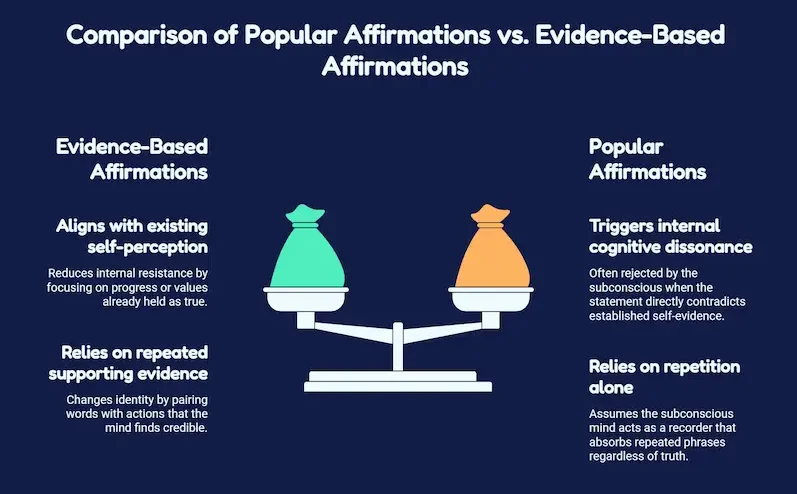
A statement like “I am confident,” repeated by someone who currently feels anything but, isn’t an affirmation in the sense Steele’s research describes. It’s closer to a direct contradiction of existing evidence and minds are generally reluctant to accept a claim that contradicts a large body of evidence they’ve already collected about themselves.
This connects to a broader pattern in how identity actually changes. As explored in You Don’t Change Habits: You Change Identity First, self-perception research suggests people don’t only act from their beliefs. They also build beliefs about themselves by watching their own behavior over time. A belief needs supporting evidence to feel real. Words alone rarely supply that evidence, especially when they contradict a long internal record that says otherwise.
This is why affirmations so often feel hollow to the people who need them most. It isn’t that the practice is fraudulent. It’s that a bare statement, unsupported by anything the mind can point to as proof, is being asked to outweigh years of accumulated counter-evidence and it usually can’t, no matter how many times it’s repeated.
What Actually Tends to Work
None of this means affirmations are useless. It means the effective version looks different from the one most people are taught.
Statements framed as already true and unrelated to the struggle closer to Steele’s original research tend to hold up better than statements that directly contradict a current struggle. Reflecting on “I follow through on things that matter to me” tends to land differently than insisting “I am confident” while feeling anything but.
Statements framed as in progress rather than already complete also tend to create less internal resistance. “I’m learning to trust my own judgment” asks less of the mind to accept than “I am someone who trusts my judgment completely,” because it doesn’t require contradicting existing evidence, it simply describes a direction.
And most reliably, a statement paired with even a small supporting action tends to outperform a statement repeated in isolation. This is the same principle explored in How Habits Are Formed: Why You Feel Stuck repeated actions create evidence, and that evidence gradually reshapes what you believe about yourself.
This same principle sits at the heart of You Don’t Change Habits: You Change Identity First, which explores how repeated actions gradually become evidence for a new sense of self.
A Reflection Pause
Before deciding whether affirmations belong in your own routine, it can help to notice a few things:
- When you repeat a positive statement about yourself, does it feel believable, or does part of you quietly argue back?
- Is the statement describing something already true, something in progress, or something that directly contradicts how you currently see yourself?
- Is there a small action that would give this statement something real to stand on?
- Which statement feels believable enough that your mind doesn’t immediately reject it?
If you’re unsure why certain beliefs feel so difficult to shift, How to Reprogram Your Subconscious Mind explores practical ways repeated experiences gradually reshape subconscious patterns.
There’s no right answer here, just useful information about which kind of statement your mind is actually willing to accept right now.
The Bigger Picture
The real question was never “do affirmations work.” It’s closer to: what does it actually take for a belief to change, and can words alone do that work on their own?
Mostly, they can’t, not because affirmations are a myth, but because belief has always been built the same way: through evidence, accumulated over time, that the mind finds credible. Words can support that process. They were never going to replace it.
That’s also why You Don’t Change Habits: You Change Identity First argues that lasting identity grows from repeated evidence rather than repeated words.
That reframe matters more than it might seem. It means a person whose affirmations “aren’t working” isn’t failing at some mental trick everyone else has figured out. They’re simply asking a sentence to do a job that usually requires a little more a believable statement, and something real behind it.
Questions You May Quietly Be Asking Yourself
Do affirmations really change your subconscious mind?
Why do positive affirmations sometimes make me feel worse?
What makes an affirmation more effective?
Continue Your Journey
Understanding why affirmations don’t always work is only the beginning. Lasting belief change isn’t about finding better words—it’s about understanding how your subconscious, identity, and everyday actions work together.
If you want to understand how beliefs are formed in the first place:
→ What Is the Subconscious Mind: How It Controls Your Life Secretly
Learn how the subconscious shapes your thoughts, emotions, and behaviors behind the scenes.
If you want to understand how lasting self-belief actually changes:
→ You Don’t Change Habits: You Change Identity First
Discover why repeated actions create the evidence that gradually reshapes how you see yourself.
If you’re struggling to change how you see yourself:
→ How to Change Your Identity When You Feel Stuck
Explore why identity resists change and how new self-beliefs become believable over time.
If you want to turn new beliefs into lasting habits:
→ How Habits Are Formed: Why You Feel Stuck
Learn why consistent actions matter more than good intentions when creating lasting change.