Week one of cooking at home instead of ordering out felt like a small revelation — new recipes bookmarked, a trip to buy ingredients you’d never used before, an odd satisfaction in something as simple as chopping an onion well. By week four, dinner is dinner again. The recipes are still bookmarked. The satisfaction is nowhere to be found, and neither, somehow, is the motivation that made week one feel so easy.
Nothing about the goal changed. Eating better at home still matters exactly as much as it did a month ago. What disappeared was something else entirely — something more specific and more predictable than it feels like from the inside.
Why Motivation Always Feels Temporary
Most people interpret that fade as evidence something went wrong — willpower running dry, commitment quietly failing a test it should have passed. Something more specific and more predictable is actually happening, and understanding it changes what needs to happen next.
What Motivation Is Actually Designed to Do
Motivation is often treated as though the excitement that gets a new behavior started should remain just as strong indefinitely. But that initial surge isn’t the only form motivation can take. Novelty, anticipation, and early enthusiasm can act like an ignition system — giving a new goal an energetic start — while the motivation that supports behavior over time may become quieter, more internalized, and more closely connected to personal values.
Self-determination theory, developed by psychologists Richard Ryan and Edward Deci, offers a useful lens here. Their research distinguishes motivation along a spectrum — from purely external reasons for acting to fully internalized ones, where a behavior has become genuinely tied to personal values or identity. The excitement of that first grocery trip doesn’t tell us where someone’s motivation sits on that spectrum. Novelty can accompany many different reasons for acting. What SDT helps explain instead is that the quality of motivation matters: behavior is more likely to be sustained when the reasons for doing it become more autonomous and personally meaningful, rather than depending mainly on external pressure or reward.
Why the Initial Excitement Fades
One reason the beginning of a new goal can feel unusually energizing is novelty. Repeated exposure to the same experience can reduce some of its initial emotional intensity — a process related to habituation. Research on hedonic adaptation also shows more broadly that people’s emotional responses to changed circumstances often become less intense over time. Neither process means the goal itself has stopped mattering. The first weeks of cooking may simply feel less exciting once choosing recipes, buying ingredients, and preparing dinner are no longer new.
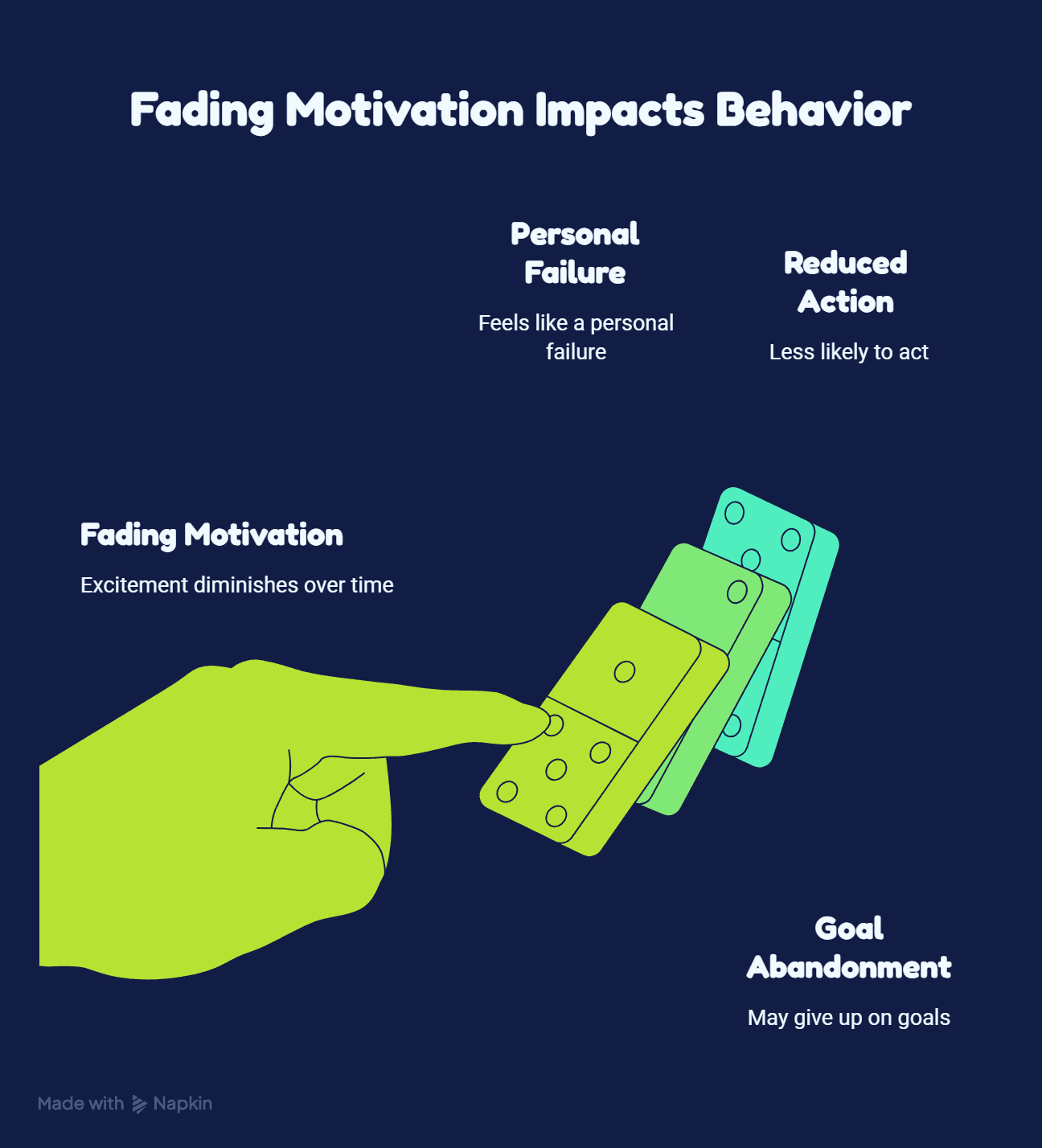 This isn’t a flaw in the person experiencing it. It’s a predictable feature of how motivation actually works. Expecting that initial burst of energy to persist indefinitely is closer to expecting the excitement of a first date to stay exactly the same after ten years together — not because something went wrong, but because that specific kind of energy was never designed to remain at its starting intensity.
What Replaces Motivation Over Time
According to self-determination theory, motivation that actually sustains behavior over the long term tends to be more internalized — connected to personal values, or genuinely integrated into how someone sees themselves, rather than driven by novelty or external excitement. This kind of motivation can feel different — less dependent on novelty or external excitement and more connected to something the person genuinely values or cares about.
But even well-internalized motivation doesn’t have to carry behavior on its own. Motivation can vary in strength and quality across situations and over time, which is why sustainable behavior also benefits from something sturdier: habits, supportive environments, routines, and identity-aligned patterns that make action less dependent on feeling highly motivated in a particular moment.
How Systems Make Motivation Less Important
A system, in this sense, is simply a structure that makes a behavior less dependent on how motivated someone feels in a given moment — a routine that provides a reliable cue for action, an environment arranged to make the intended behavior easier, or a plan that reduces the number of decisions required each time. How to Build Habits That Actually Stick covers what that structural support actually looks like in practice, once the initial burst of excitement has already done its job.
Once these are in place, motivation stops being the thing carrying the behavior day to day. It becomes something closer to a bonus — pleasant when it’s present, but no longer the load-bearing structure the whole thing depends on. This is closely connected to what makes any consistency achievable at all, a pattern explored more directly in Why You Can’t Stay Consistent Even When Motivated, which looks at what happens in the space between motivation and actual follow-through.
The BYW Behavior Systems Framework
Put together, we can use a simple BYW framework to understand how behavior can become less dependent on fluctuating motivation — not as a fixed sequence, but as a practical way of seeing how different supports can work together:
Motivation → provides one reason or source of energy for taking action.
Initial Action → turns intention into something you actually do.
Repetition → gives the behavior opportunities to become more familiar and established.
Systems & Habits → routines, cues, and supportive environments make repeated action easier.
Identity Support → the behavior may increasingly feel consistent with your values and sense of self.
Greater Consistency → behavior becomes less dependent on feeling highly motivated every time.
This connects directly to the knowledge–action distinction explored in Why You Know What to Do But Still Don’t Do It — motivation fading doesn’t erase the knowledge of what to do. It just means the systems stage has to start carrying weight the motivation used to carry alone.