

Alone in the kitchen, the new recipe goes fine — a few missteps, nothing dramatic, adjustments made on the fly without much thought.
The same recipe, cooked for guests a week later, becomes a different experience entirely: hands slightly less steady, decisions second-guessed, a small mistake that would have been shrugged off alone now feels like it needs an explanation.
Nothing about the skill changed between those two kitchens.
What changed was what getting something wrong seemed to mean.
Why Change Can Feel Threatening
Change, almost by definition, asks you to do something you don’t completely know how to do yet.
That means uncertainty.
It means imperfect attempts.
Sometimes it means being seen before you feel competent.
And sometimes the stakes aren’t external at all. A failed attempt may threaten something much more personal:
What if I can’t do this?
What if I embarrass myself?
What if this proves I’m not who I thought I was?
What if I try again and fail again?
Advice about fear of change often treats this discomfort as something to overcome with enough courage, motivation, or willpower.
But there is another question worth asking:
What does this attempt feel like it’s putting at risk?
Because when an experience becomes sufficiently stressful or threatening, the way we think and respond can change too.
What Psychological Safety Means Here
The term psychological safety is most firmly established in research on teams and workplaces, where it generally refers to whether people feel safe taking interpersonal risks such as speaking up, asking questions, admitting mistakes, or expressing concerns.
This article uses the idea more narrowly as a BYW personal-growth lens.
Here, feeling psychologically safe means experiencing enough room to make an imperfect attempt without interpreting every mistake as catastrophic evidence about your worth, identity, or ability.
That doesn’t mean convincing yourself that failure has no consequences.
It means creating enough psychological room to experiment, notice what happened, and try again without every mistake becoming a verdict on you.
That’s an important distinction because change requires learning.
And learning requires getting some things wrong.
What Stress Can Do to Flexible Thinking
There is good neuroscience behind one important part of this picture.
Neuroscientist Amy Arnsten has extensively studied how stress affects the prefrontal cortex, a brain region involved in higher-order abilities including working memory, attention regulation, decision-making and flexible regulation of behavior.
Her review of the evidence found that even relatively mild uncontrollable stress can impair prefrontal cognitive functioning. Under stress, brain regulation can shift away from slower, thoughtful prefrontal control toward faster, more reflexive responses involving other neural systems.
Importantly, this doesn’t mean that whenever you feel unsafe, your prefrontal cortex simply “switches off.”
Nor does the research show that every fear of change is caused by this mechanism.
What it does show is something useful:
stress can make some of the flexible cognitive abilities that difficult change often requires harder to access.
That matters when you’re trying something unfamiliar.
You may need to hold information in mind, adjust your strategy, tolerate a mistake, inhibit an old response, and choose a different one.
Those are precisely the kinds of higher-order processes that can become more difficult under sufficient stress.
Think Again About the Two Kitchens
This gives us a more careful way to understand the kitchen example.
Cooking for guests may carry more social pressure than cooking alone.
That pressure could increase stress, self-monitoring, or concern about making mistakes.
And stress, depending on its intensity and the person experiencing it, can interfere with some forms of flexible cognition.
But we shouldn’t assume we know exactly what happened inside the cook’s brain.
The useful observation is simpler.
The same task can feel very different when the perceived consequences of getting it wrong change.
Alone, a mistake might mean:
I’ll adjust the seasoning.
With guests waiting, the same mistake might become:
They’re going to think I can’t cook.
The cooking problem hasn’t necessarily become more difficult.
The meaning attached to the mistake has.
The Difference Between Safety and Comfort
Feeling safer doesn’t mean eliminating challenge.
That’s important.
Learning something new can be frustrating, uncertain, demanding, and uncomfortable without being psychologically devastating.
You can struggle and still feel able to continue.
You can make a mistake and still remain curious about what went wrong.
You can feel nervous and still experiment.
So the goal isn’t:
Make change comfortable before attempting it.
Some meaningful changes may never feel particularly comfortable.
A better goal is:
Make imperfection survivable enough that discomfort doesn’t automatically become a reason to stop learning.
That’s a very different standard.
How Feeling Threatened Can Pull You Toward Familiar Responses
This connects with something explored in Why Is Change So Hard?
Familiar behaviors already have one major advantage: you’ve practiced them.
New behavior asks for something different.
You have to notice the old response, interrupt it, remember what you intended to do instead, and sometimes adjust when the new strategy doesn’t work perfectly.
Arnsten’s review is relevant here because stress can impair PFC-dependent flexible cognition while leaving well-rehearsed or habitual responding relatively spared — and in some circumstances strengthening the pull toward those responses.
That doesn’t mean stress makes change impossible.
It means asking yourself to learn a difficult new response while also managing significant threat or stress may make the task harder.
And that gives us another way to approach resistance:
not only,
How can I force myself to do this?
but also,
What is making this attempt feel so threatening?
Why Emotional Regulation Matters During Change
This is where emotional regulation becomes relevant.
Emotional Regulation vs Emotional Suppression explores the difference between responding to an emotion and simply trying not to show or experience it.
If an attempt at change brings anxiety, shame, frustration, or fear of judgment, pretending those feelings aren’t there doesn’t necessarily resolve what produced them.
Sometimes a more useful response is to identify the threat more precisely.
Are you afraid of failing?
Being judged?
Feeling foolish?
Disappointing someone?
Confirming something painful you already believe about yourself?
Those aren’t interchangeable fears.
And understanding which one is operating can change what kind of support you actually need.
When an attempt goes badly despite genuine effort, How to Recover Emotionally After a Setback becomes relevant for the same reason.
A setback is one event.
What you conclude about yourself because of it can become something much larger.
The BYW Psychological Safety Framework
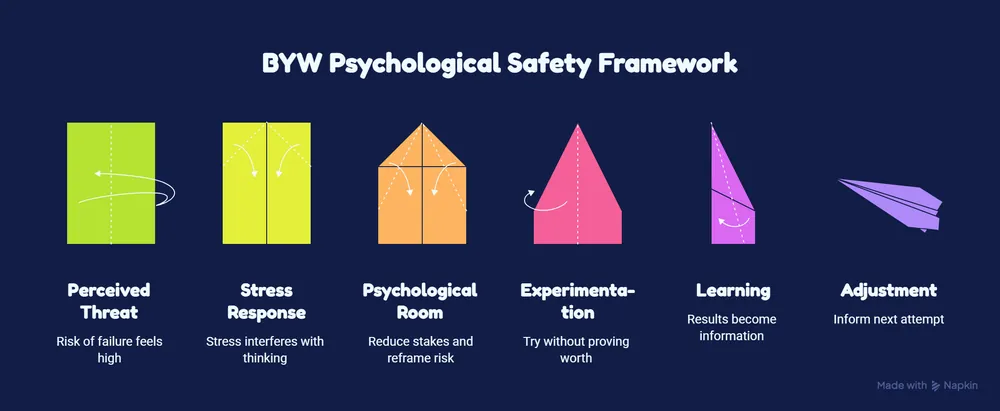 The following is a BYW synthesis, not a scientifically established causal sequence.
It’s a practical way to think about the conditions that may make experimentation and learning easier during personal change:
Perceived Threat → What does getting this wrong seem to put at risk?
Stress Response → Does that perceived risk create enough stress to interfere with flexible thinking or action?
Psychological Room → Can the stakes be reduced, reframed, or supported enough for an imperfect attempt to remain tolerable?
Experimentation → Can you try something without requiring the attempt to prove anything about your worth?
Learning → Can the result become information rather than a final verdict?
Adjustment → Can what you learned inform the next attempt?
This framework doesn’t mean you must feel completely safe before changing.
It means reducing unnecessary threat may give you more room to do what change already requires:
experiment, learn, adjust, and try again.