
Better You Within

How to Control Emotional Triggers Before They Control You

You can’t always prevent the trigger, but you can change the response. Learn the behavioral steps to steady your nervous system and reclaim your peace.

Glistening sunlight sparkling on dark green water ripples, symbolizing how to manage emotional triggers and find inner calm before reacting automatically.
Bringing conscious awareness to deep subconscious patterns allows you to calm the emotional waves before they take over.

Table of Contents

You tell yourself you’ll stay calm this time. You’ll ignore the comment.

You’ll avoid the argument. You’ll stop letting small things affect you so much.

Then it happens.

Someone says something.

A message goes unanswered.

A mistake gets pointed out.

A familiar situation appears.

And suddenly your emotions arrive before your logic does.

You react faster than you intended.

Later, when the moment passes, you wonder:

“Why did that affect me so much?”

If you’ve been searching for how to manage emotional triggers, you may have noticed that emotional reactions often feel automatic.

Part of you knows the situation isn’t as serious as it feels.

Yet another part reacts as though something much bigger is happening beneath the surface.

That experience can feel frustrating.

But emotional triggers are rarely random.

They often reveal patterns the subconscious mind has learned through repetition, emotional conditioning, and past experiences.

If you’ve already read Emotional Triggers: Why You React So Deeply, you already understand that emotional reactions usually begin long before conscious reasoning fully catches up.

The reaction you see is often the surface expression of a deeper emotional pattern.

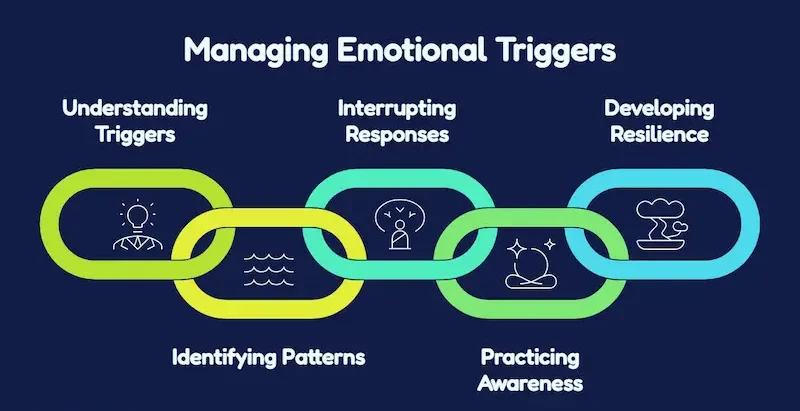
An infographic diagram titled Managing Emotional Triggers, featuring an interconnected chain of steps: Understanding Triggers, Identifying Patterns, Interrupting Responses, Practicing Awareness, and Developing Resilience, showing how to manage emotional triggers systematically.What Are Emotional Triggers?

Emotional triggers are situations, words, experiences, or interactions that automatically activate automatic emotional responses based on past experiences, emotional conditioning, and learned associations.

Triggers can create emotions such as:

  • anger
  • shame
  • anxiety
  • defensiveness
  • rejection
  • embarrassment
  • frustration
  • insecurity

The important thing to understand is that the trigger itself is often not the entire problem.

Two people can experience the exact same situation.

One reacts calmly.

The other reacts intensely.

The difference is usually not the event.

It is the cognitive appraisal, the meaning your brain automatically assigns to that experience.

One person may interpret criticism as helpful feedback.

Another may interpret it as proof that they are failing.

The situation is the same.

The interpretation is different.

And that interpretation shapes the emotional response that follows.

The difference is the meaning the subconscious mind has attached to it.

Why Emotional Triggers Happen

Many people believe emotional reactions happen because they are:

  • too sensitive
  • emotionally weak
  • lacking self-control

That explanation is usually incomplete.

The brain constantly evaluates situations for:

  • safety
  • belonging
  • respect
  • acceptance
  • certainty

When something appears to threaten one of those needs, the nervous system may respond automatically. The brain activates a stress response, preparing you to protect yourself long before you’ve consciously evaluated whether the situation is actually dangerous.

According to the National Institute of Mental Health, emotional responses are closely connected to emotional memory, stress processing, and learned behavioral patterns. The brain continually compares present experiences with emotionally significant experiences stored from the past. When a current situation resembles an earlier painful or emotionally meaningful experience, it may respond as though the original threat has returned—even when the present situation is objectively different.

This is why a seemingly minor event can create a surprisingly intense reaction.

The situation may be happening in the present.

But the emotional pattern often originated much earlier.

Emotional Triggers Are Usually About Meaning

Consider two examples.

Someone receives constructive criticism.

One person thinks:

“That’s helpful feedback.”

Another thinks:

“I’m failing again.”

The event is identical.

The interpretation is completely different.

Triggers often emerge from the meaning the brain assigns to an experience.

Not merely the experience itself.

The Nervous System Reacts Before Logic

Many emotional reactions occur before conscious analysis begins.

You may notice:

  • tension in your chest
  • racing thoughts
  • defensiveness
  • irritation
  • emotional overwhelm

before you’ve fully processed what happened.

This occurs because emotional processing systems are designed to respond quickly.

The brain prefers speed when it believes something important is at stake.

The Hidden Pattern Most People Miss

Most people focus on controlling reactions.

Very few people examine what keeps creating them.

This becomes a problem.

Because emotional triggers are often symptoms.

Not causes.

A trigger frequently points toward:

  • unresolved emotional learning
  • repeated insecurity
  • fear of rejection rooted in long held subconscious beliefs about worth, acceptance, or safety.
  • fear of criticism
  • fear of being misunderstood
  • fear of losing control

The visible reaction is only the final step in a much larger pattern.

Why the Same Situation Doesn’t Trigger Everyone

Two people can experience the same conversation, criticism, or disagreement and respond completely differently.

The reason is that emotional triggers are shaped less by the event itself and more by each person’s unique emotional history.

Past experiences, subconscious beliefs, attachment patterns, and repeated emotional learning all influence how the brain interprets a situation.

In other words, people don’t react to events alone.

They react to what those events represent emotionally.

A Quiet Realization

Many triggers are not actually about what happened.

They are about what your mind believes the event means about you.

That distinction changes everything.

Why Certain Triggers Keep Returning

People are often surprised that the same emotional themes appear repeatedly.

For example:

Someone feels triggered whenever:

  • they are ignored
  • they receive criticism
  • plans suddenly change
  • they feel excluded

The situations vary.

The emotional pattern remains the same.

This is why emotional awareness matters more than simply trying to stay calm.

Real-Life Examples of Emotional Triggers

The Delayed Reply

Someone sends a message.

Hours pass without a response.

Logically they understand:

“The person may simply be busy.”

Emotionally they begin:

  • overthinking
  • imagining conflict
  • questioning themselves
  • anticipating rejection

The emotional reaction becomes much larger than the situation itself.

The trigger is not the delayed message.

The trigger is the meaning attached to uncertainty.

Workplace Feedback

A manager offers constructive feedback.

One employee sees an opportunity to improve.

Another spends the entire day feeling upset.

Why?

Because the feedback activated a deeper emotional pattern connected to criticism and self-worth.

If workplace reactions feel familiar, Why Work Triggers You More Than You Think explores these patterns in greater depth.

Why the Pattern Keeps Repeating

Triggers strengthen through repetition.

Each time you respond to a trigger in the same way, the brain becomes more efficient at repeating that response. Over time, the entire sequence starts feeling automatic—not because it is permanent, but because it has been practiced many times before.

According to the Cleveland Clinic, repeated emotional responses can become conditioned nervous-system patterns that activate with minimal conscious awareness.

This is why certain reactions seem to happen before you’ve had time to think.

Repeated emotional reactions can also begin shaping your identity. Over time, people stop saying, “I get triggered,” and start saying, “I’m just an angry person,” or “I’m too sensitive.” That shift matters because repeated reactions can slowly become part of how someone defines themselves even though they originally began as learned emotional patterns rather than permanent personality traits.

The Emotional Trigger Cycle

Most emotional triggers follow a predictable psychological pattern.

Once you understand the cycle, it becomes much easier to recognize where you can interrupt it.

Trigger

Automatic Interpretation (Meaning)

Emotional Response

Behavior

Reinforcement

The most important part of this cycle is often the meaning your mind assigns to the situation. The trigger itself usually has less power than the interpretation attached to it. When you begin questioning that interpretation, you create the opportunity to change the emotional response that follows.

If you’ve read 10 Emotional Triggers That Control Your Behavior, you’ve already seen how specific triggers often operate beneath awareness until they become visible consciously.

Why Emotional Triggers Can Change

Many people assume:

“I’ve always reacted this way.”

“So I’ll probably always react this way.”

Fortunately, emotional triggers are not permanent personality traits.

They are learned emotional patterns.

And learned patterns can gradually change.

The brain constantly updates emotional responses based on new experiences, repeated behaviors, and changing interpretations.

Research on neuroplasticity suggests that the brain remains capable of forming new neural pathways throughout life. As you repeatedly respond differently to familiar triggers, your brain gradually learns that the situation is no longer as threatening as it once believed.

This doesn’t happen overnight.

But every conscious response weakens the old emotional pathway and strengthens a healthier one.

That is why awareness matters.

It gives the brain new evidence to learn from.

Your strongest emotional reactions often reveal your oldest emotional patterns.

That doesn’t mean every trigger points to trauma.

Often, it points to an unmet emotional need, an old belief, or a protective pattern your mind learned long ago.

The reaction you’re experiencing today may be trying to protect a version of you that once needed that protection.

Understanding that pattern is often the first step toward changing it.

If you’ve read 10 Emotional Triggers That Control Your Behavior, you’ve already seen how specific triggers often operate beneath awareness until they become visible consciously.

Reflection Pause

Ask yourself honestly:

• Which situations trigger me most often?
• What emotion appears first?
• What fear sits underneath that emotion?
• Do certain people trigger the same reaction repeatedly?
• What story does my mind automatically tell in those moments?

Greater self- awareness is often the first step toward changing patterns that once felt automatic.

How to Change the Pattern

Emotional awareness is where meaningful change begins. Understanding a trigger is important, but awareness becomes truly powerful when it changes how you respond.

The goal is not to eliminate every emotional reaction.

The goal is to create enough space between the trigger and your response that you regain choice.

1. Notice the Trigger Before the Story Begins

Most emotional reactions happen so quickly that the mind immediately starts creating explanations.

For example:

  • “They don’t respect me.”
  • “I’m being judged.”
  • “Something is wrong.”
  • “I failed.”

The problem is that these interpretations often appear within seconds.

Before accepting the story, pause and ask:

“What actually happened?”

Then ask:

“What am I assuming happened?”

That small distinction creates psychological distance.

And distance creates awareness.

2. Identify the Emotion Beneath the Reaction

Many people focus only on the visible emotion.

But emotional reactions often sit on top of deeper feelings.

For example:

Anger may hide:

  • hurt
  • rejection
  • embarrassment

Defensiveness may hide:

  • insecurity
  • shame
  • fear of criticism

Anxiety may hide:

  • uncertainty
  • fear of losing control
  • fear of abandonment

The deeper emotion is usually where the real pattern lives.

Once it becomes visible, the trigger often loses some of its power.

Pause and Notice

The strongest reaction is not always the most important emotion.

Sometimes it is simply protecting a more vulnerable one underneath.

3. Interrupt the Physical Response

Emotional triggers are not only mental.

They are physiological.

Your nervous system reacts first.

That means calming the body often helps calm the mind.

Helpful interruptions include:

  • taking a short walk
  • slowing your breathing
  • stepping away briefly
  • reducing stimulation
  • drinking water
  • changing environments

These actions support nervous system regulation, helping your body shift away from automatic threat responses so clearer thinking becomes possible. A calmer nervous system makes clearer thinking possible.

4. Look for the Repeating Theme

Most people have recurring emotional themes.

For example:

  • fear of rejection
  • fear of criticism
  • fear of being ignored
  • fear of failure
  • fear of disappointing others

The situations change.

The emotional theme remains.

When you start noticing the pattern, triggers become easier to predict.

And predictable patterns become easier to interrupt.

This is one reason emotional intelligence grows through observation rather than self-criticism.

5. Practice Responding Instead of Reacting

Reaction is automatic.

Response is intentional.

A reaction says:

“I need to do something immediately.”

A response says:

“I can pause before deciding what to do.”

This pause may only last a few seconds.

Yet those few seconds can completely change:

  • conversations
  • decisions
  • relationships
  • emotional outcomes

Over time, repeated pauses become a new pattern.

Repeated pauses may feel awkward at first because the brain is used to reacting automatically. But each time you pause before responding, you interrupt the old emotional pathway and strengthen a different one. Over time, the brain begins recognizing the pause itself as part of the pattern. What once required conscious effort gradually becomes a more natural response. This is how emotional regulation develops not by eliminating emotions, but by repeatedly creating a different relationship with them.

And new patterns eventually become automatic too.

Over time, this also develops greater response flexibility. The ability to choose how you respond instead of repeating the same automatic reaction.

6. Give the Trigger a Name

Before you try to control the emotion, try identifying it.

Instead of saying:

“I’m upset.”

Pause and ask:

“What exactly is being triggered right now?”

You might notice thoughts like:

• This is my fear of criticism.

• This is my fear of rejection.

• This is my fear of being misunderstood.

• This is uncertainty.

• This is my need for approval.

Psychologists sometimes refer to this practice as affect labeling…

Giving the trigger a name creates psychological distance.

Instead of becoming the emotion, you begin observing it.

Research suggests that simply labeling an emotional experience can reduce its intensity by engaging areas of the brain involved in self-awareness and emotional regulation.

The trigger may still be present.

But it no longer feels like the only reality.

That small shift often creates enough space to choose a different response.

Emotional awareness is only the beginning. Lasting change happens when new ways of thinking are reinforced often enough to become familiar. If you’d like to understand how repeated thoughts gradually reshape your mental patterns, continue with How to Rewire Your Thinking Patterns: Step-by-Step.

One Uncomfortable Truth

Many people believe emotional triggers disappear once they understand them.

Unfortunately, awareness alone does not always remove a pattern.

Sometimes you will still feel triggered.

Even after recognizing exactly what is happening.

That can feel discouraging.

But it is actually normal.

Because healing is not measured by whether a trigger appears.

It is measured by how differently you respond when it does.

A trigger that once controlled you for three days may eventually affect you for three hours.

Then thirty minutes.

Then a few moments.

That is progress.

Not perfection.

And progress matters more than most people realize.

Final Thoughts

Learning how to manage emotional triggers is not about becoming emotionally numb.

It is about developing greater emotional awareness and emotional resilience over time.

It is about becoming more aware of:

  • what activates you
  • what emotions appear first
  • what fears sit underneath
  • what patterns keep repeating

Because emotional triggers rarely begin in the moment they appear.

They usually emerge from deeper subconscious associations the brain has learned over time.

The more visible those patterns become, the less control they tend to have.

You do not need to eliminate every emotional reaction.

You simply need enough awareness to recognize:

“This is a trigger.”

“This is a pattern.”

“I do not have to react the same way every time.”

And that realization is often where meaningful emotional change begins.

If you’d like to explore these patterns further, continue with Emotional Triggers: Why You React So Deeply and Why Work Triggers You More Than You Think.

Questions You May Quietly Be Asking Yourself

Why do emotional triggers feel so intense even when I know better?

Because emotional triggers often activate older emotional learning rather than current logic. Part of the brain reacts automatically before conscious reasoning has time to fully evaluate the situation. Understanding the trigger helps, but repeated awareness is usually what weakens it over time.

Can emotional triggers ever disappear completely?

Some triggers become significantly weaker as awareness increases and emotional patterns change. Others may still appear occasionally. The difference is that they stop controlling your behavior in the same way they once did.

What is the fastest way to regain control during an emotional trigger?

The fastest step is usually creating a pause. Slow your breathing, step away if possible, and focus on what actually happened rather than what your mind is predicting. That pause helps shift the brain from automatic reaction toward conscious response.


Share with someone who may need this

Continue Your Inner Growth Journey

Receive weekly reflections on emotional wellbeing, mindset, and self-growth.