
Emotional Regulation vs Emotional Suppression: Why One Helps and the Other Keeps You Stuck
Staying calm on the outside can look identical whether you’re actually working through a feeling or just hiding it — which is exactly why so many people mistake one for the other for years.

Table of Contents
Your sister makes a comment at dinner, one of those offhand lines that lands sharper than she probably meant it to. Everyone keeps eating. You keep eating too, nod, change the subject, laugh at something a few minutes later. By the time dessert comes around, it looks like nothing happened.
Later that night, lying there, it comes back. Not the comment exactly — more the feeling underneath it, replaying in a loop you didn’t invite. You handled it fine at the table. So why is it still here?
Why These Two Concepts Are Often Confused
From the outside, you handled that dinner perfectly.
You didn’t snap. You didn’t make the evening uncomfortable. You didn’t say something you’d regret. If someone had been watching, they might have called your response calm, mature, even emotionally controlled.
And perhaps it was.
But outward calm doesn’t tell us what happened to the emotion itself.
Someone regulating a difficult emotion and someone suppressing it can look almost identical in the moment. Both may stay composed. Both may choose their words carefully. Both may carry on with dinner.
The difference appears somewhere nobody else can see.
Regulation works with the emotion. Suppression works mainly on what other people can see of it.
That’s why these two experiences are so easy to confuse — and why “I stayed calm” doesn’t always tell you whether you actually regulated what you were feeling.
What Is Emotional Regulation?
Emotional regulation is the ability to notice what you’re feeling, understand what the emotion may be responding to, and choose what to do next rather than automatically following its first impulse.
It doesn’t mean feeling less.
You can be deeply hurt and still regulate that hurt. You can feel angry without immediately acting from the anger. You can feel anxious and still decide what the situation actually requires.
Think back to the dinner table.
Regulation might mean noticing that your sister’s comment stung instead of immediately telling yourself it shouldn’t bother me. You recognize that the reaction may connect to an old pattern between you, give yourself time to understand it, and later decide whether the comment is worth addressing.
The feeling hasn’t been erased.
What has changed is that you’re no longer asking “How do I stop feeling this?” You’re asking “What is this feeling telling me, and what do I want to do with it?”
That is the heart of emotional regulation.
What Is Emotional Suppression?
Emotional suppression is the conscious attempt to limit or hide the outward expression of an emotion even though the feeling itself is still present.
You feel the irritation, hurt, embarrassment, or anxiety — but instead of showing it, you control your expression, tone, words, or behavior.
And sometimes that’s exactly what the moment calls for.
You might steady yourself before walking into an important meeting. You may choose not to respond immediately when you’re angry because you know you’ll communicate better once you’ve had time to think. Keeping an emotion from showing for a while can be useful.
The problem isn’t the occasional decision to stay composed.
It’s when not showing the emotion becomes the same thing as dealing with it.
That’s where suppression and regulation begin to look similar from the outside while doing very different things underneath.
Emotional Regulation vs Emotional Suppression
| Emotional Regulation | Emotional Suppression | |
| Goal | Understand the emotion and choose how to respond | Prevent the emotion from showing |
| What happens internally | The emotion is acknowledged and worked with | The outward expression is controlled while the internal feeling may remain |
| Short-term effect | Can feel uncomfortable or effortful | Can create immediate composure |
| Over time | Can support more flexible ways of responding to emotions | Habitual reliance on it is associated with poorer emotional and interpersonal outcomes |
| Everyday example | Noticing that a comment hurt and deciding how to address it | Feeling hurt but concentrating only on making sure it doesn’t show |
| Impact on relationships | Can make more open and appropriate communication possible | Habitual suppression has been associated with less social connection and poorer relationship functioning |
| Main difference | Changes how you relate and respond to the emotion | Primarily changes how much of the emotion other people can see |
Why Emotional Suppression Feels Helpful at First
Suppression earns its popularity honestly.
At the dinner table, it worked. No argument. No awkward silence. Nobody asked what was wrong. Dinner simply continued.
And that immediate payoff matters. If hiding a reaction helps you get through an uncomfortable moment, your mind has a good reason to reach for the same strategy the next time something stings.
The problem is that looking calm and feeling calmer are not necessarily the same thing.
Psychologist James Gross’s research on emotion regulation found that suppressing the outward expression of emotion did not necessarily reduce the emotional experience itself. In some experimental research, suppression was also accompanied by increased physiological responding even while participants appeared more composed on the outside.
Research by Gross and Oliver John has also linked habitual use of expressive suppression with poorer interpersonal functioning and lower wellbeing. That doesn’t mean suppressing an emotion occasionally is harmful. Sometimes composure is exactly what a situation requires.
The distinction is in what happens next.
If suppression gives you enough space to return to the feeling later and deal with it, it has served a temporary purpose. If making sure nothing shows becomes the entire strategy, the outside may look settled while the experience underneath remains largely untouched.
How Healthy Emotional Regulation Actually Works
Healthy emotional regulation doesn’t begin with asking How do I make this feeling go away?
A more useful process is:
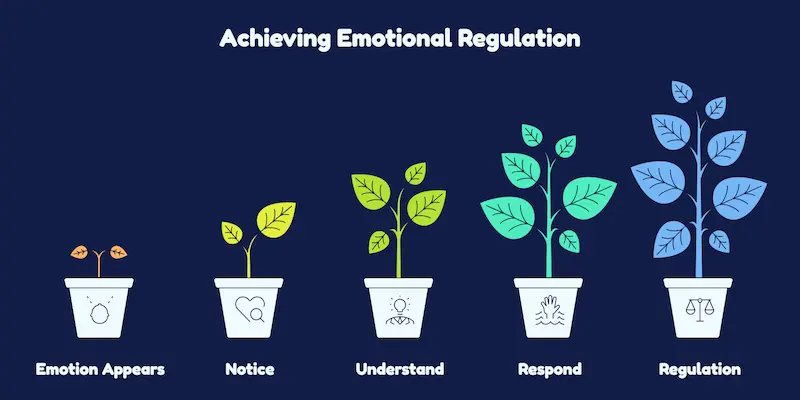
Notice → Understand → Respond
Notice
First, catch the emotion before you’re already acting from it.
At the dinner table, this might be the tightness in your chest, the sudden urge to defend yourself, or the impulse to change the subject and pretend the comment didn’t land.
Putting the feeling into words can be useful here. In affect-labeling research, neuroscientist Matthew Lieberman and colleagues found that labeling emotional stimuli was associated with reduced amygdala activity and greater activity in a region involved in regulating emotional responses.
The finding offers one possible explanation for why naming what you’re feeling can sometimes create a little distance from the immediate reaction:
This is frustration.
This is embarrassment.
This is hurt.
You haven’t solved the emotion. You’ve simply noticed it clearly enough to stop it from remaining invisible.
Understand
Next comes a different question:
What is this emotion actually responding to?
Your sister’s comment may have hurt because of the words themselves. Or perhaps it touched an old dynamic between you — a familiar feeling of being dismissed, criticized, or not taken seriously.
The same underlying sensitivities can show up in very different situations. 10 Emotional Triggers That Control Your Behavior explores some of the common triggers that can repeatedly shape emotional reactions, often before you consciously recognize the pattern.
Anxiety before a difficult conversation may be about the conversation. But it may also be pointing toward uncertainty, fear of rejection, or the possibility of being misunderstood.
Respond
Only then do you decide what the emotion requires from you.
Sometimes that means speaking.
Sometimes it means setting a boundary.
Sometimes it means waiting until the emotional intensity has settled before having a conversation.
And sometimes, after understanding the feeling, you decide that nothing needs to be done at all.
That’s why emotional regulation isn’t really about staying calm.
It’s about having more choice in what happens after an emotion arrives.
Signs You May Be Suppressing Instead of Regulating
Suppression doesn’t always feel like suppression. Sometimes it feels like being mature, keeping the peace, or simply getting on with your day. The clues often appear later, when the moment itself is already over.
You said “It’s fine,” but your jaw is still tight an hour later.
You handled the conversation calmly, but you’re replaying it in bed that night.
You didn’t show your frustration when it happened, only to find yourself snapping at someone else over something that normally wouldn’t bother you.
Or perhaps nothing dramatic happens at all. You simply notice a growing distance from someone close to you, even though you rarely argue and almost never show visible distress around them.
None of these automatically mean you’re suppressing an emotion. But when they become a repeating pattern, they’re worth noticing. Sometimes the surface has moved on while the feeling underneath hasn’t.
How to Practice Healthier Emotional Regulation
Start by getting more specific about what you’re feeling. “I feel bad” doesn’t give you much to work with. “I feel dismissed,” “I feel embarrassed,” or “I feel overwhelmed” begins to tell you what may actually need attention.
Then resist the urge to immediately make the feeling smaller.
Imagine you’ve just received a short reply from someone you care about and irritation rises almost instantly. Instead of deciding “I’m being ridiculous” or trying to push the reaction away, pause long enough to ask: What exactly bothered me about that?
Perhaps the irritation is covering hurt. Perhaps the message created uncertainty. Perhaps it touched a familiar fear of being ignored.
That curiosity is the Understand part of Notice → Understand → Respond. What Is an Emotional Trigger? Why You Get Triggered So Easily explores why certain situations activate such strong emotional responses, while How to Control Emotional Triggers Before They Control You takes the next step into recognizing those triggers and responding before they take over.
Then comes the part that can initially feel less satisfying: choosing what to do with what you’ve noticed.
Sometimes the response is a conversation. Sometimes it’s setting a boundary. Sometimes it’s realizing the feeling doesn’t require any action at all. And sometimes it’s simply giving yourself enough time to respond from a clearer place instead of reacting from the first emotional surge.
Healthy regulation may therefore feel less controlled than suppression at first. Suppression gives you an immediate result: nothing shows. Regulation asks you to stay with the feeling long enough to understand what it’s asking of you.
Over time, that difference matters.
💡 BYW Insight
Regulation changes your relationship with an emotion. Suppression only changes its visibility. One works with what you’re feeling. The other makes sure it doesn’t show.
The Emotional Regulation Blueprint
Emotion Appears
↓
NOTICE — What am I feeling?
↓
UNDERSTAND — What is this emotion responding to?
↓
RESPOND — What response fits the situation and what I actually need?
↓
Regulation — The emotion is acknowledged rather than merely hidden
The Bigger Picture
Learning to regulate emotions doesn’t mean becoming calmer all the time. Sometimes a healthy response is quiet. Sometimes it means speaking up, setting a boundary, asking for space, or admitting that something hurt.
The more useful question isn’t “Did I stay calm?” It’s “Did I actually deal with what I was feeling?”
That distinction changes emotional regulation from a performance of composure into something more meaningful: the ability to experience an emotion without either being controlled by it or pretending it isn’t there.
Final Thoughts
By the time dessert arrived, nobody at the table knew anything had happened.
And that is precisely why emotional suppression can be so difficult to recognize. From the outside, it may look exactly like emotional regulation.
The more useful measure isn’t how composed you appeared in the moment. It’s what happened to the feeling afterward.
Did you notice it? Did you understand what it was responding to? Did you eventually choose what to do with it?
Or did the moment end for everyone except you?
Learning that difference doesn’t mean you need to express every emotion or confront every person who upsets you. It simply means that staying calm no longer has to be the only evidence you use to decide whether you’ve actually dealt with what you felt.
💭 A Quiet Realization
Sometimes the moment you thought proved how well you controlled your emotions was actually the moment you became very good at hiding them.
That doesn’t make the calm meaningless. It simply gives you a different question to ask next time: Did this feeling actually move through me, or did I just make sure nobody could see it?
Continue Your Journey
Now that you can tell the difference between regulating an emotion and simply keeping it from showing, the next step is understanding what sets those emotions in motion in the first place.
→ What Is an Emotional Trigger? Why You Get Triggered So Easily
Explore why certain situations affect you more strongly than others and what may be happening underneath the reaction.
When you can recognize the trigger but still find yourself reacting before you’ve had time to think:
→ How to Control Emotional Triggers Before They Control You
Learn practical ways to pause between the trigger and your response, building directly on the Notice → Understand → Respond process.
And if the emotion seems to disappear only to return later as something you keep thinking about:
→ Why You Keep Thinking the Same Thoughts: Break the Loop
Explore why certain thoughts become easier to revisit and what keeps a recurring mental pattern going.
→ How to Recover Emotionally After a Setback
Learn what emotional recovery actually involves and how to move through a difficult experience without suppressing what you feel or expecting yourself to bounce back immediately.
Questions You May Still Be Asking
Is emotional suppression always unhealthy?
No. Briefly suppressing an emotional reaction can be useful when expressing it immediately would be unhelpful or inappropriate. You might stay composed during an important meeting, wait until you’ve calmed down before responding to an upsetting message, or choose not to show irritation in a situation that doesn’t require a response.
The concern is less about occasional suppression and more about relying on it as your default way of handling difficult emotions. Staying composed can buy you time. It doesn’t necessarily mean the emotion itself has been dealt with.
Can emotional regulation be learned?
Yes. Emotional regulation is a skill that can develop with practice.
The process often begins with noticing emotions earlier, becoming more specific about what you’re feeling, understanding what may have triggered the response, and creating enough space to choose what happens next.
You won’t regulate every emotion perfectly — nor is that the goal. Over time, the aim is simply to have more choice between feeling something and automatically acting from it.
What’s the difference between emotional suppression and emotional repression?
The key difference is awareness.
With suppression, you know the emotion is there but consciously limit or hide its outward expression.
Repression generally refers to psychological processes operating outside conscious awareness, so the person may not consciously recognize the feeling, thought, or impulse being kept out of awareness.
They are related ideas, but they are not interchangeable. This article focuses specifically on emotional suppression and how it differs from healthy emotional regulation.













One Response