

Two hundred words a day, easy enough on paper.
Three weeks in, it’s holding — not always inspired, but holding.
Then a genuinely chaotic week arrives, and one day gets missed entirely. Just one. The plan was to pick it back up the next morning.
Two months later, the two hundred words still haven’t resumed.
Not because the missed day was catastrophic.
Because somewhere in the hours right after it, a quiet verdict got reached:
Well, that’s blown now.
And the writing that had survived three genuinely difficult weeks couldn’t survive what that one missed day came to mean.
Why Perfectionism Feels Productive
Perfectionism can look remarkably similar to high standards.
You care about doing something properly. You don’t want to produce mediocre work. You don’t want to become someone who constantly makes excuses.
None of those things is inherently a problem.
In fact, psychological research increasingly treats perfectionism as multidimensional rather than simply labeling all high standards unhealthy. Perfectionistic strivings — setting and pursuing demanding standards — don’t show the same relationship with procrastination as perfectionistic concerns, which involve worries about mistakes, negative evaluation, and falling short of expectations.
That distinction matters.
The problem isn’t simply wanting to do something well.
It begins when doing it imperfectly starts to feel unacceptable.
Why All-or-Nothing Standards Can Disrupt Action
Imagine the rule isn’t:
I want to write regularly.
It’s:
I write 200 words every single day.
For three weeks, those rules may look identical.
Then comes the day you can’t do 200.
Suddenly the difference matters.
Research on self-regulation has long examined what can happen after people violate a rule they’ve been trying to follow. Work associated with Janet Polivy and Peter Herman on dietary restraint helped popularize the “what-the-hell effect”: after an initial perceived violation, people may sometimes abandon restraint further rather than simply treating the lapse as one limited event.
Related relapse-prevention research introduced the abstinence violation effect, describing cognitive and emotional responses that can follow a lapse and may contribute to further relapse.
Neither effect means that one mistake inevitably causes abandonment.
The important idea is that how a lapse is interpreted can matter.
One missed day and two months of not writing are nowhere near equivalent.
But all-or-nothing thinking can make the first feel like evidence that the entire attempt has already failed.
That’s what turns a small interruption into something much larger.
Why Consistency Creates a Different Relationship With Progress
Consistency asks a different question.
Perfection asks:
Did I meet the standard exactly?
Consistency asks:
Am I continuing to return to this behavior over time?
That difference changes what an imperfect day means.
If success requires flawless execution, every miss threatens the entire record.
If success means repeatedly returning to the behavior, a missed day becomes one event inside a much larger pattern.
This doesn’t mean repetition magically creates an unstoppable psychological force.
Behavioral research does show that repetition is important in habit development, and repeated performance in stable contexts can gradually make behaviors more automatic.
But the useful lesson for everyday change is simpler:
a pattern can survive an imperfect instance if you allow yourself to resume it.
The Psychology Behind Repeated Action
This connects directly to How to Build Habits That Actually Stick.
Habit research suggests that automaticity develops gradually as behaviors are repeated in recurring contexts.
A behavior doesn’t have to be performed flawlessly for learning to occur.
What matters is having opportunities to perform the behavior repeatedly in contexts that can become associated with it.
That makes consistency valuable for a very practical reason: it keeps creating opportunities for repetition.
One missed day doesn’t erase the learning that came before it.
What matters more is whether the behavior returns.
How Perfectionistic Concerns Can Raise the Barrier to Action
Some forms of perfectionism can make beginning harder.
Research examining perfectionism and procrastination shows why we need to be precise here. Perfectionism isn’t a single trait with a single effect.
A large meta-analysis found that perfectionistic concerns were positively associated with procrastination, while perfectionistic strivings showed a negative association.
So high standards themselves aren’t necessarily what delay action.
The difficulty is more likely to emerge when those standards become entangled with fear of mistakes, concern about evaluation, or a sense that anything short of the intended performance doesn’t count.
That’s the kind of barrier explored in Why You Can’t Stay Consistent Even When Motivated.
The two hundred words might feel manageable on an ordinary day.
But on the chaotic day, the choice can quietly become:
Do the full version properly — or don’t do it at all.
That’s a much harder rule to live with.
How Consistency Can Lower the Barrier to Beginning
A consistency-first approach allows the behavior to have more than one acceptable size.
Maybe the ordinary target is two hundred words.
On a difficult day, it might be twenty.
On another day, you might genuinely miss it altogether.
The important part isn’t maintaining a mathematically perfect streak.
It’s protecting your ability to return.
Twenty words instead of two hundred isn’t pretending you completed the original target. It’s simply choosing a smaller version of the behavior when the alternative is doing nothing.
And if even that doesn’t happen?
Tomorrow remains available.
This connects closely with Why Do I Lose Motivation? Motivation naturally varies. A behavior that can only happen when motivation, energy, time, and circumstances are all favorable is much harder to repeat consistently.
Building some flexibility into the behavior gives it more conditions under which it can still happen.
Practical Ways to Prioritize Consistency Over Perfection
One useful shift is deciding in advance what a smaller version of the behavior could look like.
Not because the smaller version is secretly identical to the full goal.
It isn’t.
But because difficult days are easier to navigate when the only alternatives aren’t perfect performance and complete abandonment.
For example:
200 words becomes 20.
A 45-minute workout becomes a 10-minute walk.
Reading a chapter becomes reading two pages.
Cooking the planned meal becomes choosing the simplest reasonable alternative available.
You can also decide in advance what a missed day means:
one missed day.
Not a failed streak.
Not evidence that you can’t stay consistent.
Not permission to abandon the goal.
Just one data point in a much longer pattern.
This is closely related to the distinction explored in Why Do I Keep Going Back to Old Habits?: the reappearance of an old pattern doesn’t erase the learning or progress that came before it.
And when a longer break happens, the principle becomes even more important.
You don’t need to recreate the perfect beginning.
You need another next action.
The BYW Consistency Framework
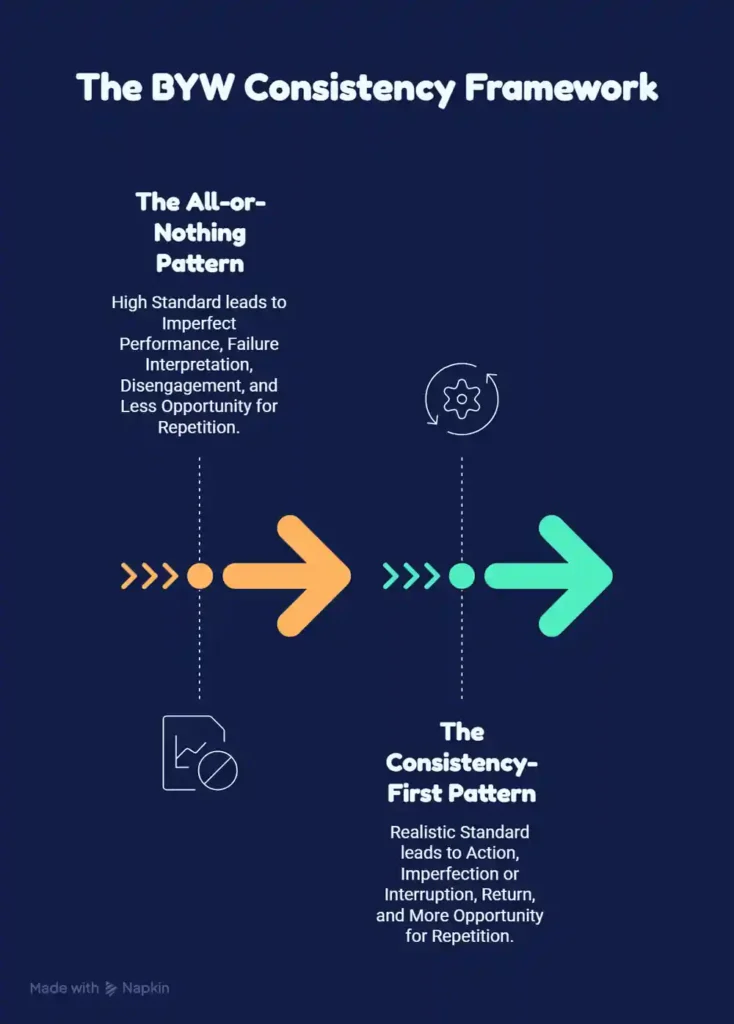 Rather than treating perfectionism and consistency as two scientifically established “systems,” it is more useful to think of these as two BYW patterns for interpreting and responding to imperfect action:
The All-or-Nothing Pattern
High Standard → Imperfect Performance → Failure Interpretation → Disengagement → Less Opportunity for Repetition
The Consistency-First Pattern
Realistic Standard → Action → Imperfection or Interruption → Return → More Opportunity for Repetition
These aren’t inevitable causal sequences.
They’re a practical way to notice the difference between a standard that can survive ordinary life and one that makes every imperfect day feel like a verdict.