

Eleven o’clock, lights out — that was the promise, made with real conviction on a Sunday night.
Monday, it slips to midnight.
By Thursday, it’s not really a promise anymore so much as a thing said out of habit while scrolling well past one.
What’s strange isn’t that the bedtime keeps slipping.
It’s that saying the promise out loud on Sunday now carries a faint, almost embarrassed weight it didn’t have a month ago — as if part of you is already skeptical before the week has even started.
Why We Break Promises to Ourselves
That skepticism may reflect something larger than the bedtime itself.
Every time you make a commitment to yourself, you have two kinds of information available.
There is what you intend to do.
And there is what your history suggests you actually tend to do.
When those two repeatedly disagree, your past behavior can begin influencing what you expect from yourself the next time.
That’s where self-trust becomes interesting.
It isn’t only about whether you sincerely mean today’s promise.
It can also be shaped by what happened to yesterday’s.
How Past Behavior Can Shape What You Expect From Yourself
Economists Roland Bénabou and Jean Tirole developed an influential theoretical model that helps explain why personal commitments can carry more weight than the individual action involved.
Their work focuses on self-reputation over willpower.
The model starts from the idea that people may not perfectly remember or know all the motives and circumstances behind their previous choices. Because of that uncertainty, they can draw inferences about their own willpower from what they have done before.
In other words, behavior can become information about the self.
Bénabou and Tirole describe personal rules — diets, exercise plans, resolutions and similar commitments — as potentially carrying a reputational meaning within the person making them.
A lapse can therefore matter for more than the immediate goal.
It may also influence what you expect from yourself next time.
Why One Lapse Can Feel Bigger Than One Lapse
Bénabou and Tirole use a particularly useful word for this:
precedent.
In their theoretical model, breaking a personal rule can create a precedent that weakens future self-restraint.
That doesn’t mean missing one bedtime inevitably causes another.
And it doesn’t mean researchers have established a universal psychological law in which every broken promise automatically reduces self-trust.
The idea is more specific.
If you are uncertain about your own future willpower, what you did previously can become evidence you use when forming expectations about what you are likely to do next. The bedtime that slipped on Monday can therefore become relevant on Tuesday.
Not because Monday permanently changed your identity.
But because Tuesday’s promise now exists alongside another piece of information:
I made this promise yesterday too.
This connects with How Your Self-Image Predicts Your Behavior.
Our expectations about ourselves don’t exist separately from our behavioral history. What we repeatedly do can contribute to the picture we form of ourselves — even while that picture, in turn, can influence later choices.
How Expectations Can Shape Future Behavior
This is where repeated broken commitments can become particularly discouraging.
The issue isn’t that every lapse causes exactly the same amount of damage.
It’s that repetition can gradually make a pattern harder to dismiss as an exception.
One late bedtime?
Bad night.
A long sequence of them?
Maybe this is just what I do.
Notice what changed.
The behavior hasn’t merely happened repeatedly.
Its meaning has begun to change.
This connects with You Don’t Change Habits: You Change Identity First — the broader relationship between repeated behavior and the way we understand ourselves.
It also helps explain why the erosion of self-trust can feel so quiet.
No single missed bedtime seems important enough to trigger some dramatic psychological collapse.
It’s the accumulation that can eventually change the tone of the next promise.
Instead of:
I’m going to bed at eleven tonight.
it becomes:
I’m going to try to go to bed at eleven tonight.
And sometimes even you can hear the difference.
Why Small Kept Promises Matter
If your behavioral history can influence what you expect from yourself, rebuilding self-trust doesn’t necessarily require one enormous act of discipline.
It may require new evidence.
That is where Consistency Over Perfection: Which Actually Creates Lasting Change? becomes especially relevant.
A realistic commitment that you can repeatedly return to gives you more opportunities to follow through than an extreme commitment that depends on everything going perfectly.
This doesn’t mean Bénabou and Tirole proved that every small kept promise directly increases self-trust.
Their model is about self-reputation, personal rules and the precedent-setting consequences of lapses.
But it gives us a useful way to think about rebuilding:
if past behavior can inform expectations about future behavior, then future behavior can provide new information too.
Instead of:
From now on, I will be asleep by 10:30 every single night.
the starting commitment might be:
Tonight, my phone goes away at 11:00.
One promise.
Small enough to keep.
Then another.
This also fits with How to Change Your Identity When You Feel Stuck.
You don’t necessarily need to convince yourself that you’re suddenly a completely different person.
Sometimes it’s more believable to start behaving in ways that gradually give you a reason to update the story.
Don’t Turn Self-Trust Into Another Perfectionism Test
There is an important caution here.
If every promise becomes a test of your character, this idea can backfire badly.
In fact, Bénabou and Tirole explicitly discuss a downside to personal rules: concern about maintaining self-reputation can sometimes contribute to excessively rigid rules, where individual decisions become loaded with too much significance.
So rebuilding self-trust does not mean:
I must never break another promise to myself.
That simply turns self-trust into another impossible promise.
A healthier goal is to create commitments realistic enough that follow-through becomes more common — while allowing an occasional lapse to remain a lapse rather than treating it as proof of who you are.
That’s an important distinction.
Because your history matters.
But one moment doesn’t have to become your entire history.
The BYW Self-Trust Framework
The following is a BYW synthesis, not a scientifically established causal sequence.
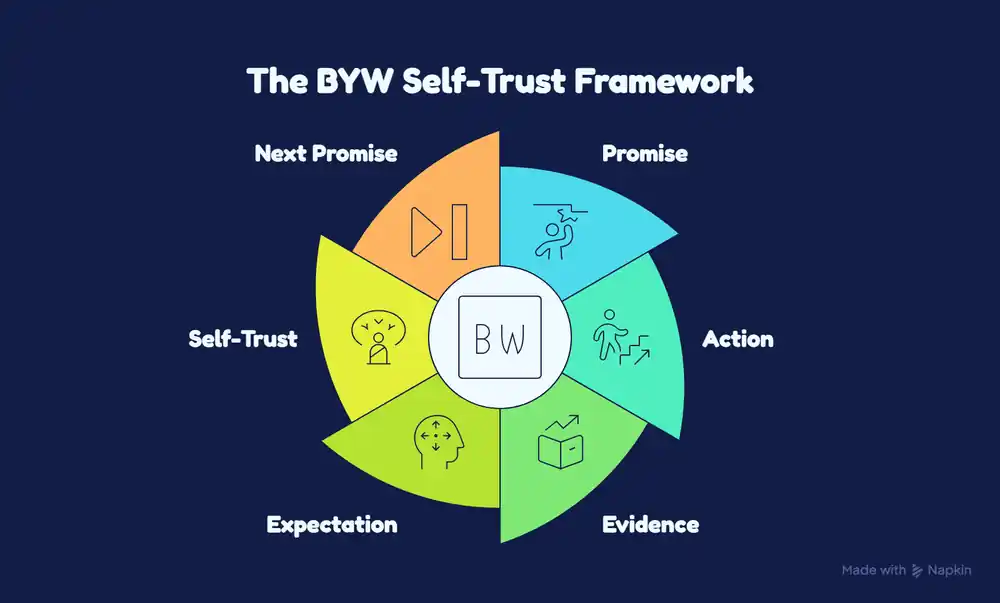 It is a practical way to think about how repeated commitments may influence self-trust over time:
Promise → You make a commitment to yourself.
Action → You follow through, partially follow through, or don’t.
Evidence → The outcome becomes one piece of information about your behavioral history.
Expectation → Repeated experiences may influence what you expect from yourself next time.
Self-Trust → Those expectations can contribute to how reliable you believe your own commitments are.
Next Promise → The next commitment is made in the context of that history.
And then the cycle continues.
This is one smaller piece of the broader behavior-change system explored in Why Most Behavior Change Fails.
It also connects back to How Your Self-Image Predicts Your Behavior, because expectations about what you will do can eventually become part of the larger story you tell about who you are.